Event submissions
Published
This submission belongs to the session S2. Circular Economy and Policy Innovations towards Improved Resource Recovery of the event The 1st International Online Conference on Recycling
Published date
02 Sep, 2026
Academic Editor
'%3e%3cpath%20d='M12.6657%2010.9104C12.4185%2010.325%2012.0599%209.79327%2011.6097%209.34482C11.1609%208.89508%2010.6293%208.5365%2010.0442%208.28888C10.0389%208.28626%2010.0337%208.28495%2010.0285%208.28233C10.8446%207.69279%2011.3752%206.73249%2011.3752%205.64904C11.3752%203.8542%209.92103%202.39999%208.1262%202.39999C6.33136%202.39999%204.87715%203.8542%204.87715%205.64904C4.87715%206.73249%205.40774%207.69279%206.22393%208.28364C6.21869%208.28626%206.21345%208.28757%206.20821%208.29019C5.62129%208.5378%205.09463%208.89284%204.64265%209.34613C4.1929%209.79493%203.83432%2010.3266%203.58671%2010.9117C3.34345%2011.4845%203.21226%2012.0987%203.20023%2012.7209C3.19988%2012.7349%203.20233%2012.7488%203.20744%2012.7619C3.21255%2012.7749%203.22022%2012.7867%203.22998%2012.7968C3.23975%2012.8068%203.25142%2012.8147%203.26431%2012.8202C3.2772%2012.8256%203.29105%2012.8284%203.30504%2012.8284H4.09109C4.14874%2012.8284%204.19459%2012.7825%204.1959%2012.7262C4.2221%2011.7148%204.62823%2010.7676%205.34617%2010.0497C6.08899%209.30683%207.0755%208.89808%208.1262%208.89808C9.17689%208.89808%2010.1634%209.30683%2010.9062%2010.0497C11.6242%2010.7676%2012.0303%2011.7148%2012.0565%2012.7262C12.0578%2012.7838%2012.1037%2012.8284%2012.1613%2012.8284H12.9474C12.9613%2012.8284%2012.9752%2012.8256%2012.9881%2012.8202C13.001%2012.8147%2013.0126%2012.8068%2013.0224%2012.7968C13.0322%2012.7867%2013.0398%2012.7749%2013.0449%2012.7619C13.0501%2012.7488%2013.0525%2012.7349%2013.0522%2012.7209C13.0391%2012.0947%2012.9094%2011.4855%2012.6657%2010.9104ZM8.1262%207.9024C7.52486%207.9024%206.9589%207.6679%206.53312%207.24211C6.10733%206.81633%205.87283%206.25037%205.87283%205.64904C5.87283%205.0477%206.10733%204.48174%206.53312%204.05596C6.9589%203.63018%207.52486%203.39567%208.1262%203.39567C8.72753%203.39567%209.29349%203.63018%209.71927%204.05596C10.1451%204.48174%2010.3796%205.0477%2010.3796%205.64904C10.3796%206.25037%2010.1451%206.81633%209.71927%207.24211C9.29349%207.6679%208.72753%207.9024%208.1262%207.9024Z'%20fill='%235D1EE1'/%3e%3c/g%3e%3c/svg%3e) Eric Van Hullebusch
Eric Van HullebuschCitation
Maria Iftikhar, Hira Faisal, Hadia Younas, Sara Tahir, Tahreem Tanweer, Sidra Shahid, From Policy to Practice: Assessing Compliance with Pakistan’s Single-Use Plastic Bag Ban in the Context of Circular Economy and Microplastic Reduction, in Proceedings of The 1st International Online Conference on Recycling, 7 September–8 September 2026, MDPI: Basel, Switzerland
Share
Email
Facebook
Twitter
LinkedIn
From Policy to Practice: Assessing Compliance with Pakistan’s Single-Use Plastic Bag Ban in the Context of Circular Economy and Microplastic Reduction
'%3e%3cpath%20d='M12.6647%2010.9104C12.4176%2010.325%2012.0589%209.7933%2011.6088%209.34485C11.16%208.89511%2010.6283%208.53653%2010.0432%208.28891C10.038%208.28629%2010.0327%208.28498%2010.0275%208.28236C10.8437%207.69282%2011.3743%206.73252%2011.3743%205.64907C11.3743%203.85423%209.92005%202.40002%208.12522%202.40002C6.33038%202.40002%204.87618%203.85423%204.87618%205.64907C4.87618%206.73252%205.40677%207.69282%206.22296%208.28367C6.21772%208.28629%206.21248%208.2876%206.20724%208.29022C5.62031%208.53783%205.09365%208.89287%204.64167%209.34616C4.19192%209.79496%203.83334%2010.3266%203.58573%2010.9117C3.34247%2011.4846%203.21128%2012.0987%203.19925%2012.721C3.1989%2012.735%203.20135%2012.7489%203.20646%2012.7619C3.21157%2012.7749%203.21924%2012.7868%203.22901%2012.7968C3.23877%2012.8068%203.25045%2012.8148%203.26334%2012.8202C3.27623%2012.8256%203.29007%2012.8284%203.30406%2012.8284H4.09012C4.14776%2012.8284%204.19362%2012.7825%204.19493%2012.7262C4.22113%2011.7148%204.62726%2010.7676%205.34519%2010.0497C6.08802%209.30686%207.07452%208.89811%208.12522%208.89811C9.17592%208.89811%2010.1624%209.30686%2010.9052%2010.0497C11.6232%2010.7676%2012.0293%2011.7148%2012.0555%2012.7262C12.0568%2012.7839%2012.1027%2012.8284%2012.1603%2012.8284H12.9464C12.9604%2012.8284%2012.9742%2012.8256%2012.9871%2012.8202C13%2012.8148%2013.0117%2012.8068%2013.0214%2012.7968C13.0312%2012.7868%2013.0389%2012.7749%2013.044%2012.7619C13.0491%2012.7489%2013.0515%2012.735%2013.0512%2012.721C13.0381%2012.0947%2012.9084%2011.4856%2012.6647%2010.9104ZM8.12522%207.90243C7.52388%207.90243%206.95792%207.66793%206.53214%207.24215C6.10636%206.81636%205.87185%206.2504%205.87185%205.64907C5.87185%205.04773%206.10636%204.48177%206.53214%204.05599C6.95792%203.63021%207.52388%203.3957%208.12522%203.3957C8.72655%203.3957%209.29252%203.63021%209.7183%204.05599C10.1441%204.48177%2010.3786%205.04773%2010.3786%205.64907C10.3786%206.2504%2010.1441%206.81636%209.7183%207.24215C9.29252%207.66793%208.72655%207.90243%208.12522%207.90243Z'%20fill='%235D1EE1'/%3e%3c/g%3e%3c/svg%3e)
Maria Iftikhar 1
Hira Faisal 1
Hadia Younas 1
Sara Tahir 1
Tahreem Tanweer 1,2
Sidra Shahid 1
1. Humanities and Social Sciences Department, Bahria University, E-8 Campus, Islamabad, 44000, Pakistan
2. Department of Biomedical Engineering and sciences, School of Mechanical and Manufacturing Engineering, National University of Sciences and Technology (NUST), Islamabad, 44000, Pakistan
Abstract
Introduction:
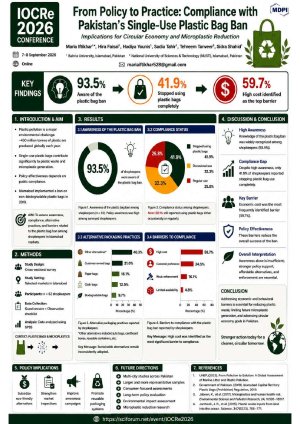
Single use plastic bags pose a significant threat to the environment by contributoring towards microplastic pollution. When released into air, water, or soil, they break down, fragment, and interact with the environment and create pollution that affects both humans and ecosystems. Recognizing their role in promoting environmental damage, the Government of Pakistan has enforced a nationwide ban on single-use plastic bags as a policy intervention aligned with circular economy principles.
Objective:
In this study, awareness and compliance of the shopkeepers towards the single use plastic ban was evaluated. Furthermore, alternative packaging options were explore and problems faced in showing compliance were also explored.
Methods:
A cross-sectional observational study was conducted in four major markets of Islamabad from October 2025 to November 2025. A homogenous purposive sampling technique was used to recruit shopkeepers with relevant knowledge about the ban. Observation checklists and structured questionnaires were used to record compliance with plastic bag bans and availability of ecofriendly alternatives. Barriers to compliance including high cost of ecofriendly alternatives, ineffective policy enforcement, and customer demand for plastic bags were also assessed. Data was analyzed using SPSS version 18 to generate descriptive statistics.
Results:
Although very high proportion of shopkeepers(93.5%) knew about the ban ,only 41.9% complied fully. Alternatives like paper bags, cloth bags, biodegradable plastic bags, and bags supplied by customers are under use but have not been mentioned as a satisfactory solution. The obstacles include high cost of alternatives (59.7%), ineffective policy enforcement (16.1%) and addition to that customer demand for plastic bags (14.5%).
Conclusions:
The study concluded that although awareness of plastic bag ban among shopkeepers was high however, compliance was limited. This was due to expensive alternatives, poor policy enforcement as well as customer preference towards one use plastic bags. Policy enforcement and affordable ecofriendly options are essential to advance circular economy goals and reduce microplastic pollution.
Keywords
plastic bags
compliance
Circular economy
Poster
maria.pdf
Circular Biomass Valorization for Ireland’s Horticulture: Land-Use Linked GIS Projection and Multivariate Screening for Peat-Alternative Growing Media
Regulatory Gaps in the EU Funerary Sector: Challenges and Policy Recommendations for Circular Economy Integration