Event submissions
Published
This submission belongs to the session S2. Circular Economy and Policy Innovations towards Improved Resource Recovery of the event The 1st International Online Conference on Recycling
Published date
02 Sep, 2026
Academic Editor
'%3e%3cpath%20d='M12.6657%2010.9104C12.4185%2010.325%2012.0599%209.79327%2011.6097%209.34482C11.1609%208.89508%2010.6293%208.5365%2010.0442%208.28888C10.0389%208.28626%2010.0337%208.28495%2010.0285%208.28233C10.8446%207.69279%2011.3752%206.73249%2011.3752%205.64904C11.3752%203.8542%209.92103%202.39999%208.1262%202.39999C6.33136%202.39999%204.87715%203.8542%204.87715%205.64904C4.87715%206.73249%205.40774%207.69279%206.22393%208.28364C6.21869%208.28626%206.21345%208.28757%206.20821%208.29019C5.62129%208.5378%205.09463%208.89284%204.64265%209.34613C4.1929%209.79493%203.83432%2010.3266%203.58671%2010.9117C3.34345%2011.4845%203.21226%2012.0987%203.20023%2012.7209C3.19988%2012.7349%203.20233%2012.7488%203.20744%2012.7619C3.21255%2012.7749%203.22022%2012.7867%203.22998%2012.7968C3.23975%2012.8068%203.25142%2012.8147%203.26431%2012.8202C3.2772%2012.8256%203.29105%2012.8284%203.30504%2012.8284H4.09109C4.14874%2012.8284%204.19459%2012.7825%204.1959%2012.7262C4.2221%2011.7148%204.62823%2010.7676%205.34617%2010.0497C6.08899%209.30683%207.0755%208.89808%208.1262%208.89808C9.17689%208.89808%2010.1634%209.30683%2010.9062%2010.0497C11.6242%2010.7676%2012.0303%2011.7148%2012.0565%2012.7262C12.0578%2012.7838%2012.1037%2012.8284%2012.1613%2012.8284H12.9474C12.9613%2012.8284%2012.9752%2012.8256%2012.9881%2012.8202C13.001%2012.8147%2013.0126%2012.8068%2013.0224%2012.7968C13.0322%2012.7867%2013.0398%2012.7749%2013.0449%2012.7619C13.0501%2012.7488%2013.0525%2012.7349%2013.0522%2012.7209C13.0391%2012.0947%2012.9094%2011.4855%2012.6657%2010.9104ZM8.1262%207.9024C7.52486%207.9024%206.9589%207.6679%206.53312%207.24211C6.10733%206.81633%205.87283%206.25037%205.87283%205.64904C5.87283%205.0477%206.10733%204.48174%206.53312%204.05596C6.9589%203.63018%207.52486%203.39567%208.1262%203.39567C8.72753%203.39567%209.29349%203.63018%209.71927%204.05596C10.1451%204.48174%2010.3796%205.0477%2010.3796%205.64904C10.3796%206.25037%2010.1451%206.81633%209.71927%207.24211C9.29349%207.6679%208.72753%207.9024%208.1262%207.9024Z'%20fill='%235D1EE1'/%3e%3c/g%3e%3c/svg%3e) Eric Van Hullebusch
Eric Van HullebuschCitation
Almudena Muñoz Babiano, Nuria Capdevila Roig, José Montoya Belmonte, Federico Muñoz Babiano, Regulatory Gaps in the EU Funerary Sector: Challenges and Policy Recommendations for Circular Economy Integration, in Proceedings of The 1st International Online Conference on Recycling, 7 September–8 September 2026, MDPI: Basel, Switzerland
Share
Email
Facebook
Twitter
LinkedIn
Regulatory Gaps in the EU Funerary Sector: Challenges and Policy Recommendations for Circular Economy Integration
'%3e%3cpath%20d='M12.6647%2010.9104C12.4176%2010.325%2012.0589%209.7933%2011.6088%209.34485C11.16%208.89511%2010.6283%208.53653%2010.0432%208.28891C10.038%208.28629%2010.0327%208.28498%2010.0275%208.28236C10.8437%207.69282%2011.3743%206.73252%2011.3743%205.64907C11.3743%203.85423%209.92005%202.40002%208.12522%202.40002C6.33038%202.40002%204.87618%203.85423%204.87618%205.64907C4.87618%206.73252%205.40677%207.69282%206.22296%208.28367C6.21772%208.28629%206.21248%208.2876%206.20724%208.29022C5.62031%208.53783%205.09365%208.89287%204.64167%209.34616C4.19192%209.79496%203.83334%2010.3266%203.58573%2010.9117C3.34247%2011.4846%203.21128%2012.0987%203.19925%2012.721C3.1989%2012.735%203.20135%2012.7489%203.20646%2012.7619C3.21157%2012.7749%203.21924%2012.7868%203.22901%2012.7968C3.23877%2012.8068%203.25045%2012.8148%203.26334%2012.8202C3.27623%2012.8256%203.29007%2012.8284%203.30406%2012.8284H4.09012C4.14776%2012.8284%204.19362%2012.7825%204.19493%2012.7262C4.22113%2011.7148%204.62726%2010.7676%205.34519%2010.0497C6.08802%209.30686%207.07452%208.89811%208.12522%208.89811C9.17592%208.89811%2010.1624%209.30686%2010.9052%2010.0497C11.6232%2010.7676%2012.0293%2011.7148%2012.0555%2012.7262C12.0568%2012.7839%2012.1027%2012.8284%2012.1603%2012.8284H12.9464C12.9604%2012.8284%2012.9742%2012.8256%2012.9871%2012.8202C13%2012.8148%2013.0117%2012.8068%2013.0214%2012.7968C13.0312%2012.7868%2013.0389%2012.7749%2013.044%2012.7619C13.0491%2012.7489%2013.0515%2012.735%2013.0512%2012.721C13.0381%2012.0947%2012.9084%2011.4856%2012.6647%2010.9104ZM8.12522%207.90243C7.52388%207.90243%206.95792%207.66793%206.53214%207.24215C6.10636%206.81636%205.87185%206.2504%205.87185%205.64907C5.87185%205.04773%206.10636%204.48177%206.53214%204.05599C6.95792%203.63021%207.52388%203.3957%208.12522%203.3957C8.72655%203.3957%209.29252%203.63021%209.7183%204.05599C10.1441%204.48177%2010.3786%205.04773%2010.3786%205.64907C10.3786%206.2504%2010.1441%206.81636%209.7183%207.24215C9.29252%207.66793%208.72655%207.90243%208.12522%207.90243Z'%20fill='%235D1EE1'/%3e%3c/g%3e%3c/svg%3e)
Almudena Muñoz Babiano 1
Nuria Capdevila Roig 1
José Montoya Belmonte 1
Federico Muñoz Babiano 1
1. Sustainable Innovation and Advanced Technologies Research Group (GISTA), Department of Business, Faculty of Social and Legal Sciences, Universidad Internacional de Valencia (VIU), Valencia 46002, Spain
Abstract
-
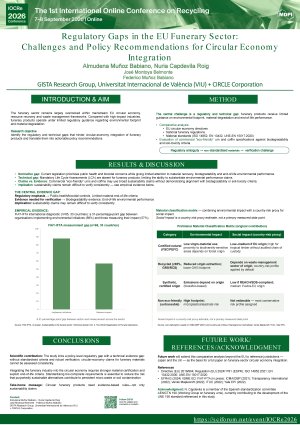
Introduction: The funerary sector remains largely overlooked within mainstream European Union (EU) circular economy (CE), resource recovery and waste management frameworks. While high-impact industries benefit from clear directives for resource recovery and end-of-life management, funerary products operate under limited regulatory guidance regarding their environmental footprint and material degradation. This regulatory ambiguity and lack of oversight have contributed to the proliferation of non-standardized materials that may hinder sustainable transition strategies.
-
Methods: This research involved a comparative analysis between EU circular economy directives and current national funerary regulations. Additionally, the specifications of commercial “eco-friendly” urns and coffins were evaluated to assess their alignment with international standards for biodegradability and soil toxicity, such as ISO 14852.
-
Results: The findings reveal a significant normative gap, as current legislation prioritizes public health and biocidal concerns while providing limited consideration for material recovery, biodegradability, and end-of-life environmental performance. Furthermore, a notable technical gap exists due to the absence of mandatory Life Cycle Assessments (LCA). This absence may facilitate "greenwashing" practices, whereby products carry vague sustainability claims despite failing to meet industrial composting or natural degradation criteria.
-
Conclusions: Successfully integrating the funerary industry into the circular economy requires robust material certification and the inclusion of end-of-life criteria in sector-specific legislation. Standardizing bio-composite requirements is essential to ensure that "sustainable" alternatives do not contribute to long-term soil contamination or the accumulation of persistent micro-waste. These measures are necessary to better align funerary products with EU circular economy objectives and sustainable resource management strategies.
Keywords
Circular Economy
Funerary Sector
Regulatory Gaps
Material Recovery
Poster
IOCRe2026_Funerary_Sector_Gaps_Poster.pdf
From Policy to Practice: Assessing Compliance with Pakistan’s Single-Use Plastic Bag Ban in the Context of Circular Economy and Microplastic Reduction
Bridging Policy Ambition and Implementation Reality: EU-Funded Recycling Programmes in Romania under NRRP and SDOP