Event submissions
Published
This submission belongs to the session S2. Circular Economy and Policy Innovations towards Improved Resource Recovery of the event The 1st International Online Conference on Recycling
Published date
02 Sep, 2026
Academic Editor
'%3e%3cpath%20d='M12.6657%2010.9104C12.4185%2010.325%2012.0599%209.79327%2011.6097%209.34482C11.1609%208.89508%2010.6293%208.5365%2010.0442%208.28888C10.0389%208.28626%2010.0337%208.28495%2010.0285%208.28233C10.8446%207.69279%2011.3752%206.73249%2011.3752%205.64904C11.3752%203.8542%209.92103%202.39999%208.1262%202.39999C6.33136%202.39999%204.87715%203.8542%204.87715%205.64904C4.87715%206.73249%205.40774%207.69279%206.22393%208.28364C6.21869%208.28626%206.21345%208.28757%206.20821%208.29019C5.62129%208.5378%205.09463%208.89284%204.64265%209.34613C4.1929%209.79493%203.83432%2010.3266%203.58671%2010.9117C3.34345%2011.4845%203.21226%2012.0987%203.20023%2012.7209C3.19988%2012.7349%203.20233%2012.7488%203.20744%2012.7619C3.21255%2012.7749%203.22022%2012.7867%203.22998%2012.7968C3.23975%2012.8068%203.25142%2012.8147%203.26431%2012.8202C3.2772%2012.8256%203.29105%2012.8284%203.30504%2012.8284H4.09109C4.14874%2012.8284%204.19459%2012.7825%204.1959%2012.7262C4.2221%2011.7148%204.62823%2010.7676%205.34617%2010.0497C6.08899%209.30683%207.0755%208.89808%208.1262%208.89808C9.17689%208.89808%2010.1634%209.30683%2010.9062%2010.0497C11.6242%2010.7676%2012.0303%2011.7148%2012.0565%2012.7262C12.0578%2012.7838%2012.1037%2012.8284%2012.1613%2012.8284H12.9474C12.9613%2012.8284%2012.9752%2012.8256%2012.9881%2012.8202C13.001%2012.8147%2013.0126%2012.8068%2013.0224%2012.7968C13.0322%2012.7867%2013.0398%2012.7749%2013.0449%2012.7619C13.0501%2012.7488%2013.0525%2012.7349%2013.0522%2012.7209C13.0391%2012.0947%2012.9094%2011.4855%2012.6657%2010.9104ZM8.1262%207.9024C7.52486%207.9024%206.9589%207.6679%206.53312%207.24211C6.10733%206.81633%205.87283%206.25037%205.87283%205.64904C5.87283%205.0477%206.10733%204.48174%206.53312%204.05596C6.9589%203.63018%207.52486%203.39567%208.1262%203.39567C8.72753%203.39567%209.29349%203.63018%209.71927%204.05596C10.1451%204.48174%2010.3796%205.0477%2010.3796%205.64904C10.3796%206.25037%2010.1451%206.81633%209.71927%207.24211C9.29349%207.6679%208.72753%207.9024%208.1262%207.9024Z'%20fill='%235D1EE1'/%3e%3c/g%3e%3c/svg%3e) Eric Van Hullebusch
Eric Van HullebuschCitation
Suzana Turcu, Otilia Manta, Bridging Policy Ambition and Implementation Reality: EU-Funded Recycling Programmes in Romania under NRRP and SDOP, in Proceedings of The 1st International Online Conference on Recycling, 7 September–8 September 2026, MDPI: Basel, Switzerland
Share
Email
Facebook
Twitter
LinkedIn
Bridging Policy Ambition and Implementation Reality: EU-Funded Recycling Programmes in Romania under NRRP and SDOP

Suzana Turcu 1,2

Otilia Manta 3,4
1. Francisc I. Rainer” Institute of Anthropology, Romanian Academy; Bucharest, 050474, Romania
2. School of Advanced Studies of the Romanian Academy, Doctoral School of Economic Sciences, National Institute for Economic Research "Costin C. Kirițescu", “Victor Slăvescu” Centre for Financial and Monetary Research; Bucharest, 050474, Romania
3. Romanian Academy, Centre for Financial and Monetary Research “Victor Slăvescu”, 050711 Bucharest, Romania
4. Department of Finance and Banking, Faculty of Economic Sciences, Romanian-American University, 012101 Bucharest, Romania
Abstract
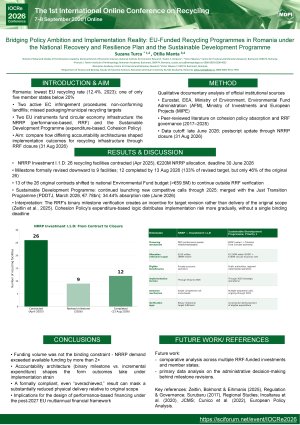
Romania is among the lowest-performing EU member states in municipal waste recycling, with a current rate of approximately 12,4% (2023), well below the 55% target set by the EU Circular Economy Package for 2025. This shortfall, compounded by an active European Commission infringement procedure, points to a persistent gap between ambitious legislative frameworks and the institutional capacity required to implement them effectively. This paper examines two major EU-funded instruments shaping Romania's circular economy trajectory. The first is the National Recovery and Resilience Plan (NRRP), Component C3, Investment I.1.D, which allocates 220 million euros to the construction of 26 recycling facilities, all required to be operational by June 2026. The second is the Sustainable Development Operational Programme (SDOP) 2021-2027, Priority Axis 2, with a combined allocation of 3.49 billion euros addressing both water infrastructure and the circular economy transition, primarily targeting public authorities and regional waste operators over a longer implementation horizon. The NRRP trajectory raises particular concern. Project approvals were only published in April 2025, leaving beneficiaries fewer than 14 months to complete construction. At that point, the most advanced facilities had reached approximately 45% physical progress, while several had yet to break ground. A parallel NRRP investment in selective waste collection infrastructure achieved only 20% of its original target before the programme scope was substantially reduced. Drawing on programme documentation, official progress reports, and policy analysis, the paper identifies the main drivers of delay, including prolonged administrative cycles, repeated revisions to financing guidelines, and limited project readiness among applicants. It also assesses the financial consequences of missed NRRP milestones and discusses governance lessons relevant to other EU cohesion policy contexts. The analysis reveals that while Romania's funding architecture is broadly fit for purpose, structural weaknesses in public administration and beneficiary capacity continue to prevent financial commitments from translating into measurable environmental outcomes.
Keywords
circular economy
recycling policy
PNRR
PODD
waste management
Romania
implementation gap
EU Cohesion Funds
Poster
Poster recycling sept 2026.pdf
Regulatory Gaps in the EU Funerary Sector: Challenges and Policy Recommendations for Circular Economy Integration
Beyond Copycat EPR: Designing Next-Generation Producer Responsibility for Resource Recovery in the Global South