Event submissions
Published
This submission belongs to the session S2. Circular Economy and Policy Innovations towards Improved Resource Recovery of the event The 1st International Online Conference on Recycling
Published date
02 Sep, 2026
Academic Editor
'%3e%3cpath%20d='M12.6657%2010.9104C12.4185%2010.325%2012.0599%209.79327%2011.6097%209.34482C11.1609%208.89508%2010.6293%208.5365%2010.0442%208.28888C10.0389%208.28626%2010.0337%208.28495%2010.0285%208.28233C10.8446%207.69279%2011.3752%206.73249%2011.3752%205.64904C11.3752%203.8542%209.92103%202.39999%208.1262%202.39999C6.33136%202.39999%204.87715%203.8542%204.87715%205.64904C4.87715%206.73249%205.40774%207.69279%206.22393%208.28364C6.21869%208.28626%206.21345%208.28757%206.20821%208.29019C5.62129%208.5378%205.09463%208.89284%204.64265%209.34613C4.1929%209.79493%203.83432%2010.3266%203.58671%2010.9117C3.34345%2011.4845%203.21226%2012.0987%203.20023%2012.7209C3.19988%2012.7349%203.20233%2012.7488%203.20744%2012.7619C3.21255%2012.7749%203.22022%2012.7867%203.22998%2012.7968C3.23975%2012.8068%203.25142%2012.8147%203.26431%2012.8202C3.2772%2012.8256%203.29105%2012.8284%203.30504%2012.8284H4.09109C4.14874%2012.8284%204.19459%2012.7825%204.1959%2012.7262C4.2221%2011.7148%204.62823%2010.7676%205.34617%2010.0497C6.08899%209.30683%207.0755%208.89808%208.1262%208.89808C9.17689%208.89808%2010.1634%209.30683%2010.9062%2010.0497C11.6242%2010.7676%2012.0303%2011.7148%2012.0565%2012.7262C12.0578%2012.7838%2012.1037%2012.8284%2012.1613%2012.8284H12.9474C12.9613%2012.8284%2012.9752%2012.8256%2012.9881%2012.8202C13.001%2012.8147%2013.0126%2012.8068%2013.0224%2012.7968C13.0322%2012.7867%2013.0398%2012.7749%2013.0449%2012.7619C13.0501%2012.7488%2013.0525%2012.7349%2013.0522%2012.7209C13.0391%2012.0947%2012.9094%2011.4855%2012.6657%2010.9104ZM8.1262%207.9024C7.52486%207.9024%206.9589%207.6679%206.53312%207.24211C6.10733%206.81633%205.87283%206.25037%205.87283%205.64904C5.87283%205.0477%206.10733%204.48174%206.53312%204.05596C6.9589%203.63018%207.52486%203.39567%208.1262%203.39567C8.72753%203.39567%209.29349%203.63018%209.71927%204.05596C10.1451%204.48174%2010.3796%205.0477%2010.3796%205.64904C10.3796%206.25037%2010.1451%206.81633%209.71927%207.24211C9.29349%207.6679%208.72753%207.9024%208.1262%207.9024Z'%20fill='%235D1EE1'/%3e%3c/g%3e%3c/svg%3e) Eric Van Hullebusch
Eric Van HullebuschCitation
Son Nguyen, Beyond Copycat EPR: Designing Next-Generation Producer Responsibility for Resource Recovery in the Global South, in Proceedings of The 1st International Online Conference on Recycling, 7 September–8 September 2026, MDPI: Basel, Switzerland
Share
Email
Facebook
Twitter
LinkedIn
Beyond Copycat EPR: Designing Next-Generation Producer Responsibility for Resource Recovery in the Global South

Son Nguyen 1
1. Executive Board, Sustainable Development Governance and Law Association – Vietnam National Branch, Ho Chi Minh City 700000, Vietnam
Abstract
Extended Producer Responsibility (EPR) is increasingly promoted as a cornerstone of circular economy policy and improved resource recovery. Yet many EPR models remain conceptually and institutionally anchored in high-income contexts, where formal collection systems, strong enforcement, and stable recycling markets are more common. This paper asks: what would a next-generation EPR architecture look like if it were designed from the realities of the Global South rather than imported into them? Using a qualitative synthesis of recent policy papers, international guidance, country cases, and critical perspectives, the paper develops a framework for “EPR 2.0” built around five design shifts: hierarchy alignment, informal-sector integration, adaptive financing, data transparency, and climate-industrial linkage. The analysis finds that the most promising frontier lies not in replicating conventional OECD producer-financed recycling schemes, but in building plural, justice-oriented systems that fund prevention, repair, reuse, and inclusive recovery while strengthening local industrial capacity and resilience. The paper’s contribution is threefold: it reframes EPR as a governance system rather than a compliance mechanism; it advances a policy innovation agenda specifically suited to Global South conditions; and it identifies a strategic role for ecosystem accelerators and enablers in convening stakeholders, pilots, translating new concepts, evidence, and scaling practice and innovations across regions.
Keywords
extended producer responsibility
circular economy
Global South
resource recovery
informal waste workers
waste pickers
policy innovation
packaging
e-waste
just transition
Poster
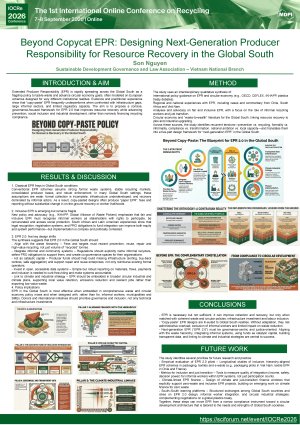
Beyond Copy-Paste EPR - Designing Next-Generation Producer Responsibility for Resource Recovery in the Global South poster.pdf
Bridging Policy Ambition and Implementation Reality: EU-Funded Recycling Programmes in Romania under NRRP and SDOP
The Role of Household Waste Sorting in Sustainable Waste Processing