Event submissions
Published
This submission belongs to the session S3. Plastic and Composite Waste Recycling of the event The 1st International Online Conference on Recycling
Published date
02 Sep, 2026
Academic Editor
'%3e%3cpath%20d='M12.6657%2010.9104C12.4185%2010.325%2012.0599%209.79327%2011.6097%209.34482C11.1609%208.89508%2010.6293%208.5365%2010.0442%208.28888C10.0389%208.28626%2010.0337%208.28495%2010.0285%208.28233C10.8446%207.69279%2011.3752%206.73249%2011.3752%205.64904C11.3752%203.8542%209.92103%202.39999%208.1262%202.39999C6.33136%202.39999%204.87715%203.8542%204.87715%205.64904C4.87715%206.73249%205.40774%207.69279%206.22393%208.28364C6.21869%208.28626%206.21345%208.28757%206.20821%208.29019C5.62129%208.5378%205.09463%208.89284%204.64265%209.34613C4.1929%209.79493%203.83432%2010.3266%203.58671%2010.9117C3.34345%2011.4845%203.21226%2012.0987%203.20023%2012.7209C3.19988%2012.7349%203.20233%2012.7488%203.20744%2012.7619C3.21255%2012.7749%203.22022%2012.7867%203.22998%2012.7968C3.23975%2012.8068%203.25142%2012.8147%203.26431%2012.8202C3.2772%2012.8256%203.29105%2012.8284%203.30504%2012.8284H4.09109C4.14874%2012.8284%204.19459%2012.7825%204.1959%2012.7262C4.2221%2011.7148%204.62823%2010.7676%205.34617%2010.0497C6.08899%209.30683%207.0755%208.89808%208.1262%208.89808C9.17689%208.89808%2010.1634%209.30683%2010.9062%2010.0497C11.6242%2010.7676%2012.0303%2011.7148%2012.0565%2012.7262C12.0578%2012.7838%2012.1037%2012.8284%2012.1613%2012.8284H12.9474C12.9613%2012.8284%2012.9752%2012.8256%2012.9881%2012.8202C13.001%2012.8147%2013.0126%2012.8068%2013.0224%2012.7968C13.0322%2012.7867%2013.0398%2012.7749%2013.0449%2012.7619C13.0501%2012.7488%2013.0525%2012.7349%2013.0522%2012.7209C13.0391%2012.0947%2012.9094%2011.4855%2012.6657%2010.9104ZM8.1262%207.9024C7.52486%207.9024%206.9589%207.6679%206.53312%207.24211C6.10733%206.81633%205.87283%206.25037%205.87283%205.64904C5.87283%205.0477%206.10733%204.48174%206.53312%204.05596C6.9589%203.63018%207.52486%203.39567%208.1262%203.39567C8.72753%203.39567%209.29349%203.63018%209.71927%204.05596C10.1451%204.48174%2010.3796%205.0477%2010.3796%205.64904C10.3796%206.25037%2010.1451%206.81633%209.71927%207.24211C9.29349%207.6679%208.72753%207.9024%208.1262%207.9024Z'%20fill='%235D1EE1'/%3e%3c/g%3e%3c/svg%3e) Rossella Arrigo
Rossella ArrigoCitation
Hina Qasim Shaikh, A Novel Enzyme-Driven Biotechnological Strategy for Plastic Waste Valorization, in Proceedings of The 1st International Online Conference on Recycling, 7 September–8 September 2026, MDPI: Basel, Switzerland
Share
Email
Facebook
Twitter
LinkedIn
A Novel Enzyme-Driven Biotechnological Strategy for Plastic Waste Valorization
'%3e%3cpath%20d='M12.6647%2010.9104C12.4176%2010.325%2012.0589%209.7933%2011.6088%209.34485C11.16%208.89511%2010.6283%208.53653%2010.0432%208.28891C10.038%208.28629%2010.0327%208.28498%2010.0275%208.28236C10.8437%207.69282%2011.3743%206.73252%2011.3743%205.64907C11.3743%203.85423%209.92005%202.40002%208.12522%202.40002C6.33038%202.40002%204.87618%203.85423%204.87618%205.64907C4.87618%206.73252%205.40677%207.69282%206.22296%208.28367C6.21772%208.28629%206.21248%208.2876%206.20724%208.29022C5.62031%208.53783%205.09365%208.89287%204.64167%209.34616C4.19192%209.79496%203.83334%2010.3266%203.58573%2010.9117C3.34247%2011.4846%203.21128%2012.0987%203.19925%2012.721C3.1989%2012.735%203.20135%2012.7489%203.20646%2012.7619C3.21157%2012.7749%203.21924%2012.7868%203.22901%2012.7968C3.23877%2012.8068%203.25045%2012.8148%203.26334%2012.8202C3.27623%2012.8256%203.29007%2012.8284%203.30406%2012.8284H4.09012C4.14776%2012.8284%204.19362%2012.7825%204.19493%2012.7262C4.22113%2011.7148%204.62726%2010.7676%205.34519%2010.0497C6.08802%209.30686%207.07452%208.89811%208.12522%208.89811C9.17592%208.89811%2010.1624%209.30686%2010.9052%2010.0497C11.6232%2010.7676%2012.0293%2011.7148%2012.0555%2012.7262C12.0568%2012.7839%2012.1027%2012.8284%2012.1603%2012.8284H12.9464C12.9604%2012.8284%2012.9742%2012.8256%2012.9871%2012.8202C13%2012.8148%2013.0117%2012.8068%2013.0214%2012.7968C13.0312%2012.7868%2013.0389%2012.7749%2013.044%2012.7619C13.0491%2012.7489%2013.0515%2012.735%2013.0512%2012.721C13.0381%2012.0947%2012.9084%2011.4856%2012.6647%2010.9104ZM8.12522%207.90243C7.52388%207.90243%206.95792%207.66793%206.53214%207.24215C6.10636%206.81636%205.87185%206.2504%205.87185%205.64907C5.87185%205.04773%206.10636%204.48177%206.53214%204.05599C6.95792%203.63021%207.52388%203.3957%208.12522%203.3957C8.72655%203.3957%209.29252%203.63021%209.7183%204.05599C10.1441%204.48177%2010.3786%205.04773%2010.3786%205.64907C10.3786%206.2504%2010.1441%206.81636%209.7183%207.24215C9.29252%207.66793%208.72655%207.90243%208.12522%207.90243Z'%20fill='%235D1EE1'/%3e%3c/g%3e%3c/svg%3e)
Hina Qasim Shaikh 1
1. Department of Chemistry, Wilson College, Mumbai, Maharashtra, India
Abstract
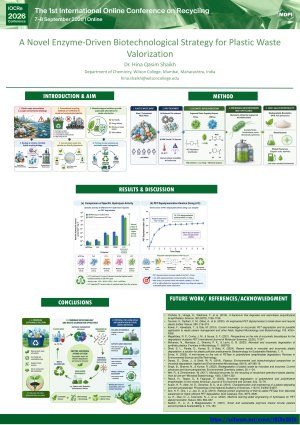
The accumulation of plastic waste poses a serious threat to environmental sustainability, particularly in rapidly urbanizing regions where conventional mechanical recycling methods are inefficient for mixed and contaminated plastics. To address these limitations, this study proposes an innovative enzyme–microbial hybrid recycling approach for the sustainable management and upcycling of plastic waste. The method integrates enzymatic depolymerization with microbial bioconversion to transform plastic waste into high-value, environmentally benign products.
In this approach, plastic waste undergoes mechanical pre-treatment followed by mild thermal or ultraviolet exposure to enhance polymer accessibility. Engineered plastic-degrading enzymes, such as PETase and MHETase, are then employed to depolymerize plastics into their constituent monomers under controlled, low-energy conditions. The resulting monomers are subsequently utilized by selected and genetically optimized microbial strains, including Pseudomonas putida, for bio-upcycling into valuable biochemicals such as biodegradable bioplastics, biosurfactants, and biofuel precursors. This two-step process enables the conversion of low-value plastic waste into commercially useful products while minimizing secondary pollution.
The proposed system offers several advantages over conventional recycling and chemical conversion techniques, including reduced energy consumption, minimal toxic by-product formation, and the ability to process mixed or contaminated plastic streams. Additionally, the approach aligns with circular economy principles by closing material loops and promoting resource efficiency. The integration of this bio-upcycling strategy into municipal waste management systems could significantly reduce plastic leakage into terrestrial and marine environments. Overall, the enzyme–microbial hybrid recycling approach presents a promising, scalable, and environmentally sustainable solution for mitigating plastic pollution and advancing plastic waste valorization.
Keywords
Plastic waste recycling
Bio-upcycling
Enzymatic depolymerization
Microbial conversion
Circular economy
Poster
Hina Shaikh poster.pdf
Using agro-waste as potential raw material of flours and bioplastics under a circular economy framework
Plastic Waste Generation, Mismanagement, and Recycling Potential in Pakistan: A Quantitative Assessment for Circular Economy Transition