Event submissions
Published
This submission belongs to the session S3. Plastic and Composite Waste Recycling of the event The 1st International Online Conference on Recycling
Published date
02 Sep, 2026
Academic Editor
'%3e%3cpath%20d='M12.6657%2010.9104C12.4185%2010.325%2012.0599%209.79327%2011.6097%209.34482C11.1609%208.89508%2010.6293%208.5365%2010.0442%208.28888C10.0389%208.28626%2010.0337%208.28495%2010.0285%208.28233C10.8446%207.69279%2011.3752%206.73249%2011.3752%205.64904C11.3752%203.8542%209.92103%202.39999%208.1262%202.39999C6.33136%202.39999%204.87715%203.8542%204.87715%205.64904C4.87715%206.73249%205.40774%207.69279%206.22393%208.28364C6.21869%208.28626%206.21345%208.28757%206.20821%208.29019C5.62129%208.5378%205.09463%208.89284%204.64265%209.34613C4.1929%209.79493%203.83432%2010.3266%203.58671%2010.9117C3.34345%2011.4845%203.21226%2012.0987%203.20023%2012.7209C3.19988%2012.7349%203.20233%2012.7488%203.20744%2012.7619C3.21255%2012.7749%203.22022%2012.7867%203.22998%2012.7968C3.23975%2012.8068%203.25142%2012.8147%203.26431%2012.8202C3.2772%2012.8256%203.29105%2012.8284%203.30504%2012.8284H4.09109C4.14874%2012.8284%204.19459%2012.7825%204.1959%2012.7262C4.2221%2011.7148%204.62823%2010.7676%205.34617%2010.0497C6.08899%209.30683%207.0755%208.89808%208.1262%208.89808C9.17689%208.89808%2010.1634%209.30683%2010.9062%2010.0497C11.6242%2010.7676%2012.0303%2011.7148%2012.0565%2012.7262C12.0578%2012.7838%2012.1037%2012.8284%2012.1613%2012.8284H12.9474C12.9613%2012.8284%2012.9752%2012.8256%2012.9881%2012.8202C13.001%2012.8147%2013.0126%2012.8068%2013.0224%2012.7968C13.0322%2012.7867%2013.0398%2012.7749%2013.0449%2012.7619C13.0501%2012.7488%2013.0525%2012.7349%2013.0522%2012.7209C13.0391%2012.0947%2012.9094%2011.4855%2012.6657%2010.9104ZM8.1262%207.9024C7.52486%207.9024%206.9589%207.6679%206.53312%207.24211C6.10733%206.81633%205.87283%206.25037%205.87283%205.64904C5.87283%205.0477%206.10733%204.48174%206.53312%204.05596C6.9589%203.63018%207.52486%203.39567%208.1262%203.39567C8.72753%203.39567%209.29349%203.63018%209.71927%204.05596C10.1451%204.48174%2010.3796%205.0477%2010.3796%205.64904C10.3796%206.25037%2010.1451%206.81633%209.71927%207.24211C9.29349%207.6679%208.72753%207.9024%208.1262%207.9024Z'%20fill='%235D1EE1'/%3e%3c/g%3e%3c/svg%3e) Rossella Arrigo
Rossella ArrigoCitation
Rehan Ullah, Plastic Waste Generation, Mismanagement, and Recycling Potential in Pakistan: A Quantitative Assessment for Circular Economy Transition, in Proceedings of The 1st International Online Conference on Recycling, 7 September–8 September 2026, MDPI: Basel, Switzerland
Share
Email
Facebook
Twitter
LinkedIn
Plastic Waste Generation, Mismanagement, and Recycling Potential in Pakistan: A Quantitative Assessment for Circular Economy Transition

Rehan Ullah 1
1. Department of Environmental Sciences, University of Peshawar, Peshawar 25120, Khyber Pakhtunkhwa, Pakistan
Abstract
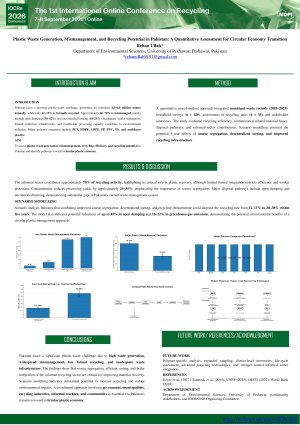
Plastic waste generation has become a rapidly escalating environmental issue in developing countries, with Pakistan producing an estimated 4.5–6.0 million tons of plastic waste annually, of which less than 12–15% is formally recycled. This study evaluates plastic waste generation patterns, recycling efficiency, and management gaps across urban and peri-urban regions, with emphasis on identifying systemic barriers to circular material recovery.
A quantitative mixed-method approach was employed, integrating municipal waste data (2018–2025), field surveys of n = 120 households and 35 recycling units, and semi-structured interviews with stakeholders in waste management systems. Statistical analysis was performed to assess recycling efficiency, material flow losses, and environmental leakage rates.
Results indicate that approximately 60–70% of plastic waste is mismanaged, with open dumping (38–42%) and uncontrolled burning (18–25%) being the dominant disposal pathways. Recycling systems are largely dependent on informal sectors, which contribute nearly 70% of total recycling activity, yet operate without regulatory integration. Efficiency analysis shows that contamination levels in collected plastic waste reduce processing yields by 25–35%, significantly limiting recovery potential.
Scenario modeling suggests that implementing decentralized sorting systems and improving waste segregation at source could increase recycling rates to 30–38% within five years, while reducing open dumping by up to 45%. Additionally, integrating circular economy strategies at municipal levels could reduce greenhouse gas emissions from plastic waste management by 18–22% annually.
The study concludes that Pakistan’s plastic waste challenge is not solely a technological issue but a systemic governance and infrastructure gap. Strengthening formal-informal sector integration, coupled with targeted policy enforcement and recycling innovation, is essential for transitioning toward a sustainable circular waste economy.
Keywords
Plastic waste
recycling efficiency
circular economy
waste management
Pakistan
environmental pollution
Poster
A Quantitative Assessment for Circular Economy Transition.pdf
A Novel Enzyme-Driven Biotechnological Strategy for Plastic Waste Valorization
Quantifying structural inefficiencies in household plastics waste management in India