Event submissions
Published
This submission belongs to the session S3. Plastic and Composite Waste Recycling of the event The 1st International Online Conference on Recycling
Published date
02 Sep, 2026
Academic Editor
'%3e%3cpath%20d='M12.6657%2010.9104C12.4185%2010.325%2012.0599%209.79327%2011.6097%209.34482C11.1609%208.89508%2010.6293%208.5365%2010.0442%208.28888C10.0389%208.28626%2010.0337%208.28495%2010.0285%208.28233C10.8446%207.69279%2011.3752%206.73249%2011.3752%205.64904C11.3752%203.8542%209.92103%202.39999%208.1262%202.39999C6.33136%202.39999%204.87715%203.8542%204.87715%205.64904C4.87715%206.73249%205.40774%207.69279%206.22393%208.28364C6.21869%208.28626%206.21345%208.28757%206.20821%208.29019C5.62129%208.5378%205.09463%208.89284%204.64265%209.34613C4.1929%209.79493%203.83432%2010.3266%203.58671%2010.9117C3.34345%2011.4845%203.21226%2012.0987%203.20023%2012.7209C3.19988%2012.7349%203.20233%2012.7488%203.20744%2012.7619C3.21255%2012.7749%203.22022%2012.7867%203.22998%2012.7968C3.23975%2012.8068%203.25142%2012.8147%203.26431%2012.8202C3.2772%2012.8256%203.29105%2012.8284%203.30504%2012.8284H4.09109C4.14874%2012.8284%204.19459%2012.7825%204.1959%2012.7262C4.2221%2011.7148%204.62823%2010.7676%205.34617%2010.0497C6.08899%209.30683%207.0755%208.89808%208.1262%208.89808C9.17689%208.89808%2010.1634%209.30683%2010.9062%2010.0497C11.6242%2010.7676%2012.0303%2011.7148%2012.0565%2012.7262C12.0578%2012.7838%2012.1037%2012.8284%2012.1613%2012.8284H12.9474C12.9613%2012.8284%2012.9752%2012.8256%2012.9881%2012.8202C13.001%2012.8147%2013.0126%2012.8068%2013.0224%2012.7968C13.0322%2012.7867%2013.0398%2012.7749%2013.0449%2012.7619C13.0501%2012.7488%2013.0525%2012.7349%2013.0522%2012.7209C13.0391%2012.0947%2012.9094%2011.4855%2012.6657%2010.9104ZM8.1262%207.9024C7.52486%207.9024%206.9589%207.6679%206.53312%207.24211C6.10733%206.81633%205.87283%206.25037%205.87283%205.64904C5.87283%205.0477%206.10733%204.48174%206.53312%204.05596C6.9589%203.63018%207.52486%203.39567%208.1262%203.39567C8.72753%203.39567%209.29349%203.63018%209.71927%204.05596C10.1451%204.48174%2010.3796%205.0477%2010.3796%205.64904C10.3796%206.25037%2010.1451%206.81633%209.71927%207.24211C9.29349%207.6679%208.72753%207.9024%208.1262%207.9024Z'%20fill='%235D1EE1'/%3e%3c/g%3e%3c/svg%3e) Rossella Arrigo
Rossella ArrigoCitation
ABDERRAOUF Omar GHERISSI, Sustainable Recycling of Wind Turbine Blades in NEOM Through Integrated Material, Heat, and Power Recovery, in Proceedings of The 1st International Online Conference on Recycling, 7 September–8 September 2026, MDPI: Basel, Switzerland
Share
Email
Facebook
Twitter
LinkedIn
Sustainable Recycling of Wind Turbine Blades in NEOM Through Integrated Material, Heat, and Power Recovery

ABDERRAOUF Omar GHERISSI 1
1. Mechanical Engineering Department, Faculty of Engineering, University of Tabuk, P.O. Box 741, Tabuk 71491, Saudi Arabia
Abstract
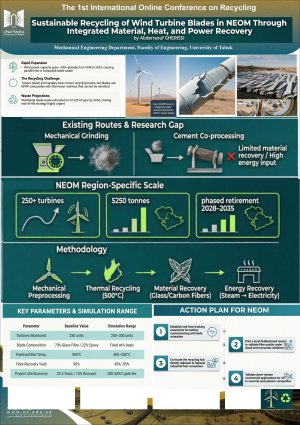
NEOM is deploying more than 250 onshore wind turbines as part of the 1.6 GW wind farm developed for the NEOM Green Hydrogen Company. This major renewable energy project will create a future need for sustainable end-of-life blade management, since wind turbine blades are mainly manufactured from glass fiber-reinforced polymer composites. Based on typical blade masses for 6–7 MW onshore turbines, the project is expected to generate about 18,000 to 30,000 tonnes of blade waste over a 20–25 year service life, equivalent to nearly 750 to 1,500 tonnes annually during phased retirement. This study proposes an innovative recycling strategy for wind turbine blades in NEOM through an integrated material, heat, and power recovery system. The objective is to evaluate the energy, economic, and environmental performance of recovering recycled glass fibre under local operating conditions. A validated thermal recycling model is adopted as the baseline and scaled from pilot level to commercial capacities suitable for future regional demand. The methodology includes turbine inventory analysis, estimation of annual blade retirement flows, mechanical shredding and thermal treatment for fibre recovery, and process simulation to quantify energy use, CO₂ emissions, and production cost. In addition, a combined material, heat, and power configuration is assessed by integrating the recycling unit with an Organic Rankine Cycle, thermal storage, and nearby buildings or industrial loads.
Keywords
Wind turbine blades
NEOM
Recycling
Glass fibre reinforced polymer
Recycled glass fibre
Circular economy
Composite waste
Renewable energy.
Poster
Poster Template 22-8-2026.pdf
Modification of Rice Straw Biochar via Co-pyrolysis with Polyethylene Terephthalate: A Valorization Approach to Lead(II) Adsorption
Project ROCKY: Recycling Operations for Circular Knowledge and Yield in Plastic and Composite Waste Management