Event submissions
Published
This submission belongs to the session S3. Plastic and Composite Waste Recycling of the event The 1st International Online Conference on Recycling
Published date
02 Sep, 2026
Academic Editor
'%3e%3cpath%20d='M12.6657%2010.9104C12.4185%2010.325%2012.0599%209.79327%2011.6097%209.34482C11.1609%208.89508%2010.6293%208.5365%2010.0442%208.28888C10.0389%208.28626%2010.0337%208.28495%2010.0285%208.28233C10.8446%207.69279%2011.3752%206.73249%2011.3752%205.64904C11.3752%203.8542%209.92103%202.39999%208.1262%202.39999C6.33136%202.39999%204.87715%203.8542%204.87715%205.64904C4.87715%206.73249%205.40774%207.69279%206.22393%208.28364C6.21869%208.28626%206.21345%208.28757%206.20821%208.29019C5.62129%208.5378%205.09463%208.89284%204.64265%209.34613C4.1929%209.79493%203.83432%2010.3266%203.58671%2010.9117C3.34345%2011.4845%203.21226%2012.0987%203.20023%2012.7209C3.19988%2012.7349%203.20233%2012.7488%203.20744%2012.7619C3.21255%2012.7749%203.22022%2012.7867%203.22998%2012.7968C3.23975%2012.8068%203.25142%2012.8147%203.26431%2012.8202C3.2772%2012.8256%203.29105%2012.8284%203.30504%2012.8284H4.09109C4.14874%2012.8284%204.19459%2012.7825%204.1959%2012.7262C4.2221%2011.7148%204.62823%2010.7676%205.34617%2010.0497C6.08899%209.30683%207.0755%208.89808%208.1262%208.89808C9.17689%208.89808%2010.1634%209.30683%2010.9062%2010.0497C11.6242%2010.7676%2012.0303%2011.7148%2012.0565%2012.7262C12.0578%2012.7838%2012.1037%2012.8284%2012.1613%2012.8284H12.9474C12.9613%2012.8284%2012.9752%2012.8256%2012.9881%2012.8202C13.001%2012.8147%2013.0126%2012.8068%2013.0224%2012.7968C13.0322%2012.7867%2013.0398%2012.7749%2013.0449%2012.7619C13.0501%2012.7488%2013.0525%2012.7349%2013.0522%2012.7209C13.0391%2012.0947%2012.9094%2011.4855%2012.6657%2010.9104ZM8.1262%207.9024C7.52486%207.9024%206.9589%207.6679%206.53312%207.24211C6.10733%206.81633%205.87283%206.25037%205.87283%205.64904C5.87283%205.0477%206.10733%204.48174%206.53312%204.05596C6.9589%203.63018%207.52486%203.39567%208.1262%203.39567C8.72753%203.39567%209.29349%203.63018%209.71927%204.05596C10.1451%204.48174%2010.3796%205.0477%2010.3796%205.64904C10.3796%206.25037%2010.1451%206.81633%209.71927%207.24211C9.29349%207.6679%208.72753%207.9024%208.1262%207.9024Z'%20fill='%235D1EE1'/%3e%3c/g%3e%3c/svg%3e) Michele John
Michele JohnCitation
Alberto Frache, Chiara Gnoffo, Rossella Arrigo, HDPE Packaging Recycling: Combined Effects of Aging, Cross-Contamination, and Reprocessing, in Proceedings of The 1st International Online Conference on Recycling, 7 September–8 September 2026, MDPI: Basel, Switzerland
Share
Email
Facebook
Twitter
LinkedIn
HDPE Packaging Recycling: Combined Effects of Aging, Cross-Contamination, and Reprocessing

Alberto Frache 1
'%3e%3cpath%20d='M12.6647%2010.9104C12.4176%2010.325%2012.0589%209.7933%2011.6088%209.34485C11.16%208.89511%2010.6283%208.53653%2010.0432%208.28891C10.038%208.28629%2010.0327%208.28498%2010.0275%208.28236C10.8437%207.69282%2011.3743%206.73252%2011.3743%205.64907C11.3743%203.85423%209.92005%202.40002%208.12522%202.40002C6.33038%202.40002%204.87618%203.85423%204.87618%205.64907C4.87618%206.73252%205.40677%207.69282%206.22296%208.28367C6.21772%208.28629%206.21248%208.2876%206.20724%208.29022C5.62031%208.53783%205.09365%208.89287%204.64167%209.34616C4.19192%209.79496%203.83334%2010.3266%203.58573%2010.9117C3.34247%2011.4846%203.21128%2012.0987%203.19925%2012.721C3.1989%2012.735%203.20135%2012.7489%203.20646%2012.7619C3.21157%2012.7749%203.21924%2012.7868%203.22901%2012.7968C3.23877%2012.8068%203.25045%2012.8148%203.26334%2012.8202C3.27623%2012.8256%203.29007%2012.8284%203.30406%2012.8284H4.09012C4.14776%2012.8284%204.19362%2012.7825%204.19493%2012.7262C4.22113%2011.7148%204.62726%2010.7676%205.34519%2010.0497C6.08802%209.30686%207.07452%208.89811%208.12522%208.89811C9.17592%208.89811%2010.1624%209.30686%2010.9052%2010.0497C11.6232%2010.7676%2012.0293%2011.7148%2012.0555%2012.7262C12.0568%2012.7839%2012.1027%2012.8284%2012.1603%2012.8284H12.9464C12.9604%2012.8284%2012.9742%2012.8256%2012.9871%2012.8202C13%2012.8148%2013.0117%2012.8068%2013.0214%2012.7968C13.0312%2012.7868%2013.0389%2012.7749%2013.044%2012.7619C13.0491%2012.7489%2013.0515%2012.735%2013.0512%2012.721C13.0381%2012.0947%2012.9084%2011.4856%2012.6647%2010.9104ZM8.12522%207.90243C7.52388%207.90243%206.95792%207.66793%206.53214%207.24215C6.10636%206.81636%205.87185%206.2504%205.87185%205.64907C5.87185%205.04773%206.10636%204.48177%206.53214%204.05599C6.95792%203.63021%207.52388%203.3957%208.12522%203.3957C8.72655%203.3957%209.29252%203.63021%209.7183%204.05599C10.1441%204.48177%2010.3786%205.04773%2010.3786%205.64907C10.3786%206.2504%2010.1441%206.81636%209.7183%207.24215C9.29252%207.66793%208.72655%207.90243%208.12522%207.90243Z'%20fill='%235D1EE1'/%3e%3c/g%3e%3c/svg%3e)
Chiara Gnoffo 1

Rossella Arrigo 1
1. Department of Applied Science and Technology, Polytechnic of Turin, Viale Teresa Michel, 5. Alessandria, Italy
Abstract
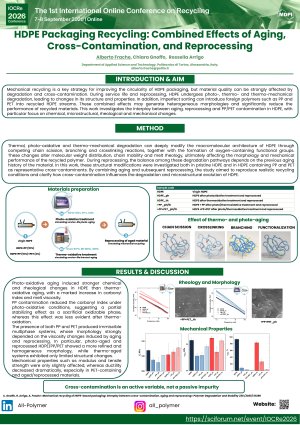
Mechanical recycling of polyolefins is often limited by the combined effects of thermo-mechanical degradation during reprocessing, oxidative aging during service life, and cross-contamination caused by imperfect waste sorting. These factors generate heterogeneous recycled streams with reduced performance and restricted end-use applications. In this work, the combined influence of aging, reprocessing, and contamination on high-density polyethylene (HDPE) packaging waste was investigated, with particular attention to the presence of polypropylene (PP) and polyethylene terephthalate (PET) as typical foreign polymers.
Three model systems were prepared by twin-screw extrusion: pristine HDPE, HDPE containing 10 wt% PP, and HDPE containing 10 wt% PP and 2 wt% PET. Samples were exposed to either photo-oxidative or thermo-oxidative aging for 300 h, then reprocessed and characterized by spectroscopic, rheological, morphological, and mechanical analyses.
The results showed that contamination affects HDPE degradation behavior in different ways depending on the aging conditions. In particular, during the photo-oxidative aging, PP contamination reduces the carbonyl index of HDPE compared with pristine material, suggesting a stabilizing role of PP as a sacrificial oxidizable phase, while this effect was less evident under thermo-oxidative conditions. In systems containing both PP and PET, higher carbonyl index values were observed, partly due to the intrinsic carbonyl contribution of PET.
Rheological and morphological investigations confirmed the multi-phase microstructure of the cross-contaminated materials and revealed that the dispersed-phase morphology is strongly influenced by aging-induced changes in matrix viscosity. Photo-oxidized and reprocessed HDPE/PP/PET samples exhibited marked morphological refinement, whereas thermo-oxidized systems showed only limited structural variation. Mechanical testing showed that elastic modulus and tensile strength were only slightly affected, while ductility was highly sensitive to contamination and aging. In particular, PET strongly reduced elongation at break, and the combination of photo-oxidative aging and reprocessing led to severe embrittlement, especially in contaminated systems.
Keywords
Mechanical recycling Cross-contamination Polyolefins Photo-oxidation Thermo-oxidation
Poster
POSTER_FRACHE_REC.pdf
Additive-Assisted Upcycling of Recycled Polyolefins: Tailoring the Molecular Architecture and Processability of polyolefins
Chemical Recycling of Thermoplastic Polyurethane Residues from the Ceramic Sector