Event submissions
Published
This submission belongs to the session S3. Plastic and Composite Waste Recycling of the event The 1st International Online Conference on Recycling
Published date
02 Sep, 2026
Academic Editor
'%3e%3cpath%20d='M12.6657%2010.9104C12.4185%2010.325%2012.0599%209.79327%2011.6097%209.34482C11.1609%208.89508%2010.6293%208.5365%2010.0442%208.28888C10.0389%208.28626%2010.0337%208.28495%2010.0285%208.28233C10.8446%207.69279%2011.3752%206.73249%2011.3752%205.64904C11.3752%203.8542%209.92103%202.39999%208.1262%202.39999C6.33136%202.39999%204.87715%203.8542%204.87715%205.64904C4.87715%206.73249%205.40774%207.69279%206.22393%208.28364C6.21869%208.28626%206.21345%208.28757%206.20821%208.29019C5.62129%208.5378%205.09463%208.89284%204.64265%209.34613C4.1929%209.79493%203.83432%2010.3266%203.58671%2010.9117C3.34345%2011.4845%203.21226%2012.0987%203.20023%2012.7209C3.19988%2012.7349%203.20233%2012.7488%203.20744%2012.7619C3.21255%2012.7749%203.22022%2012.7867%203.22998%2012.7968C3.23975%2012.8068%203.25142%2012.8147%203.26431%2012.8202C3.2772%2012.8256%203.29105%2012.8284%203.30504%2012.8284H4.09109C4.14874%2012.8284%204.19459%2012.7825%204.1959%2012.7262C4.2221%2011.7148%204.62823%2010.7676%205.34617%2010.0497C6.08899%209.30683%207.0755%208.89808%208.1262%208.89808C9.17689%208.89808%2010.1634%209.30683%2010.9062%2010.0497C11.6242%2010.7676%2012.0303%2011.7148%2012.0565%2012.7262C12.0578%2012.7838%2012.1037%2012.8284%2012.1613%2012.8284H12.9474C12.9613%2012.8284%2012.9752%2012.8256%2012.9881%2012.8202C13.001%2012.8147%2013.0126%2012.8068%2013.0224%2012.7968C13.0322%2012.7867%2013.0398%2012.7749%2013.0449%2012.7619C13.0501%2012.7488%2013.0525%2012.7349%2013.0522%2012.7209C13.0391%2012.0947%2012.9094%2011.4855%2012.6657%2010.9104ZM8.1262%207.9024C7.52486%207.9024%206.9589%207.6679%206.53312%207.24211C6.10733%206.81633%205.87283%206.25037%205.87283%205.64904C5.87283%205.0477%206.10733%204.48174%206.53312%204.05596C6.9589%203.63018%207.52486%203.39567%208.1262%203.39567C8.72753%203.39567%209.29349%203.63018%209.71927%204.05596C10.1451%204.48174%2010.3796%205.0477%2010.3796%205.64904C10.3796%206.25037%2010.1451%206.81633%209.71927%207.24211C9.29349%207.6679%208.72753%207.9024%208.1262%207.9024Z'%20fill='%235D1EE1'/%3e%3c/g%3e%3c/svg%3e) Rossella Arrigo
Rossella ArrigoCitation
Joanna Kazimierowicz, Marcin Dębowski, Recycled Filling Materials for Enhancing Anaerobic Treatment of Wastewater, in Proceedings of The 1st International Online Conference on Recycling, 7 September–8 September 2026, MDPI: Basel, Switzerland
Share
Email
Facebook
Twitter
LinkedIn
Recycled Filling Materials for Enhancing Anaerobic Treatment of Wastewater

Joanna Kazimierowicz 1

Marcin Dębowski 2
1. Department of Water Supply and Sewage Systems, Faculty of Civil Engineering and Environmental Sciences, Bialystok University of Technology, 15-351 Bialystok, Poland
2. Department of Environment Engineering, Faculty of Geoengineering, University of Warmia and Mazury in Olsztyn, Str. Oczapowskiego 5, 10-719 Olsztyn, Poland
Abstract
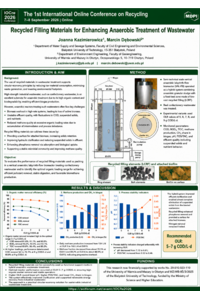
The use of recycled materials in environmental engineering is an important approach supporting circular economy, resource efficiency, and sustainable waste management. In anaerobic wastewater treatment systems, recycled filling materials may serve as low-cost functional components that improve biomass retention, support the development of attached microbial communities, and enhance process stability. This study presents the application of recycled filling in a vertical anaerobic labyrinth-flow bioreactor for the treatment of high-strength industrial wastewater. The proposed system combines anaerobic granular sludge with a fixed-bed zone based on recycled filling, creating a hybrid configuration that integrates suspended and attached biomass. This design is intended to improve the biodegradation of organic pollutants, support biogas production, and enhance the separation of suspended solids from treated wastewater. The study focuses on evaluating the role of recycled filling under different organic loading conditions and identifying operational indicators associated with stable anaerobic digestion. The results showed that the incorporation of recycled filling contributed to efficient wastewater treatment and stable reactor performance within the optimal loading range. The hybrid system supported effective organic matter removal, favorable biomethane production, and improved clarification of the effluent. However, excessive organic loading reduced process stability, which was reflected in changes in pH, the FOS/TAC - ratio of volatile organic acids to total inorganic carbonate alkalinity, and methane concentration in the biogas. The findings indicate that recycled filling materials can be successfully used as functional support media in anaerobic wastewater treatment technologies. Their application provides a practical example of integrating material recycling with biological wastewater treatment and renewable energy recovery. This approach may contribute to the development of circular and sustainable solutions for the treatment of industrial wastewater while reducing the demand for conventional reactor filling materials.
Keywords
recycled filling materials
anaerobic wastewater treatment
industrial wastewater
circular economy
material recycling
attached biomass
anaerobic granular sludge
biomethane production
renewable energy recovery
Poster
Kazimierowicz, Debowski.pdf
From model systems to post-consumer waste: towards sustainable strategies for recycling multilayer plastic packaging
Processing Induced Waste Management: Recyclable Acrylonitrile Butadiene Styrene Reduction by Using FDM Process Parameter Tuning