Event submissions
Published
This submission belongs to the session S3. Plastic and Composite Waste Recycling of the event The 1st International Online Conference on Recycling
Published date
02 Sep, 2026
Academic Editor
'%3e%3cpath%20d='M12.6657%2010.9104C12.4185%2010.325%2012.0599%209.79327%2011.6097%209.34482C11.1609%208.89508%2010.6293%208.5365%2010.0442%208.28888C10.0389%208.28626%2010.0337%208.28495%2010.0285%208.28233C10.8446%207.69279%2011.3752%206.73249%2011.3752%205.64904C11.3752%203.8542%209.92103%202.39999%208.1262%202.39999C6.33136%202.39999%204.87715%203.8542%204.87715%205.64904C4.87715%206.73249%205.40774%207.69279%206.22393%208.28364C6.21869%208.28626%206.21345%208.28757%206.20821%208.29019C5.62129%208.5378%205.09463%208.89284%204.64265%209.34613C4.1929%209.79493%203.83432%2010.3266%203.58671%2010.9117C3.34345%2011.4845%203.21226%2012.0987%203.20023%2012.7209C3.19988%2012.7349%203.20233%2012.7488%203.20744%2012.7619C3.21255%2012.7749%203.22022%2012.7867%203.22998%2012.7968C3.23975%2012.8068%203.25142%2012.8147%203.26431%2012.8202C3.2772%2012.8256%203.29105%2012.8284%203.30504%2012.8284H4.09109C4.14874%2012.8284%204.19459%2012.7825%204.1959%2012.7262C4.2221%2011.7148%204.62823%2010.7676%205.34617%2010.0497C6.08899%209.30683%207.0755%208.89808%208.1262%208.89808C9.17689%208.89808%2010.1634%209.30683%2010.9062%2010.0497C11.6242%2010.7676%2012.0303%2011.7148%2012.0565%2012.7262C12.0578%2012.7838%2012.1037%2012.8284%2012.1613%2012.8284H12.9474C12.9613%2012.8284%2012.9752%2012.8256%2012.9881%2012.8202C13.001%2012.8147%2013.0126%2012.8068%2013.0224%2012.7968C13.0322%2012.7867%2013.0398%2012.7749%2013.0449%2012.7619C13.0501%2012.7488%2013.0525%2012.7349%2013.0522%2012.7209C13.0391%2012.0947%2012.9094%2011.4855%2012.6657%2010.9104ZM8.1262%207.9024C7.52486%207.9024%206.9589%207.6679%206.53312%207.24211C6.10733%206.81633%205.87283%206.25037%205.87283%205.64904C5.87283%205.0477%206.10733%204.48174%206.53312%204.05596C6.9589%203.63018%207.52486%203.39567%208.1262%203.39567C8.72753%203.39567%209.29349%203.63018%209.71927%204.05596C10.1451%204.48174%2010.3796%205.0477%2010.3796%205.64904C10.3796%206.25037%2010.1451%206.81633%209.71927%207.24211C9.29349%207.6679%208.72753%207.9024%208.1262%207.9024Z'%20fill='%235D1EE1'/%3e%3c/g%3e%3c/svg%3e) Rossella Arrigo
Rossella ArrigoCitation
Mennatalla Kuna, Marwa Al-Ani, Ala Alardah, Noora Al-Qahtani, Plastic Waste-to-Graphene Conversion via Salt-Assisted Pyrolysis: Advancing Circular Economy Pathways for Energy Storage, in Proceedings of The 1st International Online Conference on Recycling, 7 September–8 September 2026, MDPI: Basel, Switzerland
Share
Email
Facebook
Twitter
LinkedIn
Plastic Waste-to-Graphene Conversion via Salt-Assisted Pyrolysis: Advancing Circular Economy Pathways for Energy Storage
'%3e%3cpath%20d='M12.6647%2010.9104C12.4176%2010.325%2012.0589%209.7933%2011.6088%209.34485C11.16%208.89511%2010.6283%208.53653%2010.0432%208.28891C10.038%208.28629%2010.0327%208.28498%2010.0275%208.28236C10.8437%207.69282%2011.3743%206.73252%2011.3743%205.64907C11.3743%203.85423%209.92005%202.40002%208.12522%202.40002C6.33038%202.40002%204.87618%203.85423%204.87618%205.64907C4.87618%206.73252%205.40677%207.69282%206.22296%208.28367C6.21772%208.28629%206.21248%208.2876%206.20724%208.29022C5.62031%208.53783%205.09365%208.89287%204.64167%209.34616C4.19192%209.79496%203.83334%2010.3266%203.58573%2010.9117C3.34247%2011.4846%203.21128%2012.0987%203.19925%2012.721C3.1989%2012.735%203.20135%2012.7489%203.20646%2012.7619C3.21157%2012.7749%203.21924%2012.7868%203.22901%2012.7968C3.23877%2012.8068%203.25045%2012.8148%203.26334%2012.8202C3.27623%2012.8256%203.29007%2012.8284%203.30406%2012.8284H4.09012C4.14776%2012.8284%204.19362%2012.7825%204.19493%2012.7262C4.22113%2011.7148%204.62726%2010.7676%205.34519%2010.0497C6.08802%209.30686%207.07452%208.89811%208.12522%208.89811C9.17592%208.89811%2010.1624%209.30686%2010.9052%2010.0497C11.6232%2010.7676%2012.0293%2011.7148%2012.0555%2012.7262C12.0568%2012.7839%2012.1027%2012.8284%2012.1603%2012.8284H12.9464C12.9604%2012.8284%2012.9742%2012.8256%2012.9871%2012.8202C13%2012.8148%2013.0117%2012.8068%2013.0214%2012.7968C13.0312%2012.7868%2013.0389%2012.7749%2013.044%2012.7619C13.0491%2012.7489%2013.0515%2012.735%2013.0512%2012.721C13.0381%2012.0947%2012.9084%2011.4856%2012.6647%2010.9104ZM8.12522%207.90243C7.52388%207.90243%206.95792%207.66793%206.53214%207.24215C6.10636%206.81636%205.87185%206.2504%205.87185%205.64907C5.87185%205.04773%206.10636%204.48177%206.53214%204.05599C6.95792%203.63021%207.52388%203.3957%208.12522%203.3957C8.72655%203.3957%209.29252%203.63021%209.7183%204.05599C10.1441%204.48177%2010.3786%205.04773%2010.3786%205.64907C10.3786%206.2504%2010.1441%206.81636%209.7183%207.24215C9.29252%207.66793%208.72655%207.90243%208.12522%207.90243Z'%20fill='%235D1EE1'/%3e%3c/g%3e%3c/svg%3e)
Mennatalla Kuna 1
Marwa Al-Ani 2
Ala Alardah 3
Noora Al-Qahtani 4
1. Department of Chemistry & Earth Sciences, College of Arts and Sciences, Qatar University, Doha, Qatar
2. Department of Chemical Engineering, College of Engineering, Qatar University, Doha, Qatar
3. Materials Science and Technology Graduate Program, Department of Physics and Materials Science, College of Arts and Sciences (CAS), Qatar University, Doha, Qatar
4. Center for Advanced Materials (CAM), and Central Laboratories Unit (CLU), Qatar University, Doha, Qatar
Abstract
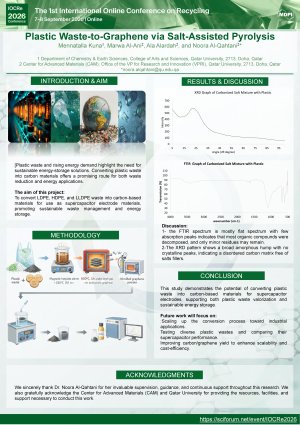
The rapid accumulation of plastic waste and the growing demand for sustainable energy storage materials present interconnected challenges for modern recycling systems. Conventional plastic waste management approaches often fail to recover high-value materials, while traditional graphene production remains resource-intensive and costly. This study proposes a recycling-oriented waste valorization strategy for converting polyethylene-based plastic bag waste, comprising high-density polyethylene (HDPE), low-density polyethylene (LDPE), and linear low-density polyethylene (LLDPE), into high-quality graphene with potential for energy storage applications, using a salt-assisted pyrolysis process. The developed method enables efficient transformation of polymer waste into carbon-rich nanostructures with structural properties favorable for electrochemical applications. Process optimization identified a KCl–K₂CO₃ catalytic system as the most effective, achieving a carbon yield of 40.04%, significantly outperforming alternative salt systems. Structural and chemical characterization using Fourier Transform Infrared Spectroscopy (FTIR), X-ray Diffraction (XRD), and Raman spectroscopy confirmed successful graphitization and removal of non-carbon components, indicating suitability for energy storage applications. From a recycling and circular economy perspective, the process provides a high-value recovery pathway for mixed plastic waste streams that are typically difficult to recycle through conventional mechanical methods. Techno-economic analysis demonstrates a reduction of up to 70% in raw material costs compared to conventional graphene production, while life cycle assessment indicates a 65% decrease in carbon emissions. The proposed approach supports scalable waste-to-resource conversion, enabling the integration of plastic waste management with advanced material production. This work highlights the potential of chemical recycling technologies to transform low-value plastic waste into functional carbon materials, contributing to resource efficiency.
Keywords
Recycling
Plastic Waste
Chemical Recycling
Graphene
Circular Economy
Waste-to-Resource
Pyrolysis
Polymer Waste Conversion
Energy Storage Ma-terials
Carbon Materials
Poster
poster Plastic Waste-to-Graphene via Salt-Assisted Pyrolysis.pdf
Processing Induced Waste Management: Recyclable Acrylonitrile Butadiene Styrene Reduction by Using FDM Process Parameter Tuning
Plastic Pyrolysis to Produce Fuel