Event submissions
Published
This submission belongs to the session S3. Plastic and Composite Waste Recycling of the event The 1st International Online Conference on Recycling
Published date
02 Sep, 2026
Academic Editor
'%3e%3cpath%20d='M12.6657%2010.9104C12.4185%2010.325%2012.0599%209.79327%2011.6097%209.34482C11.1609%208.89508%2010.6293%208.5365%2010.0442%208.28888C10.0389%208.28626%2010.0337%208.28495%2010.0285%208.28233C10.8446%207.69279%2011.3752%206.73249%2011.3752%205.64904C11.3752%203.8542%209.92103%202.39999%208.1262%202.39999C6.33136%202.39999%204.87715%203.8542%204.87715%205.64904C4.87715%206.73249%205.40774%207.69279%206.22393%208.28364C6.21869%208.28626%206.21345%208.28757%206.20821%208.29019C5.62129%208.5378%205.09463%208.89284%204.64265%209.34613C4.1929%209.79493%203.83432%2010.3266%203.58671%2010.9117C3.34345%2011.4845%203.21226%2012.0987%203.20023%2012.7209C3.19988%2012.7349%203.20233%2012.7488%203.20744%2012.7619C3.21255%2012.7749%203.22022%2012.7867%203.22998%2012.7968C3.23975%2012.8068%203.25142%2012.8147%203.26431%2012.8202C3.2772%2012.8256%203.29105%2012.8284%203.30504%2012.8284H4.09109C4.14874%2012.8284%204.19459%2012.7825%204.1959%2012.7262C4.2221%2011.7148%204.62823%2010.7676%205.34617%2010.0497C6.08899%209.30683%207.0755%208.89808%208.1262%208.89808C9.17689%208.89808%2010.1634%209.30683%2010.9062%2010.0497C11.6242%2010.7676%2012.0303%2011.7148%2012.0565%2012.7262C12.0578%2012.7838%2012.1037%2012.8284%2012.1613%2012.8284H12.9474C12.9613%2012.8284%2012.9752%2012.8256%2012.9881%2012.8202C13.001%2012.8147%2013.0126%2012.8068%2013.0224%2012.7968C13.0322%2012.7867%2013.0398%2012.7749%2013.0449%2012.7619C13.0501%2012.7488%2013.0525%2012.7349%2013.0522%2012.7209C13.0391%2012.0947%2012.9094%2011.4855%2012.6657%2010.9104ZM8.1262%207.9024C7.52486%207.9024%206.9589%207.6679%206.53312%207.24211C6.10733%206.81633%205.87283%206.25037%205.87283%205.64904C5.87283%205.0477%206.10733%204.48174%206.53312%204.05596C6.9589%203.63018%207.52486%203.39567%208.1262%203.39567C8.72753%203.39567%209.29349%203.63018%209.71927%204.05596C10.1451%204.48174%2010.3796%205.0477%2010.3796%205.64904C10.3796%206.25037%2010.1451%206.81633%209.71927%207.24211C9.29349%207.6679%208.72753%207.9024%208.1262%207.9024Z'%20fill='%235D1EE1'/%3e%3c/g%3e%3c/svg%3e) Rossella Arrigo
Rossella ArrigoCitation
Dona Kavini Hirunika Thalagala, Prabhath Dhammika Tharindu Arachchi Appuhamilage, Erekso Hadiwijoyo, Comparative Meta-Analysis of Microbial Plastic Degradation Pathways for Sustainable Bio-Recycling of Synthetic Polymers, in Proceedings of The 1st International Online Conference on Recycling, 7 September–8 September 2026, MDPI: Basel, Switzerland
Share
Email
Facebook
Twitter
LinkedIn
Comparative Meta-Analysis of Microbial Plastic Degradation Pathways for Sustainable Bio-Recycling of Synthetic Polymers
'%3e%3cpath%20d='M12.6647%2010.9104C12.4176%2010.325%2012.0589%209.7933%2011.6088%209.34485C11.16%208.89511%2010.6283%208.53653%2010.0432%208.28891C10.038%208.28629%2010.0327%208.28498%2010.0275%208.28236C10.8437%207.69282%2011.3743%206.73252%2011.3743%205.64907C11.3743%203.85423%209.92005%202.40002%208.12522%202.40002C6.33038%202.40002%204.87618%203.85423%204.87618%205.64907C4.87618%206.73252%205.40677%207.69282%206.22296%208.28367C6.21772%208.28629%206.21248%208.2876%206.20724%208.29022C5.62031%208.53783%205.09365%208.89287%204.64167%209.34616C4.19192%209.79496%203.83334%2010.3266%203.58573%2010.9117C3.34247%2011.4846%203.21128%2012.0987%203.19925%2012.721C3.1989%2012.735%203.20135%2012.7489%203.20646%2012.7619C3.21157%2012.7749%203.21924%2012.7868%203.22901%2012.7968C3.23877%2012.8068%203.25045%2012.8148%203.26334%2012.8202C3.27623%2012.8256%203.29007%2012.8284%203.30406%2012.8284H4.09012C4.14776%2012.8284%204.19362%2012.7825%204.19493%2012.7262C4.22113%2011.7148%204.62726%2010.7676%205.34519%2010.0497C6.08802%209.30686%207.07452%208.89811%208.12522%208.89811C9.17592%208.89811%2010.1624%209.30686%2010.9052%2010.0497C11.6232%2010.7676%2012.0293%2011.7148%2012.0555%2012.7262C12.0568%2012.7839%2012.1027%2012.8284%2012.1603%2012.8284H12.9464C12.9604%2012.8284%2012.9742%2012.8256%2012.9871%2012.8202C13%2012.8148%2013.0117%2012.8068%2013.0214%2012.7968C13.0312%2012.7868%2013.0389%2012.7749%2013.044%2012.7619C13.0491%2012.7489%2013.0515%2012.735%2013.0512%2012.721C13.0381%2012.0947%2012.9084%2011.4856%2012.6647%2010.9104ZM8.12522%207.90243C7.52388%207.90243%206.95792%207.66793%206.53214%207.24215C6.10636%206.81636%205.87185%206.2504%205.87185%205.64907C5.87185%205.04773%206.10636%204.48177%206.53214%204.05599C6.95792%203.63021%207.52388%203.3957%208.12522%203.3957C8.72655%203.3957%209.29252%203.63021%209.7183%204.05599C10.1441%204.48177%2010.3786%205.04773%2010.3786%205.64907C10.3786%206.2504%2010.1441%206.81636%209.7183%207.24215C9.29252%207.66793%208.72655%207.90243%208.12522%207.90243Z'%20fill='%235D1EE1'/%3e%3c/g%3e%3c/svg%3e)
Dona Kavini Hirunika Thalagala 1
Prabhath Dhammika Tharindu Arachchi Appuhamilage 2
Erekso Hadiwijoyo 2
1. Faculty of Health & Life Sciences (FHLS), INTI International University, Putra Nilai, Malaysia
2. Graduate School of Environmental and Information Studies, Tokyo City University, Yokohoma, Japan
Abstract
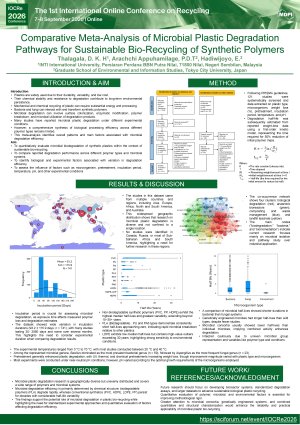
Global plastic production exceeds 460 million metric tons annually, with approximately 22 million metric tons of mismanaged plastic waste entering terrestrial and aquatic environments. Mechanical and chemical recycling methods are limited by significant energy demands. Conversely, biological recycling, particularly microbial depolymerization has emerged as a promising sustainable alternative. However, a comprehensive synthesis of biological processing efficiency across different polymer types remains limited. This study presents a comparative meta-analysis conducted in accordance with PRISMA guidelines to evaluate the bio recycling efficiency of bacterial and fungal strains against major synthetic polymers, including polyethylene (PE), low-density polyethylene (LDPE), high-density polyethylene (HDPE), linear low-density polyethylene (LLDPE), polyethylene terephthalate (PET), polyvinyl chloride (PVC), and polypropylene (PP). Data were compiled from published studies worldwide to assess processing performance, incubation conditions, microbial biocatalyst sources, pretreatment effects, and polymer characteristics. The analysis revealed that most studies employed incubation periods of 30 to 60 days, with estimated polymer half-lives falling within 1,400 days in 65% of tests. Landfill environments were the predominant source of plastic-degrading microorganisms. Among reported strains, Proteus mirabilis BTT4 demonstrated the highest bio-recycling efficiency, achieving 89.72% LDPE weight loss within 78 days (estimated half-life of 24 days). For PET recycling, microbial consortia consistently outperformed single-strain cultures, enhancing depolymerization efficiency by up to twofold. Combined Ultraviolet and thermal pretreatments produced substantially greater polymer weight loss than individual methods alone, showcasing a viable hybrid recycling strategy. Fourier-Transform Infrared spectroscopy (FTIR) analysis confirmed polymer chain modification, indicating the potential conversion of plastic waste into biologically accessible intermediates that may support future bio-recycling processes. Despite these findings, evidence supporting large-scale integration of microbial processing into real-world waste management remains limited. Future research should prioritize engineering efficient microbial consortia, optimizing industrial bioreactor systems, and evaluating techno-economic feasibility under commercial recycling conditions, ultimately advancing sustainable bio-recycling technologies for synthetic plastic waste.
Keywords
Plastic biodegradation
Microbial consortia
Synthetic polymer waste
Biorecycling
Meta-analysis
Poster
IOCRe 2026 Conference.pdf
Operating Condition-Guided Machine Learning for Solvent Selection in Polymer Solubilization
The Role of the Recycler (EoL) in the Battery Passport: what role recycling and processing facilities play in the DPP ecosystem, and what conditions must be met for the passport to genuinely support the circular economy and the recovery of critical raw materials.