Event submissions
Published
This submission belongs to the session S4. Metal, Battery, and E-Waste Recycling of the event The 1st International Online Conference on Recycling
Published date
02 Sep, 2026
Academic Editor
'%3e%3cpath%20d='M12.6657%2010.9104C12.4185%2010.325%2012.0599%209.79327%2011.6097%209.34482C11.1609%208.89508%2010.6293%208.5365%2010.0442%208.28888C10.0389%208.28626%2010.0337%208.28495%2010.0285%208.28233C10.8446%207.69279%2011.3752%206.73249%2011.3752%205.64904C11.3752%203.8542%209.92103%202.39999%208.1262%202.39999C6.33136%202.39999%204.87715%203.8542%204.87715%205.64904C4.87715%206.73249%205.40774%207.69279%206.22393%208.28364C6.21869%208.28626%206.21345%208.28757%206.20821%208.29019C5.62129%208.5378%205.09463%208.89284%204.64265%209.34613C4.1929%209.79493%203.83432%2010.3266%203.58671%2010.9117C3.34345%2011.4845%203.21226%2012.0987%203.20023%2012.7209C3.19988%2012.7349%203.20233%2012.7488%203.20744%2012.7619C3.21255%2012.7749%203.22022%2012.7867%203.22998%2012.7968C3.23975%2012.8068%203.25142%2012.8147%203.26431%2012.8202C3.2772%2012.8256%203.29105%2012.8284%203.30504%2012.8284H4.09109C4.14874%2012.8284%204.19459%2012.7825%204.1959%2012.7262C4.2221%2011.7148%204.62823%2010.7676%205.34617%2010.0497C6.08899%209.30683%207.0755%208.89808%208.1262%208.89808C9.17689%208.89808%2010.1634%209.30683%2010.9062%2010.0497C11.6242%2010.7676%2012.0303%2011.7148%2012.0565%2012.7262C12.0578%2012.7838%2012.1037%2012.8284%2012.1613%2012.8284H12.9474C12.9613%2012.8284%2012.9752%2012.8256%2012.9881%2012.8202C13.001%2012.8147%2013.0126%2012.8068%2013.0224%2012.7968C13.0322%2012.7867%2013.0398%2012.7749%2013.0449%2012.7619C13.0501%2012.7488%2013.0525%2012.7349%2013.0522%2012.7209C13.0391%2012.0947%2012.9094%2011.4855%2012.6657%2010.9104ZM8.1262%207.9024C7.52486%207.9024%206.9589%207.6679%206.53312%207.24211C6.10733%206.81633%205.87283%206.25037%205.87283%205.64904C5.87283%205.0477%206.10733%204.48174%206.53312%204.05596C6.9589%203.63018%207.52486%203.39567%208.1262%203.39567C8.72753%203.39567%209.29349%203.63018%209.71927%204.05596C10.1451%204.48174%2010.3796%205.0477%2010.3796%205.64904C10.3796%206.25037%2010.1451%206.81633%209.71927%207.24211C9.29349%207.6679%208.72753%207.9024%208.1262%207.9024Z'%20fill='%235D1EE1'/%3e%3c/g%3e%3c/svg%3e) Ana Paula Paiva
Ana Paula PaivaCitation
Karen Ailed Neri-Espinoza, José Alberto Andraca-Adame, Diana Palma-Ramírez, Acela López-Benítez, Francisco Gutiérrez-Galicia, Ramón Peña-Sierra, From Transformer Waste to Functional Substrates: Recycled Fe–Si for Sustainable Electronics, in Proceedings of The 1st International Online Conference on Recycling, 7 September–8 September 2026, MDPI: Basel, Switzerland
Share
Email
Facebook
Twitter
LinkedIn
From Transformer Waste to Functional Substrates: Recycled Fe–Si for Sustainable Electronics
'%3e%3cpath%20d='M12.6647%2010.9104C12.4176%2010.325%2012.0589%209.7933%2011.6088%209.34485C11.16%208.89511%2010.6283%208.53653%2010.0432%208.28891C10.038%208.28629%2010.0327%208.28498%2010.0275%208.28236C10.8437%207.69282%2011.3743%206.73252%2011.3743%205.64907C11.3743%203.85423%209.92005%202.40002%208.12522%202.40002C6.33038%202.40002%204.87618%203.85423%204.87618%205.64907C4.87618%206.73252%205.40677%207.69282%206.22296%208.28367C6.21772%208.28629%206.21248%208.2876%206.20724%208.29022C5.62031%208.53783%205.09365%208.89287%204.64167%209.34616C4.19192%209.79496%203.83334%2010.3266%203.58573%2010.9117C3.34247%2011.4846%203.21128%2012.0987%203.19925%2012.721C3.1989%2012.735%203.20135%2012.7489%203.20646%2012.7619C3.21157%2012.7749%203.21924%2012.7868%203.22901%2012.7968C3.23877%2012.8068%203.25045%2012.8148%203.26334%2012.8202C3.27623%2012.8256%203.29007%2012.8284%203.30406%2012.8284H4.09012C4.14776%2012.8284%204.19362%2012.7825%204.19493%2012.7262C4.22113%2011.7148%204.62726%2010.7676%205.34519%2010.0497C6.08802%209.30686%207.07452%208.89811%208.12522%208.89811C9.17592%208.89811%2010.1624%209.30686%2010.9052%2010.0497C11.6232%2010.7676%2012.0293%2011.7148%2012.0555%2012.7262C12.0568%2012.7839%2012.1027%2012.8284%2012.1603%2012.8284H12.9464C12.9604%2012.8284%2012.9742%2012.8256%2012.9871%2012.8202C13%2012.8148%2013.0117%2012.8068%2013.0214%2012.7968C13.0312%2012.7868%2013.0389%2012.7749%2013.044%2012.7619C13.0491%2012.7489%2013.0515%2012.735%2013.0512%2012.721C13.0381%2012.0947%2012.9084%2011.4856%2012.6647%2010.9104ZM8.12522%207.90243C7.52388%207.90243%206.95792%207.66793%206.53214%207.24215C6.10636%206.81636%205.87185%206.2504%205.87185%205.64907C5.87185%205.04773%206.10636%204.48177%206.53214%204.05599C6.95792%203.63021%207.52388%203.3957%208.12522%203.3957C8.72655%203.3957%209.29252%203.63021%209.7183%204.05599C10.1441%204.48177%2010.3786%205.04773%2010.3786%205.64907C10.3786%206.2504%2010.1441%206.81636%209.7183%207.24215C9.29252%207.66793%208.72655%207.90243%208.12522%207.90243Z'%20fill='%235D1EE1'/%3e%3c/g%3e%3c/svg%3e)
Karen Ailed Neri-Espinoza 1
José Alberto Andraca-Adame 1
Diana Palma-Ramírez 2
Acela López-Benítez 2
Francisco Gutiérrez-Galicia 3
Ramón Peña-Sierra 4
1. Department of Nanomaterials, Unidad Profesional Interdisciplinaria de Ingeniería Campus Hidalgo (UPIIH) - Interdisciplinary Professional Unit of Engineering, Instituto Politécnico Nacional (IPN) - National Polytechnic Institute, Hidalgo 42162, Mexico
2. Department of Polymers and Nanomaterials, - Interdisciplinary Professional Unit of Engineering, Instituto Politécnico Nacional (IPN) - National Polytechnic Institute, Hidalgo 42162, Mexico
3. Escuela Superior de Ingeniería y Arquitectura (ESIA) - Higher School of Engineering and Architecture, Instituto Politécnico Nacional (IPN) - National Polytechnic Institute, CDMX 07320, Mexico
4. Department of Electrical Engineering, Sección de Electrónica de Estado Sólido (SEES) - Solid State Electronics Section, Center for Research and Advanced Studies of the National Polytechnic Institute (CINVESTAV-IPN), Mexico City 07360, Mexico
Abstract
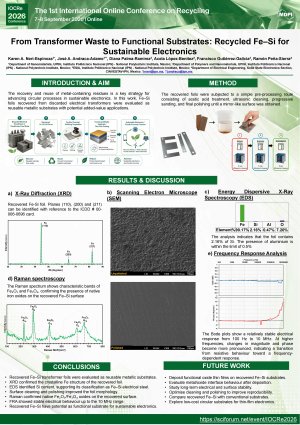
The recovery and reuse of metal-containing residues is a key strategy for advancing circular processes in sustainable electronics. In this work, Fe–Si foils recovered from discarded electrical transformers were evaluated as reusable metallic substrates with potential added-value applications. The recovered foils were subjected to a simple pre-processing route consisting of acetic acid treatment, ultrasonic cleaning, progressive sanding, and final polishing until a mirror-like surface was obtained. Structural and morphological characterization showed that the recovered material preserves the Fe crystalline structure, with the (110) identified by XRD, while SEM images revealed a clear transformation from a rough and oxidized surface to a smoother and more homogeneous finish after treatment. EDS analysis confirmed Fe as the main component, with approximately 2.16% Si, together with minor oxygen contributions associated with surface oxides. Electrical evaluation of the recovered foil showed a stable signal without significant losses from 100 Hz to 10 MHz, with a phase displacement appearing above 1 MHz, suggesting contributions from capacitive and inductive effects. These results demonstrate that transformer-derived Fe–Si residues can be upgraded through low-cost pre-processing into functional metallic substrates instead of being conventionally downcycled. The proposed approach supports circular recycling schemes by transforming electrical steel waste into reusable platforms for future conductive substrates, current collectors, shielding components, or frequency-responsive metallic supports in sustainable electronic systems.
Keywords
Fe-Si
E-waste
substrate
sustainable electronics
Poster
Poster.pdf
The Role of the Recycler (EoL) in the Battery Passport: what role recycling and processing facilities play in the DPP ecosystem, and what conditions must be met for the passport to genuinely support the circular economy and the recovery of critical raw materials.
From Additivity to Phase-Boundary Control in Lithium-Ion Battery Recycling: Implications for Selective Metal Recovery