Event submissions
Published
This submission belongs to the session S4. Metal, Battery, and E-Waste Recycling of the event The 1st International Online Conference on Recycling
Published date
02 Sep, 2026
Academic Editor
'%3e%3cpath%20d='M12.6657%2010.9104C12.4185%2010.325%2012.0599%209.79327%2011.6097%209.34482C11.1609%208.89508%2010.6293%208.5365%2010.0442%208.28888C10.0389%208.28626%2010.0337%208.28495%2010.0285%208.28233C10.8446%207.69279%2011.3752%206.73249%2011.3752%205.64904C11.3752%203.8542%209.92103%202.39999%208.1262%202.39999C6.33136%202.39999%204.87715%203.8542%204.87715%205.64904C4.87715%206.73249%205.40774%207.69279%206.22393%208.28364C6.21869%208.28626%206.21345%208.28757%206.20821%208.29019C5.62129%208.5378%205.09463%208.89284%204.64265%209.34613C4.1929%209.79493%203.83432%2010.3266%203.58671%2010.9117C3.34345%2011.4845%203.21226%2012.0987%203.20023%2012.7209C3.19988%2012.7349%203.20233%2012.7488%203.20744%2012.7619C3.21255%2012.7749%203.22022%2012.7867%203.22998%2012.7968C3.23975%2012.8068%203.25142%2012.8147%203.26431%2012.8202C3.2772%2012.8256%203.29105%2012.8284%203.30504%2012.8284H4.09109C4.14874%2012.8284%204.19459%2012.7825%204.1959%2012.7262C4.2221%2011.7148%204.62823%2010.7676%205.34617%2010.0497C6.08899%209.30683%207.0755%208.89808%208.1262%208.89808C9.17689%208.89808%2010.1634%209.30683%2010.9062%2010.0497C11.6242%2010.7676%2012.0303%2011.7148%2012.0565%2012.7262C12.0578%2012.7838%2012.1037%2012.8284%2012.1613%2012.8284H12.9474C12.9613%2012.8284%2012.9752%2012.8256%2012.9881%2012.8202C13.001%2012.8147%2013.0126%2012.8068%2013.0224%2012.7968C13.0322%2012.7867%2013.0398%2012.7749%2013.0449%2012.7619C13.0501%2012.7488%2013.0525%2012.7349%2013.0522%2012.7209C13.0391%2012.0947%2012.9094%2011.4855%2012.6657%2010.9104ZM8.1262%207.9024C7.52486%207.9024%206.9589%207.6679%206.53312%207.24211C6.10733%206.81633%205.87283%206.25037%205.87283%205.64904C5.87283%205.0477%206.10733%204.48174%206.53312%204.05596C6.9589%203.63018%207.52486%203.39567%208.1262%203.39567C8.72753%203.39567%209.29349%203.63018%209.71927%204.05596C10.1451%204.48174%2010.3796%205.0477%2010.3796%205.64904C10.3796%206.25037%2010.1451%206.81633%209.71927%207.24211C9.29349%207.6679%208.72753%207.9024%208.1262%207.9024Z'%20fill='%235D1EE1'/%3e%3c/g%3e%3c/svg%3e) Ana Paula Paiva
Ana Paula PaivaCitation
Igor Povar, Natalia Bolocan, Oxana Spinu, From Additivity to Phase-Boundary Control in Lithium-Ion Battery Recycling: Implications for Selective Metal Recovery, in Proceedings of The 1st International Online Conference on Recycling, 7 September–8 September 2026, MDPI: Basel, Switzerland
Share
Email
Facebook
Twitter
LinkedIn
From Additivity to Phase-Boundary Control in Lithium-Ion Battery Recycling: Implications for Selective Metal Recovery
'%3e%3cpath%20d='M12.6647%2010.9104C12.4176%2010.325%2012.0589%209.7933%2011.6088%209.34485C11.16%208.89511%2010.6283%208.53653%2010.0432%208.28891C10.038%208.28629%2010.0327%208.28498%2010.0275%208.28236C10.8437%207.69282%2011.3743%206.73252%2011.3743%205.64907C11.3743%203.85423%209.92005%202.40002%208.12522%202.40002C6.33038%202.40002%204.87618%203.85423%204.87618%205.64907C4.87618%206.73252%205.40677%207.69282%206.22296%208.28367C6.21772%208.28629%206.21248%208.2876%206.20724%208.29022C5.62031%208.53783%205.09365%208.89287%204.64167%209.34616C4.19192%209.79496%203.83334%2010.3266%203.58573%2010.9117C3.34247%2011.4846%203.21128%2012.0987%203.19925%2012.721C3.1989%2012.735%203.20135%2012.7489%203.20646%2012.7619C3.21157%2012.7749%203.21924%2012.7868%203.22901%2012.7968C3.23877%2012.8068%203.25045%2012.8148%203.26334%2012.8202C3.27623%2012.8256%203.29007%2012.8284%203.30406%2012.8284H4.09012C4.14776%2012.8284%204.19362%2012.7825%204.19493%2012.7262C4.22113%2011.7148%204.62726%2010.7676%205.34519%2010.0497C6.08802%209.30686%207.07452%208.89811%208.12522%208.89811C9.17592%208.89811%2010.1624%209.30686%2010.9052%2010.0497C11.6232%2010.7676%2012.0293%2011.7148%2012.0555%2012.7262C12.0568%2012.7839%2012.1027%2012.8284%2012.1603%2012.8284H12.9464C12.9604%2012.8284%2012.9742%2012.8256%2012.9871%2012.8202C13%2012.8148%2013.0117%2012.8068%2013.0214%2012.7968C13.0312%2012.7868%2013.0389%2012.7749%2013.044%2012.7619C13.0491%2012.7489%2013.0515%2012.735%2013.0512%2012.721C13.0381%2012.0947%2012.9084%2011.4856%2012.6647%2010.9104ZM8.12522%207.90243C7.52388%207.90243%206.95792%207.66793%206.53214%207.24215C6.10636%206.81636%205.87185%206.2504%205.87185%205.64907C5.87185%205.04773%206.10636%204.48177%206.53214%204.05599C6.95792%203.63021%207.52388%203.3957%208.12522%203.3957C8.72655%203.3957%209.29252%203.63021%209.7183%204.05599C10.1441%204.48177%2010.3786%205.04773%2010.3786%205.64907C10.3786%206.2504%2010.1441%206.81636%209.7183%207.24215C9.29252%207.66793%208.72655%207.90243%208.12522%207.90243Z'%20fill='%235D1EE1'/%3e%3c/g%3e%3c/svg%3e)
Igor Povar 1
Natalia Bolocan 1

Oxana Spinu 1
1. Institute of Chemistry, Moldova State University, Chisinau, MD2028, Republic of Moldova.
Abstract
Introduction:
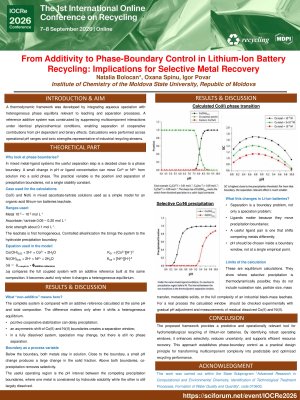
Hydrometallurgical recycling of lithium-ion batteries requires moving from additive descriptions to phase-boundary control of multicomponent aqueous systems in which metal ions, ligands, and competing species interact under tightly coupled conditions. Process design often relies on additive assumptions, although deviations from additivity frequently determine metal selectivity, recovery efficiency, and reagent use. A predictive description of these effects is essential for reliable and scalable recycling.
Methods:
A thermodynamic framework was developed by integrating aqueous speciation with heterogeneous phase equilibria relevant to leaching and separation processes. A reference additive system was constructed by suppressing multicomponent interactions under identical physicochemical conditions, enabling separation of cooperative contributions from pH dependent and binary effects. Calculations were performed across operational pH ranges and ionic strengths representative of industrial recycling streams.
Results:
The analysis shows that the transition from additive behavior to phase-boundary control governs precipitation, dissolution, and complexation processes in multicomponent recycling systems. These effects define narrow operational domains where small variations in composition lead to pronounced changes in metal recovery and selectivity. Additive models fail to capture these regimes, particularly near critical conditions relevant for separation of Co, Ni, and Mn. In contrast, the proposed framework identifies stability domains and enables reduction of co precipitation and improved selectivity under practically relevant conditions.
Conclusions:
The proposed framework provides a predictive and operationally relevant tool for hydrometallurgical recycling of lithium-ion batteries. By identifying robust operating windows, it enhances selectivity, reduces uncertainty, and supports efficient resource recovery. This approach establishes phase-boundary control as a practical design principle for transforming multicomponent complexity into predictable and optimized recycling performance.
Keywords
lithium ion battery recycling
hydrometallurgical processing
multicomponent aqueous systems
non additive effects
phase boundary control
selective metal recovery
cobalt nickel manganese separation
thermodynamic modeling
process optimization
circula
Poster
Poster_The 1rd International Online Conference on Recycling.pdf
From Transformer Waste to Functional Substrates: Recycled Fe–Si for Sustainable Electronics
Airforced Chlorination: A Smart Statistical Strategy for Near-Complete Nd/Pr Recovery from NdFeB Magnets