Event submissions
Published
This submission belongs to the session S4. Metal, Battery, and E-Waste Recycling of the event The 1st International Online Conference on Recycling
Published date
02 Sep, 2026
Academic Editor
'%3e%3cpath%20d='M12.6657%2010.9104C12.4185%2010.325%2012.0599%209.79327%2011.6097%209.34482C11.1609%208.89508%2010.6293%208.5365%2010.0442%208.28888C10.0389%208.28626%2010.0337%208.28495%2010.0285%208.28233C10.8446%207.69279%2011.3752%206.73249%2011.3752%205.64904C11.3752%203.8542%209.92103%202.39999%208.1262%202.39999C6.33136%202.39999%204.87715%203.8542%204.87715%205.64904C4.87715%206.73249%205.40774%207.69279%206.22393%208.28364C6.21869%208.28626%206.21345%208.28757%206.20821%208.29019C5.62129%208.5378%205.09463%208.89284%204.64265%209.34613C4.1929%209.79493%203.83432%2010.3266%203.58671%2010.9117C3.34345%2011.4845%203.21226%2012.0987%203.20023%2012.7209C3.19988%2012.7349%203.20233%2012.7488%203.20744%2012.7619C3.21255%2012.7749%203.22022%2012.7867%203.22998%2012.7968C3.23975%2012.8068%203.25142%2012.8147%203.26431%2012.8202C3.2772%2012.8256%203.29105%2012.8284%203.30504%2012.8284H4.09109C4.14874%2012.8284%204.19459%2012.7825%204.1959%2012.7262C4.2221%2011.7148%204.62823%2010.7676%205.34617%2010.0497C6.08899%209.30683%207.0755%208.89808%208.1262%208.89808C9.17689%208.89808%2010.1634%209.30683%2010.9062%2010.0497C11.6242%2010.7676%2012.0303%2011.7148%2012.0565%2012.7262C12.0578%2012.7838%2012.1037%2012.8284%2012.1613%2012.8284H12.9474C12.9613%2012.8284%2012.9752%2012.8256%2012.9881%2012.8202C13.001%2012.8147%2013.0126%2012.8068%2013.0224%2012.7968C13.0322%2012.7867%2013.0398%2012.7749%2013.0449%2012.7619C13.0501%2012.7488%2013.0525%2012.7349%2013.0522%2012.7209C13.0391%2012.0947%2012.9094%2011.4855%2012.6657%2010.9104ZM8.1262%207.9024C7.52486%207.9024%206.9589%207.6679%206.53312%207.24211C6.10733%206.81633%205.87283%206.25037%205.87283%205.64904C5.87283%205.0477%206.10733%204.48174%206.53312%204.05596C6.9589%203.63018%207.52486%203.39567%208.1262%203.39567C8.72753%203.39567%209.29349%203.63018%209.71927%204.05596C10.1451%204.48174%2010.3796%205.0477%2010.3796%205.64904C10.3796%206.25037%2010.1451%206.81633%209.71927%207.24211C9.29349%207.6679%208.72753%207.9024%208.1262%207.9024Z'%20fill='%235D1EE1'/%3e%3c/g%3e%3c/svg%3e) Ana Paula Paiva
Ana Paula PaivaCitation
Amir Nobahar, Flavia N. Braga, Rita M. Carvalho, Helena Passos, Filipe H. B. Sosa, Nicolas Schaeffer, João A. P. Coutinho, Disulfide-Containing Mesoporous Silica for Selective Palladium Recovery from Complex Chloride Media, in Proceedings of The 1st International Online Conference on Recycling, 7 September–8 September 2026, MDPI: Basel, Switzerland
Share
Email
Facebook
Twitter
LinkedIn
Disulfide-Containing Mesoporous Silica for Selective Palladium Recovery from Complex Chloride Media
'%3e%3cpath%20d='M12.6647%2010.9104C12.4176%2010.325%2012.0589%209.7933%2011.6088%209.34485C11.16%208.89511%2010.6283%208.53653%2010.0432%208.28891C10.038%208.28629%2010.0327%208.28498%2010.0275%208.28236C10.8437%207.69282%2011.3743%206.73252%2011.3743%205.64907C11.3743%203.85423%209.92005%202.40002%208.12522%202.40002C6.33038%202.40002%204.87618%203.85423%204.87618%205.64907C4.87618%206.73252%205.40677%207.69282%206.22296%208.28367C6.21772%208.28629%206.21248%208.2876%206.20724%208.29022C5.62031%208.53783%205.09365%208.89287%204.64167%209.34616C4.19192%209.79496%203.83334%2010.3266%203.58573%2010.9117C3.34247%2011.4846%203.21128%2012.0987%203.19925%2012.721C3.1989%2012.735%203.20135%2012.7489%203.20646%2012.7619C3.21157%2012.7749%203.21924%2012.7868%203.22901%2012.7968C3.23877%2012.8068%203.25045%2012.8148%203.26334%2012.8202C3.27623%2012.8256%203.29007%2012.8284%203.30406%2012.8284H4.09012C4.14776%2012.8284%204.19362%2012.7825%204.19493%2012.7262C4.22113%2011.7148%204.62726%2010.7676%205.34519%2010.0497C6.08802%209.30686%207.07452%208.89811%208.12522%208.89811C9.17592%208.89811%2010.1624%209.30686%2010.9052%2010.0497C11.6232%2010.7676%2012.0293%2011.7148%2012.0555%2012.7262C12.0568%2012.7839%2012.1027%2012.8284%2012.1603%2012.8284H12.9464C12.9604%2012.8284%2012.9742%2012.8256%2012.9871%2012.8202C13%2012.8148%2013.0117%2012.8068%2013.0214%2012.7968C13.0312%2012.7868%2013.0389%2012.7749%2013.044%2012.7619C13.0491%2012.7489%2013.0515%2012.735%2013.0512%2012.721C13.0381%2012.0947%2012.9084%2011.4856%2012.6647%2010.9104ZM8.12522%207.90243C7.52388%207.90243%206.95792%207.66793%206.53214%207.24215C6.10636%206.81636%205.87185%206.2504%205.87185%205.64907C5.87185%205.04773%206.10636%204.48177%206.53214%204.05599C6.95792%203.63021%207.52388%203.3957%208.12522%203.3957C8.72655%203.3957%209.29252%203.63021%209.7183%204.05599C10.1441%204.48177%2010.3786%205.04773%2010.3786%205.64907C10.3786%206.2504%2010.1441%206.81636%209.7183%207.24215C9.29252%207.66793%208.72655%207.90243%208.12522%207.90243Z'%20fill='%235D1EE1'/%3e%3c/g%3e%3c/svg%3e)
Amir Nobahar 1
Flavia N. Braga 1,2
Rita M. Carvalho 2,3
Helena Passos 2

Filipe H. B. Sosa 1

Nicolas Schaeffer 1
João A. P. Coutinho 1
1. CICECO–Aveiro Institute of Materials, Department of Chemistry, University of Aveiro, 3810–193 Aveiro, Portugal.
2. LSRE‒LCM, ALiCE, Faculty of Engineering, University of Porto, Rua Dr. Roberto Frias, 4200‒465 Porto, Portugal.
3. RYA - Purification Technologies, PCI - Creative Science Park, 3830-352 Ílhavo, Portugal
Abstract
Introduction
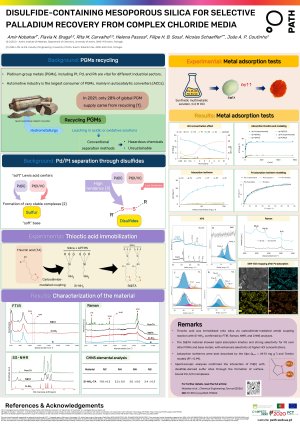
Selective Pd recovery from chloride-rich leachates remains challenging due to the chemical similarity and stable chloro-complexes of platinum group metals [1]. Conventional adsorbents often show limited selectivity or poor stability in concentrated HCl media. Therefore, selective acid-stable adsorbents are needed for efficient Pd recovery from spent automotive catalytic converters.
Methods
A thioctic acid-functionalized mesoporous silica (TA@Si) adsorbent was synthesized via silane-mediated covalent grafting, confirmed by spectroscopic analyzes. Its adsorption performance was evaluated using multi-metal batch experiments in HCl media (0.05–10 M), supported by kinetic, isotherm, and thermodynamic analyses. Binding mechanisms were investigated using Raman spectroscopy and SEM–EDS.
Results
TA@Si exhibited high selectivity toward Pd over PGMs and base metals across a wide acidity range, with a maximum adsorption capacity of 49.5±12.4 mg·g-1 at 0.2 M HCl. Adsorption followed pseudo-second-order kinetics and was best described by Sips and Temkin isotherm models, indicating heterogeneous chemisorption. Thermodynamic analysis confirmed an endothermic and entropy-driven process, with Pd adsorption remaining spontaneous under all studied conditions. Spectroscopic results revealed Pd immobilization via mixed Pd–S/Cl coordination without significant disulfide bond cleavage.
Conclusions
TA@Si represents a selective, acid-stable, and regenerable platform for Pd recovery from complex chloride leachates, offering strong potential for application in hydrometallurgical separation processes.
References
[1] H. Narita, R. Kasuya, T. Suzuki, R. Motokawa, M. Tanaka. In: Encyclopedia of Inorganic and Bioinorganic Chemistry, 2nd ed., Wiley, 2020, pp. 1–28.
Acknowledgements
This work was supported by FCT through the project PlatILPlus (2022.04478.PTDC, DOI: 10.54499/2022.04478.PTDC), LSRE-LCM (UID/50020/2025), ALiCE (LA/P/0045/2020, DOI: 10.54499/LA/P/0045/2020), and CICECO (UID/50011/2025, DOI: 10.54499/UID/50011/2025; LA/P/0006/2020, DOI: 10.54499/LA/P/0006/2020), financed through FCT/MCTES (PIDDAC). N. Schaeffer acknowledges ERC support through the DESignSX Starting Grant (Grant Agreement No. 101116461; DOI: 10.3030/101116461). F.H.B. Sosa, F. Braga, and R. Carvalho acknowledge FCT support through CEECIND/07209/2022 (DOI: 10.54499/2022.07209.CEECIND/CP1720/CT0019) and PhD grants 2023.01749.BD (DOI: 10.54499/2023.01749.BD) and 2025.06718.BDANA.
Keywords
Palladium Recovery
Selective Adsorption
Mesoporous Silica
Hydrometallurgy
Disulfide Chemistry
Poster
Poster_IOCRe_2026_Amir.pdf
Effect of Thermal Pretreatment on the Comminution and Fractional Distribution of Gold in Waste Printed Circuit Boards
Tuning Palladium and Platinum Leaching Selectivity in Aluminum-Based Salt Systems