Event submissions
Published
This submission belongs to the session S4. Metal, Battery, and E-Waste Recycling of the event The 1st International Online Conference on Recycling
Published date
02 Sep, 2026
Academic Editor
'%3e%3cpath%20d='M12.6657%2010.9104C12.4185%2010.325%2012.0599%209.79327%2011.6097%209.34482C11.1609%208.89508%2010.6293%208.5365%2010.0442%208.28888C10.0389%208.28626%2010.0337%208.28495%2010.0285%208.28233C10.8446%207.69279%2011.3752%206.73249%2011.3752%205.64904C11.3752%203.8542%209.92103%202.39999%208.1262%202.39999C6.33136%202.39999%204.87715%203.8542%204.87715%205.64904C4.87715%206.73249%205.40774%207.69279%206.22393%208.28364C6.21869%208.28626%206.21345%208.28757%206.20821%208.29019C5.62129%208.5378%205.09463%208.89284%204.64265%209.34613C4.1929%209.79493%203.83432%2010.3266%203.58671%2010.9117C3.34345%2011.4845%203.21226%2012.0987%203.20023%2012.7209C3.19988%2012.7349%203.20233%2012.7488%203.20744%2012.7619C3.21255%2012.7749%203.22022%2012.7867%203.22998%2012.7968C3.23975%2012.8068%203.25142%2012.8147%203.26431%2012.8202C3.2772%2012.8256%203.29105%2012.8284%203.30504%2012.8284H4.09109C4.14874%2012.8284%204.19459%2012.7825%204.1959%2012.7262C4.2221%2011.7148%204.62823%2010.7676%205.34617%2010.0497C6.08899%209.30683%207.0755%208.89808%208.1262%208.89808C9.17689%208.89808%2010.1634%209.30683%2010.9062%2010.0497C11.6242%2010.7676%2012.0303%2011.7148%2012.0565%2012.7262C12.0578%2012.7838%2012.1037%2012.8284%2012.1613%2012.8284H12.9474C12.9613%2012.8284%2012.9752%2012.8256%2012.9881%2012.8202C13.001%2012.8147%2013.0126%2012.8068%2013.0224%2012.7968C13.0322%2012.7867%2013.0398%2012.7749%2013.0449%2012.7619C13.0501%2012.7488%2013.0525%2012.7349%2013.0522%2012.7209C13.0391%2012.0947%2012.9094%2011.4855%2012.6657%2010.9104ZM8.1262%207.9024C7.52486%207.9024%206.9589%207.6679%206.53312%207.24211C6.10733%206.81633%205.87283%206.25037%205.87283%205.64904C5.87283%205.0477%206.10733%204.48174%206.53312%204.05596C6.9589%203.63018%207.52486%203.39567%208.1262%203.39567C8.72753%203.39567%209.29349%203.63018%209.71927%204.05596C10.1451%204.48174%2010.3796%205.0477%2010.3796%205.64904C10.3796%206.25037%2010.1451%206.81633%209.71927%207.24211C9.29349%207.6679%208.72753%207.9024%208.1262%207.9024Z'%20fill='%235D1EE1'/%3e%3c/g%3e%3c/svg%3e) Ana Paula Paiva
Ana Paula PaivaCitation
Diego Teuber Gijon, Amilton Barbosa Botelho Junior, Electrohydrometallurgy for recovery of critical metals in an age of green technologies, in Proceedings of The 1st International Online Conference on Recycling, 7 September–8 September 2026, MDPI: Basel, Switzerland
Share
Email
Facebook
Twitter
LinkedIn
Electrohydrometallurgy for recovery of critical metals in an age of green technologies
'%3e%3cpath%20d='M12.6647%2010.9104C12.4176%2010.325%2012.0589%209.7933%2011.6088%209.34485C11.16%208.89511%2010.6283%208.53653%2010.0432%208.28891C10.038%208.28629%2010.0327%208.28498%2010.0275%208.28236C10.8437%207.69282%2011.3743%206.73252%2011.3743%205.64907C11.3743%203.85423%209.92005%202.40002%208.12522%202.40002C6.33038%202.40002%204.87618%203.85423%204.87618%205.64907C4.87618%206.73252%205.40677%207.69282%206.22296%208.28367C6.21772%208.28629%206.21248%208.2876%206.20724%208.29022C5.62031%208.53783%205.09365%208.89287%204.64167%209.34616C4.19192%209.79496%203.83334%2010.3266%203.58573%2010.9117C3.34247%2011.4846%203.21128%2012.0987%203.19925%2012.721C3.1989%2012.735%203.20135%2012.7489%203.20646%2012.7619C3.21157%2012.7749%203.21924%2012.7868%203.22901%2012.7968C3.23877%2012.8068%203.25045%2012.8148%203.26334%2012.8202C3.27623%2012.8256%203.29007%2012.8284%203.30406%2012.8284H4.09012C4.14776%2012.8284%204.19362%2012.7825%204.19493%2012.7262C4.22113%2011.7148%204.62726%2010.7676%205.34519%2010.0497C6.08802%209.30686%207.07452%208.89811%208.12522%208.89811C9.17592%208.89811%2010.1624%209.30686%2010.9052%2010.0497C11.6232%2010.7676%2012.0293%2011.7148%2012.0555%2012.7262C12.0568%2012.7839%2012.1027%2012.8284%2012.1603%2012.8284H12.9464C12.9604%2012.8284%2012.9742%2012.8256%2012.9871%2012.8202C13%2012.8148%2013.0117%2012.8068%2013.0214%2012.7968C13.0312%2012.7868%2013.0389%2012.7749%2013.044%2012.7619C13.0491%2012.7489%2013.0515%2012.735%2013.0512%2012.721C13.0381%2012.0947%2012.9084%2011.4856%2012.6647%2010.9104ZM8.12522%207.90243C7.52388%207.90243%206.95792%207.66793%206.53214%207.24215C6.10636%206.81636%205.87185%206.2504%205.87185%205.64907C5.87185%205.04773%206.10636%204.48177%206.53214%204.05599C6.95792%203.63021%207.52388%203.3957%208.12522%203.3957C8.72655%203.3957%209.29252%203.63021%209.7183%204.05599C10.1441%204.48177%2010.3786%205.04773%2010.3786%205.64907C10.3786%206.2504%2010.1441%206.81636%209.7183%207.24215C9.29252%207.66793%208.72655%207.90243%208.12522%207.90243Z'%20fill='%235D1EE1'/%3e%3c/g%3e%3c/svg%3e)
Diego Teuber Gijon 1

Amilton Barbosa Botelho Junior 1
1. Department of Chemical Engineering, Norwegian University of Science and Technology (NTNU), 7091 Trondheim, Norway.
Abstract
Increasing demand of critical metals has been intensified by the expansion of green technologies, including batteries and renewable energy generation. However, traditional techniques often face high energy consumption, intense chemical consumption and environmental burdens. In our work, we demonstrate that electrochemical techniques in hydrometallurgical processes to obtain critical metals could address these issues towards circular economy.
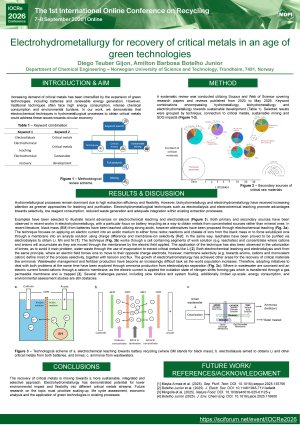
In electrohydrometallurgy process, electrochemical leaching is capable of agent regeneration and reducing/oxidizing generation. Supported liquid membranes integrates solvent extraction and membrane techniques for selective separation of metallic ions with less amount of solvents. In electrodialysis, membrane-based separation can separate cations and anions and also based on valency (monovalent/divalent). Separation of Li from brine by electrodialysis has close-to-zero water losses and high separation efficiency over divalent ions (Mg and Ca). The cell contains four chambers separated by anionic and monovalent selective membranes, and salts (chloride) were used to simulate the brine. Similar reactor was designed for application in LFP battery recycling for selective separation of Li.
Hydrometallurgical processes remain dominant due to high extraction efficiency and flexibility. However, biohydrometallurgy and electrohydrometallurgy have received increasing attention as greener approaches for leaching and purification. Electrohydrometallurgical techniques such as electrodialysis promote advantages towards selectivity, low reagent consumption, reduced waste generation, and adequate integration within existing extraction processes. Several challenges persist, including slow kinetics and system fouling, additionally limited up-scale, energy consumption, and environmental assessment studies are still obstacles.
The recovery of critical metals is moving towards a more sustainable, integrated and selective approach. Electrohydrometallurgy has demonstrated potential for lower environmental impact and flexibility into different critical metals streams. Future research on the topic must prioritize scaling-up, life cycle assessment, economic analysis and the application of green technologies in existing processes.
Keywords
hydrometallurgy
electrodialysis
critical minerals
electrochemical leaching
Poster
29.08.26 - IOCR poster v2.pdf
Sustainable Recovery of Critical Metals from Waste Lithium-Ion Batteries through Bio-electrochemical System
Electric Arc Furnace Dust as an Alternative Reactive Iron Source in Pyrometallurgical Processes for Lead–Acid Battery Recycling