Event submissions
Published
This submission belongs to the session S4. Metal, Battery, and E-Waste Recycling of the event The 1st International Online Conference on Recycling
Published date
02 Sep, 2026
Academic Editor
'%3e%3cpath%20d='M12.6657%2010.9104C12.4185%2010.325%2012.0599%209.79327%2011.6097%209.34482C11.1609%208.89508%2010.6293%208.5365%2010.0442%208.28888C10.0389%208.28626%2010.0337%208.28495%2010.0285%208.28233C10.8446%207.69279%2011.3752%206.73249%2011.3752%205.64904C11.3752%203.8542%209.92103%202.39999%208.1262%202.39999C6.33136%202.39999%204.87715%203.8542%204.87715%205.64904C4.87715%206.73249%205.40774%207.69279%206.22393%208.28364C6.21869%208.28626%206.21345%208.28757%206.20821%208.29019C5.62129%208.5378%205.09463%208.89284%204.64265%209.34613C4.1929%209.79493%203.83432%2010.3266%203.58671%2010.9117C3.34345%2011.4845%203.21226%2012.0987%203.20023%2012.7209C3.19988%2012.7349%203.20233%2012.7488%203.20744%2012.7619C3.21255%2012.7749%203.22022%2012.7867%203.22998%2012.7968C3.23975%2012.8068%203.25142%2012.8147%203.26431%2012.8202C3.2772%2012.8256%203.29105%2012.8284%203.30504%2012.8284H4.09109C4.14874%2012.8284%204.19459%2012.7825%204.1959%2012.7262C4.2221%2011.7148%204.62823%2010.7676%205.34617%2010.0497C6.08899%209.30683%207.0755%208.89808%208.1262%208.89808C9.17689%208.89808%2010.1634%209.30683%2010.9062%2010.0497C11.6242%2010.7676%2012.0303%2011.7148%2012.0565%2012.7262C12.0578%2012.7838%2012.1037%2012.8284%2012.1613%2012.8284H12.9474C12.9613%2012.8284%2012.9752%2012.8256%2012.9881%2012.8202C13.001%2012.8147%2013.0126%2012.8068%2013.0224%2012.7968C13.0322%2012.7867%2013.0398%2012.7749%2013.0449%2012.7619C13.0501%2012.7488%2013.0525%2012.7349%2013.0522%2012.7209C13.0391%2012.0947%2012.9094%2011.4855%2012.6657%2010.9104ZM8.1262%207.9024C7.52486%207.9024%206.9589%207.6679%206.53312%207.24211C6.10733%206.81633%205.87283%206.25037%205.87283%205.64904C5.87283%205.0477%206.10733%204.48174%206.53312%204.05596C6.9589%203.63018%207.52486%203.39567%208.1262%203.39567C8.72753%203.39567%209.29349%203.63018%209.71927%204.05596C10.1451%204.48174%2010.3796%205.0477%2010.3796%205.64904C10.3796%206.25037%2010.1451%206.81633%209.71927%207.24211C9.29349%207.6679%208.72753%207.9024%208.1262%207.9024Z'%20fill='%235D1EE1'/%3e%3c/g%3e%3c/svg%3e) Ana Paula Paiva
Ana Paula PaivaCitation
Leonardo Henrique Gomes, Haroldo de Araújo Ponte, Henrique de Santana, Wagner Viana Bielefeldt, Sílvia Cardinal Pinho, Maria José Jerônimo de Santana Ponte, Electric Arc Furnace Dust as an Alternative Reactive Iron Source in Pyrometallurgical Processes for Lead–Acid Battery Recycling, in Proceedings of The 1st International Online Conference on Recycling, 7 September–8 September 2026, MDPI: Basel, Switzerland
Share
Email
Facebook
Twitter
LinkedIn
Electric Arc Furnace Dust as an Alternative Reactive Iron Source in Pyrometallurgical Processes for Lead–Acid Battery Recycling
'%3e%3cpath%20d='M12.6647%2010.9104C12.4176%2010.325%2012.0589%209.7933%2011.6088%209.34485C11.16%208.89511%2010.6283%208.53653%2010.0432%208.28891C10.038%208.28629%2010.0327%208.28498%2010.0275%208.28236C10.8437%207.69282%2011.3743%206.73252%2011.3743%205.64907C11.3743%203.85423%209.92005%202.40002%208.12522%202.40002C6.33038%202.40002%204.87618%203.85423%204.87618%205.64907C4.87618%206.73252%205.40677%207.69282%206.22296%208.28367C6.21772%208.28629%206.21248%208.2876%206.20724%208.29022C5.62031%208.53783%205.09365%208.89287%204.64167%209.34616C4.19192%209.79496%203.83334%2010.3266%203.58573%2010.9117C3.34247%2011.4846%203.21128%2012.0987%203.19925%2012.721C3.1989%2012.735%203.20135%2012.7489%203.20646%2012.7619C3.21157%2012.7749%203.21924%2012.7868%203.22901%2012.7968C3.23877%2012.8068%203.25045%2012.8148%203.26334%2012.8202C3.27623%2012.8256%203.29007%2012.8284%203.30406%2012.8284H4.09012C4.14776%2012.8284%204.19362%2012.7825%204.19493%2012.7262C4.22113%2011.7148%204.62726%2010.7676%205.34519%2010.0497C6.08802%209.30686%207.07452%208.89811%208.12522%208.89811C9.17592%208.89811%2010.1624%209.30686%2010.9052%2010.0497C11.6232%2010.7676%2012.0293%2011.7148%2012.0555%2012.7262C12.0568%2012.7839%2012.1027%2012.8284%2012.1603%2012.8284H12.9464C12.9604%2012.8284%2012.9742%2012.8256%2012.9871%2012.8202C13%2012.8148%2013.0117%2012.8068%2013.0214%2012.7968C13.0312%2012.7868%2013.0389%2012.7749%2013.044%2012.7619C13.0491%2012.7489%2013.0515%2012.735%2013.0512%2012.721C13.0381%2012.0947%2012.9084%2011.4856%2012.6647%2010.9104ZM8.12522%207.90243C7.52388%207.90243%206.95792%207.66793%206.53214%207.24215C6.10636%206.81636%205.87185%206.2504%205.87185%205.64907C5.87185%205.04773%206.10636%204.48177%206.53214%204.05599C6.95792%203.63021%207.52388%203.3957%208.12522%203.3957C8.72655%203.3957%209.29252%203.63021%209.7183%204.05599C10.1441%204.48177%2010.3786%205.04773%2010.3786%205.64907C10.3786%206.2504%2010.1441%206.81636%209.7183%207.24215C9.29252%207.66793%208.72655%207.90243%208.12522%207.90243Z'%20fill='%235D1EE1'/%3e%3c/g%3e%3c/svg%3e)
Leonardo Henrique Gomes 1
Haroldo de Araújo Ponte 1
Henrique de Santana 2
Wagner Viana Bielefeldt 3
Sílvia Cardinal Pinho 4
Maria José Jerônimo de Santana Ponte 1
1. Department of Mechanical Engineering, Environmental Technology Laboratory, Federal University of Paraná (UFPR), Curitiba, Paraná, Brazil
2. Department of Chemistry, State University of Londrina (UEL), Londrina, Paraná, Brazil
3. Department of Metallurgical Engineering, Federal University of Rio Grande do Sul (UFRGS), Porto Alegre, Rio Grande do Sul, Brazil
4. Laboratory for Process Engineering, Environment, Biotechnology and Energy (LEPABE), Faculty of Engineering, University of Porto (FEUP), Porto, Portugal
Abstract
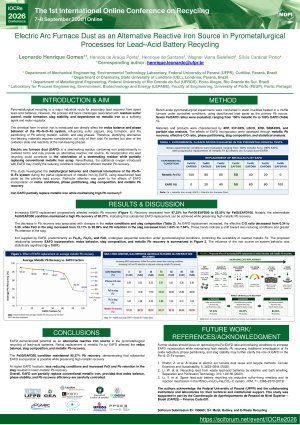
Pyrometallurgical recycling of lead–acid batteries is one of the main industrial routes for secondary lead recovery; however, it still faces challenges related to residual sulfur control, matte formation, slag stability, and dependence on metallic iron as a sulfiding agent and redox regulator. In this context, electric arc furnace dust (EAFD), a steelmaking residue rich in iron oxides, emerges as a potential alternative for partially replacing conventional metallic iron scrap. This study investigated the metallurgical behavior and chemical interactions of the Pb–S–O–Fe system during partial replacement of metallic iron scrap by EAFD, using previously desulfurized lead paste as the primary lead source. Bench-scale pyrometallurgical experiments were conducted in static crucibles heated in a muffle furnace under controlled conditions. Seven Fe/EAFD ratios were evaluated to assess the effect of oxidized iron on system behavior. Material and product characterization was performed using X-ray fluorescence (XRF), ICP-OES, combustion elemental analysis (LECO), X-ray diffraction (XRD), scanning electron microscopy coupled with energy-dispersive spectroscopy (SEM-EDS), and particle size analysis. Metallic lead recovery, effective C/O ratio, phase partitioning, and slag composition were also evaluated. Results showed that iron introduced via EAFD, predominantly as Fe₂O₃, Fe₃O₄, and FeO, underwent sequential reduction under pyrometallurgical conditions, controlling the temporal availability of reactive metallic iron. Average lead recovery decreased from 97.33% (Fe100/EAFD00) to 83.55% (Fe00/EAFD100), accompanied by an increase in slag FeO content from 12.11% to 28.09% and Pb retention in slag from 1.64% to 7.64%. The effective C/O ratio decreased from 0.34 to 0.30, indicating a shift toward less reducing conditions. Under intermediate replacement conditions (Fe50/EAFD50), 95.27% Pb recovery was maintained. Statistical analysis confirmed a significant influence of the iron source on system behavior (p < 0.001). Overall, EAFD demonstrated potential as an alternative reactive iron source in pyrometallurgical lead–acid battery recycling, provided its effects on redox balance, phase stability, and metallic recovery efficiency are considered.
Keywords
lead–acid battery recycling
pyrometallurgical processing
electric arc furnace dust (EAFD)
Pb–S–O–Fe system
redox behavior
lead recovery.
Poster
ID190660_LHG.pdf
Electrohydrometallurgy for recovery of critical metals in an age of green technologies
Adaptive Reuse as a Strategy for Demolition-Waste Reduction in European Post-Industrial Regeneration