Event submissions
Published
This submission belongs to the session S5. Challenges and Opportunities in Construction and Demolition Waste of the event The 1st International Online Conference on Recycling
Published date
02 Sep, 2026
Academic Editor
'%3e%3cpath%20d='M12.6657%2010.9104C12.4185%2010.325%2012.0599%209.79327%2011.6097%209.34482C11.1609%208.89508%2010.6293%208.5365%2010.0442%208.28888C10.0389%208.28626%2010.0337%208.28495%2010.0285%208.28233C10.8446%207.69279%2011.3752%206.73249%2011.3752%205.64904C11.3752%203.8542%209.92103%202.39999%208.1262%202.39999C6.33136%202.39999%204.87715%203.8542%204.87715%205.64904C4.87715%206.73249%205.40774%207.69279%206.22393%208.28364C6.21869%208.28626%206.21345%208.28757%206.20821%208.29019C5.62129%208.5378%205.09463%208.89284%204.64265%209.34613C4.1929%209.79493%203.83432%2010.3266%203.58671%2010.9117C3.34345%2011.4845%203.21226%2012.0987%203.20023%2012.7209C3.19988%2012.7349%203.20233%2012.7488%203.20744%2012.7619C3.21255%2012.7749%203.22022%2012.7867%203.22998%2012.7968C3.23975%2012.8068%203.25142%2012.8147%203.26431%2012.8202C3.2772%2012.8256%203.29105%2012.8284%203.30504%2012.8284H4.09109C4.14874%2012.8284%204.19459%2012.7825%204.1959%2012.7262C4.2221%2011.7148%204.62823%2010.7676%205.34617%2010.0497C6.08899%209.30683%207.0755%208.89808%208.1262%208.89808C9.17689%208.89808%2010.1634%209.30683%2010.9062%2010.0497C11.6242%2010.7676%2012.0303%2011.7148%2012.0565%2012.7262C12.0578%2012.7838%2012.1037%2012.8284%2012.1613%2012.8284H12.9474C12.9613%2012.8284%2012.9752%2012.8256%2012.9881%2012.8202C13.001%2012.8147%2013.0126%2012.8068%2013.0224%2012.7968C13.0322%2012.7867%2013.0398%2012.7749%2013.0449%2012.7619C13.0501%2012.7488%2013.0525%2012.7349%2013.0522%2012.7209C13.0391%2012.0947%2012.9094%2011.4855%2012.6657%2010.9104ZM8.1262%207.9024C7.52486%207.9024%206.9589%207.6679%206.53312%207.24211C6.10733%206.81633%205.87283%206.25037%205.87283%205.64904C5.87283%205.0477%206.10733%204.48174%206.53312%204.05596C6.9589%203.63018%207.52486%203.39567%208.1262%203.39567C8.72753%203.39567%209.29349%203.63018%209.71927%204.05596C10.1451%204.48174%2010.3796%205.0477%2010.3796%205.64904C10.3796%206.25037%2010.1451%206.81633%209.71927%207.24211C9.29349%207.6679%208.72753%207.9024%208.1262%207.9024Z'%20fill='%235D1EE1'/%3e%3c/g%3e%3c/svg%3e) Reyes Garcia
Reyes GarciaCitation
Luigi Morgillo, Antonio Bonati, Antonio Occhiuzzi, Claudio Ferone, Giuseppina De Luca, From Waste to High-Performance Low-Carbon Binders: Opportunities Offered by Slag–Limestone Ternary Cements for Circular Construction, in Proceedings of The 1st International Online Conference on Recycling, 7 September–8 September 2026, MDPI: Basel, Switzerland
Share
Email
Facebook
Twitter
LinkedIn
From Waste to High-Performance Low-Carbon Binders: Opportunities Offered by Slag–Limestone Ternary Cements for Circular Construction
'%3e%3cpath%20d='M12.6647%2010.9104C12.4176%2010.325%2012.0589%209.7933%2011.6088%209.34485C11.16%208.89511%2010.6283%208.53653%2010.0432%208.28891C10.038%208.28629%2010.0327%208.28498%2010.0275%208.28236C10.8437%207.69282%2011.3743%206.73252%2011.3743%205.64907C11.3743%203.85423%209.92005%202.40002%208.12522%202.40002C6.33038%202.40002%204.87618%203.85423%204.87618%205.64907C4.87618%206.73252%205.40677%207.69282%206.22296%208.28367C6.21772%208.28629%206.21248%208.2876%206.20724%208.29022C5.62031%208.53783%205.09365%208.89287%204.64167%209.34616C4.19192%209.79496%203.83334%2010.3266%203.58573%2010.9117C3.34247%2011.4846%203.21128%2012.0987%203.19925%2012.721C3.1989%2012.735%203.20135%2012.7489%203.20646%2012.7619C3.21157%2012.7749%203.21924%2012.7868%203.22901%2012.7968C3.23877%2012.8068%203.25045%2012.8148%203.26334%2012.8202C3.27623%2012.8256%203.29007%2012.8284%203.30406%2012.8284H4.09012C4.14776%2012.8284%204.19362%2012.7825%204.19493%2012.7262C4.22113%2011.7148%204.62726%2010.7676%205.34519%2010.0497C6.08802%209.30686%207.07452%208.89811%208.12522%208.89811C9.17592%208.89811%2010.1624%209.30686%2010.9052%2010.0497C11.6232%2010.7676%2012.0293%2011.7148%2012.0555%2012.7262C12.0568%2012.7839%2012.1027%2012.8284%2012.1603%2012.8284H12.9464C12.9604%2012.8284%2012.9742%2012.8256%2012.9871%2012.8202C13%2012.8148%2013.0117%2012.8068%2013.0214%2012.7968C13.0312%2012.7868%2013.0389%2012.7749%2013.044%2012.7619C13.0491%2012.7489%2013.0515%2012.735%2013.0512%2012.721C13.0381%2012.0947%2012.9084%2011.4856%2012.6647%2010.9104ZM8.12522%207.90243C7.52388%207.90243%206.95792%207.66793%206.53214%207.24215C6.10636%206.81636%205.87185%206.2504%205.87185%205.64907C5.87185%205.04773%206.10636%204.48177%206.53214%204.05599C6.95792%203.63021%207.52388%203.3957%208.12522%203.3957C8.72655%203.3957%209.29252%203.63021%209.7183%204.05599C10.1441%204.48177%2010.3786%205.04773%2010.3786%205.64907C10.3786%206.2504%2010.1441%206.81636%209.7183%207.24215C9.29252%207.66793%208.72655%207.90243%208.12522%207.90243Z'%20fill='%235D1EE1'/%3e%3c/g%3e%3c/svg%3e)
Luigi Morgillo 1,2
Antonio Bonati 2
Antonio Occhiuzzi 1,2

Claudio Ferone 1,2
Giuseppina De Luca 2
1. Department of Engineering, University of Naples Parthenope, Naples 80143, Italy
2. Institute for Construction Technologies (ITC-CNR), San Giuliano Milanese 20098, Italy
Abstract
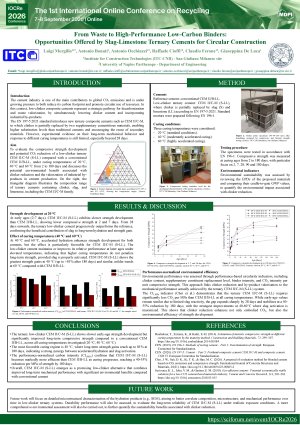
The cement industry is one of the main contributors to global CO₂ emissions and is therefore under increasing pressure to reduce CO₂ emissions and to promote the circular use of resources. In this context, the development of low-clinker composite cements represents a strategic pathway toward both decarbonization and waste valorisation.
The introduction of new composite cement types under EN 197-5:2021 opens new opportunities for the use of supplementary cementitious materials and industrial by-products in cement production. Composite cements, such as CEM II/C‑M, in which part of the clinker is replaced by two supplementary cementitious materials, promote the reuse of secondary materials, thus limiting landfill disposal and reducing the consumption of virgin raw materials compared to traditional cements. Despite their sustainability potential, experimental evidence regarding their long-term mechanical behavior and performance under different curing conditions remains limited. This laboratory-based experimental study evaluates the compressive strength on standard mortars (EN 196-1) made up by such cement at curing ages from 2 to 180 days under three curing temperatures: 20°C, 40°C, and 60°C.
The results show that CEM II/C‑M(S‑LL) exhibits slower early-age strength development but significantly improved long-term performance compared to traditional cement. Specimens cured at 20°C showed lower early-age compressive strength than the reference cement but progressively outperformed it at later ages. Similar trends were observed at elevated curing temperatures (40°C and 60°C), where accelerated hydration further enhanced long-term performance. The highest gains were observed under 40°C curing conditions, with increases reaching up to 81% after 180 days. Furthermore, clinker reduction of 23,7% resulted in an estimated decrease of 22% CO₂ emissions, while incorporating approximately 240 kg/t of industrial by-products, contributing to waste valorisation.
In conclusion, the CEM II/C-M(S-LL) not only reduced the CO2 emission and promoted the use of secondary materials, but also exhibited superior mechanical performance compared with conventional cement.
Keywords
low-clinker cements
ternary cement
slag valorization
Industrial by-products
sustainability construction
circular economy.
Poster
From Waste to High-Performance Low-Carbon Binders.pdf
Recycled Concrete Aggregate (RCA)-based Asphalt Trackbeds: Structural Design and Environmental Impact Assessment
Artificial Intelligence-Enabled Material Passports for Construction Waste Traceability: A Systematic Review