Event submissions
Published
This submission belongs to the session S1. One Health Approaches to Emerging Zoonotic Threats of the event The 2nd International Online Conference on Veterinary Sciences
Published date
02 Sep, 2026
Academic Editor
'%3e%3cpath%20d='M12.6657%2010.9104C12.4185%2010.325%2012.0599%209.79327%2011.6097%209.34482C11.1609%208.89508%2010.6293%208.5365%2010.0442%208.28888C10.0389%208.28626%2010.0337%208.28495%2010.0285%208.28233C10.8446%207.69279%2011.3752%206.73249%2011.3752%205.64904C11.3752%203.8542%209.92103%202.39999%208.1262%202.39999C6.33136%202.39999%204.87715%203.8542%204.87715%205.64904C4.87715%206.73249%205.40774%207.69279%206.22393%208.28364C6.21869%208.28626%206.21345%208.28757%206.20821%208.29019C5.62129%208.5378%205.09463%208.89284%204.64265%209.34613C4.1929%209.79493%203.83432%2010.3266%203.58671%2010.9117C3.34345%2011.4845%203.21226%2012.0987%203.20023%2012.7209C3.19988%2012.7349%203.20233%2012.7488%203.20744%2012.7619C3.21255%2012.7749%203.22022%2012.7867%203.22998%2012.7968C3.23975%2012.8068%203.25142%2012.8147%203.26431%2012.8202C3.2772%2012.8256%203.29105%2012.8284%203.30504%2012.8284H4.09109C4.14874%2012.8284%204.19459%2012.7825%204.1959%2012.7262C4.2221%2011.7148%204.62823%2010.7676%205.34617%2010.0497C6.08899%209.30683%207.0755%208.89808%208.1262%208.89808C9.17689%208.89808%2010.1634%209.30683%2010.9062%2010.0497C11.6242%2010.7676%2012.0303%2011.7148%2012.0565%2012.7262C12.0578%2012.7838%2012.1037%2012.8284%2012.1613%2012.8284H12.9474C12.9613%2012.8284%2012.9752%2012.8256%2012.9881%2012.8202C13.001%2012.8147%2013.0126%2012.8068%2013.0224%2012.7968C13.0322%2012.7867%2013.0398%2012.7749%2013.0449%2012.7619C13.0501%2012.7488%2013.0525%2012.7349%2013.0522%2012.7209C13.0391%2012.0947%2012.9094%2011.4855%2012.6657%2010.9104ZM8.1262%207.9024C7.52486%207.9024%206.9589%207.6679%206.53312%207.24211C6.10733%206.81633%205.87283%206.25037%205.87283%205.64904C5.87283%205.0477%206.10733%204.48174%206.53312%204.05596C6.9589%203.63018%207.52486%203.39567%208.1262%203.39567C8.72753%203.39567%209.29349%203.63018%209.71927%204.05596C10.1451%204.48174%2010.3796%205.0477%2010.3796%205.64904C10.3796%206.25037%2010.1451%206.81633%209.71927%207.24211C9.29349%207.6679%208.72753%207.9024%208.1262%207.9024Z'%20fill='%235D1EE1'/%3e%3c/g%3e%3c/svg%3e) Vittorio Sarchese
Vittorio SarcheseCitation
Haniyeh Amirinezhad, Sina Rouzmehr, Arya Heidari, Marziyeh Saki, Farshad Shahkhah, Toxoplasma gondii in Feline Populations: A Systematic Review of Hematological and Biochemical Markers with a One Health Perspective on Zoonotic Risk Assessment, in Proceedings of The 2nd International Online Conference on Veterinary Sciences, 7 September–9 September 2026, MDPI: Basel, Switzerland
Share
Email
Facebook
Twitter
LinkedIn
Toxoplasma gondii in Feline Populations: A Systematic Review of Hematological and Biochemical Markers with a One Health Perspective on Zoonotic Risk Assessment
'%3e%3cpath%20d='M12.6647%2010.9104C12.4176%2010.325%2012.0589%209.7933%2011.6088%209.34485C11.16%208.89511%2010.6283%208.53653%2010.0432%208.28891C10.038%208.28629%2010.0327%208.28498%2010.0275%208.28236C10.8437%207.69282%2011.3743%206.73252%2011.3743%205.64907C11.3743%203.85423%209.92005%202.40002%208.12522%202.40002C6.33038%202.40002%204.87618%203.85423%204.87618%205.64907C4.87618%206.73252%205.40677%207.69282%206.22296%208.28367C6.21772%208.28629%206.21248%208.2876%206.20724%208.29022C5.62031%208.53783%205.09365%208.89287%204.64167%209.34616C4.19192%209.79496%203.83334%2010.3266%203.58573%2010.9117C3.34247%2011.4846%203.21128%2012.0987%203.19925%2012.721C3.1989%2012.735%203.20135%2012.7489%203.20646%2012.7619C3.21157%2012.7749%203.21924%2012.7868%203.22901%2012.7968C3.23877%2012.8068%203.25045%2012.8148%203.26334%2012.8202C3.27623%2012.8256%203.29007%2012.8284%203.30406%2012.8284H4.09012C4.14776%2012.8284%204.19362%2012.7825%204.19493%2012.7262C4.22113%2011.7148%204.62726%2010.7676%205.34519%2010.0497C6.08802%209.30686%207.07452%208.89811%208.12522%208.89811C9.17592%208.89811%2010.1624%209.30686%2010.9052%2010.0497C11.6232%2010.7676%2012.0293%2011.7148%2012.0555%2012.7262C12.0568%2012.7839%2012.1027%2012.8284%2012.1603%2012.8284H12.9464C12.9604%2012.8284%2012.9742%2012.8256%2012.9871%2012.8202C13%2012.8148%2013.0117%2012.8068%2013.0214%2012.7968C13.0312%2012.7868%2013.0389%2012.7749%2013.044%2012.7619C13.0491%2012.7489%2013.0515%2012.735%2013.0512%2012.721C13.0381%2012.0947%2012.9084%2011.4856%2012.6647%2010.9104ZM8.12522%207.90243C7.52388%207.90243%206.95792%207.66793%206.53214%207.24215C6.10636%206.81636%205.87185%206.2504%205.87185%205.64907C5.87185%205.04773%206.10636%204.48177%206.53214%204.05599C6.95792%203.63021%207.52388%203.3957%208.12522%203.3957C8.72655%203.3957%209.29252%203.63021%209.7183%204.05599C10.1441%204.48177%2010.3786%205.04773%2010.3786%205.64907C10.3786%206.2504%2010.1441%206.81636%209.7183%207.24215C9.29252%207.66793%208.72655%207.90243%208.12522%207.90243Z'%20fill='%235D1EE1'/%3e%3c/g%3e%3c/svg%3e)
Haniyeh Amirinezhad 1
Sina Rouzmehr 2
Arya Heidari 2
Marziyeh Saki 3
Farshad Shahkhah 4
1. Department of Clinical Sciences, Faculty of Veterinary Medicine, Baft Branch, Islamic Azad University, Baft, Iran
2. Department of Clinical Sciences, Faculty of Veterinary Medicine, Islamic Azad University of Shoushtar, Shoushtar, Iran
3. Department of Clinical Sciences, Islamic Azad University of Shoushtar, Shoushtar, Iran
4. Department of Clinical Pathology, Faculty of Veterinary Medicine, Shahid Chamran University, Ahvaz, Iran
Abstract
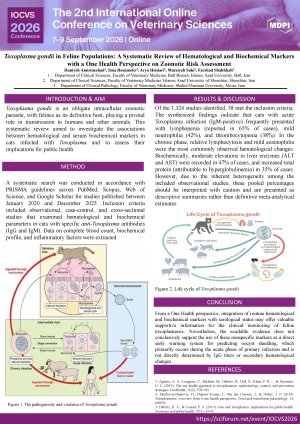
Introduction: Toxoplasma gondii is an obligate intracellular zoonotic parasite, with felines as its definitive host, playing a pivotal role in transmission to humans and other animals. This systematic review aimed to investigate the associations between hematological and serum biochemical markers in cats infected with Toxoplasma and to assess their implications for public health.
Methods: A systematic search was conducted in accordance with PRISMA guidelines across PubMed, Scopus, Web of Science, and Google Scholar for studies published between January 2020 and December 2025. Inclusion criteria included observational, case-control, and cross-sectional studies that examined hematological and biochemical parameters in cats with specific anti-Toxoplasma antibodies (IgG and IgM). Data on complete blood count, biochemical profile, and inflammatory factors were extracted.
Results: Of the 1,324 studies identified, 38 met the inclusion criteria. The synthesized findings indicate that cats with acute Toxoplasma infection (IgM-positive) frequently presented with lymphopenia (reported in 65% of cases), mild neutrophilia (42%), and thrombocytopenia (38%). In the chronic phase, relative lymphocytosis and mild eosinophilia were the most commonly observed hematological changes. Biochemically, moderate elevations in liver enzymes (ALT and AST) were recorded in 47% of cases, and increased total protein (attributable to hyperglobulinemia) in 35% of cases. However, due to the inherent heterogeneity among the included observational studies, these pooled percentages should be interpreted with caution and are presented as descriptive summaries rather than definitive meta-analytical estimates.
Conclusion: From a One Health perspective, integration of routine hematological and biochemical markers with serological status may offer valuable supportive information for the clinical monitoring of feline toxoplasmosis. Nevertheless, the available evidence does not conclusively support the use of these nonspecific markers as a direct early warning system for predicting oocyst shedding, which primarily occurs during the acute phase of primary infection and is not directly determined by IgG titers or secondary hematological changes.
Keywords
Toxoplasma gondii
Feline
Hematological markers
Biochemical markers
One Health
Poster
Poster.pdf
The One Health role of interplay between canine parvovirus and Gram-negative bacterial translocation in sepsis and multi-organ failure in dogs
One Health Pharmacotherapy of Zoonotic Giardiasis in Dogs and Cats: A Systematic Review