Event submissions
Published
This submission belongs to the session S2. Surveillance and Epidemiological Modelling at the Human–Animal–Environment Interface of the event The 2nd International Online Conference on Veterinary Sciences
Published date
02 Sep, 2026
Academic Editor
'%3e%3cpath%20d='M12.6657%2010.9104C12.4185%2010.325%2012.0599%209.79327%2011.6097%209.34482C11.1609%208.89508%2010.6293%208.5365%2010.0442%208.28888C10.0389%208.28626%2010.0337%208.28495%2010.0285%208.28233C10.8446%207.69279%2011.3752%206.73249%2011.3752%205.64904C11.3752%203.8542%209.92103%202.39999%208.1262%202.39999C6.33136%202.39999%204.87715%203.8542%204.87715%205.64904C4.87715%206.73249%205.40774%207.69279%206.22393%208.28364C6.21869%208.28626%206.21345%208.28757%206.20821%208.29019C5.62129%208.5378%205.09463%208.89284%204.64265%209.34613C4.1929%209.79493%203.83432%2010.3266%203.58671%2010.9117C3.34345%2011.4845%203.21226%2012.0987%203.20023%2012.7209C3.19988%2012.7349%203.20233%2012.7488%203.20744%2012.7619C3.21255%2012.7749%203.22022%2012.7867%203.22998%2012.7968C3.23975%2012.8068%203.25142%2012.8147%203.26431%2012.8202C3.2772%2012.8256%203.29105%2012.8284%203.30504%2012.8284H4.09109C4.14874%2012.8284%204.19459%2012.7825%204.1959%2012.7262C4.2221%2011.7148%204.62823%2010.7676%205.34617%2010.0497C6.08899%209.30683%207.0755%208.89808%208.1262%208.89808C9.17689%208.89808%2010.1634%209.30683%2010.9062%2010.0497C11.6242%2010.7676%2012.0303%2011.7148%2012.0565%2012.7262C12.0578%2012.7838%2012.1037%2012.8284%2012.1613%2012.8284H12.9474C12.9613%2012.8284%2012.9752%2012.8256%2012.9881%2012.8202C13.001%2012.8147%2013.0126%2012.8068%2013.0224%2012.7968C13.0322%2012.7867%2013.0398%2012.7749%2013.0449%2012.7619C13.0501%2012.7488%2013.0525%2012.7349%2013.0522%2012.7209C13.0391%2012.0947%2012.9094%2011.4855%2012.6657%2010.9104ZM8.1262%207.9024C7.52486%207.9024%206.9589%207.6679%206.53312%207.24211C6.10733%206.81633%205.87283%206.25037%205.87283%205.64904C5.87283%205.0477%206.10733%204.48174%206.53312%204.05596C6.9589%203.63018%207.52486%203.39567%208.1262%203.39567C8.72753%203.39567%209.29349%203.63018%209.71927%204.05596C10.1451%204.48174%2010.3796%205.0477%2010.3796%205.64904C10.3796%206.25037%2010.1451%206.81633%209.71927%207.24211C9.29349%207.6679%208.72753%207.9024%208.1262%207.9024Z'%20fill='%235D1EE1'/%3e%3c/g%3e%3c/svg%3e) Francesco Mira
Francesco MiraCitation
Elmer Alvidrez-Ledezma, Edith Rojas-Anaya, Hugo Varela-Rodríguez, Blanca Sánchez-Ramírez, M. Eduviges Burrola-Barraza, Luis Varela-Rodríguez, Molecular analysis of nasal exudates from cattle in Chihuahua to detect Mannheimia haemolytica by endpoint PCR, in Proceedings of The 2nd International Online Conference on Veterinary Sciences, 7 September–9 September 2026, MDPI: Basel, Switzerland
Share
Email
Facebook
Twitter
LinkedIn
Molecular analysis of nasal exudates from cattle in Chihuahua to detect Mannheimia haemolytica by endpoint PCR
'%3e%3cpath%20d='M12.6647%2010.9104C12.4176%2010.325%2012.0589%209.7933%2011.6088%209.34485C11.16%208.89511%2010.6283%208.53653%2010.0432%208.28891C10.038%208.28629%2010.0327%208.28498%2010.0275%208.28236C10.8437%207.69282%2011.3743%206.73252%2011.3743%205.64907C11.3743%203.85423%209.92005%202.40002%208.12522%202.40002C6.33038%202.40002%204.87618%203.85423%204.87618%205.64907C4.87618%206.73252%205.40677%207.69282%206.22296%208.28367C6.21772%208.28629%206.21248%208.2876%206.20724%208.29022C5.62031%208.53783%205.09365%208.89287%204.64167%209.34616C4.19192%209.79496%203.83334%2010.3266%203.58573%2010.9117C3.34247%2011.4846%203.21128%2012.0987%203.19925%2012.721C3.1989%2012.735%203.20135%2012.7489%203.20646%2012.7619C3.21157%2012.7749%203.21924%2012.7868%203.22901%2012.7968C3.23877%2012.8068%203.25045%2012.8148%203.26334%2012.8202C3.27623%2012.8256%203.29007%2012.8284%203.30406%2012.8284H4.09012C4.14776%2012.8284%204.19362%2012.7825%204.19493%2012.7262C4.22113%2011.7148%204.62726%2010.7676%205.34519%2010.0497C6.08802%209.30686%207.07452%208.89811%208.12522%208.89811C9.17592%208.89811%2010.1624%209.30686%2010.9052%2010.0497C11.6232%2010.7676%2012.0293%2011.7148%2012.0555%2012.7262C12.0568%2012.7839%2012.1027%2012.8284%2012.1603%2012.8284H12.9464C12.9604%2012.8284%2012.9742%2012.8256%2012.9871%2012.8202C13%2012.8148%2013.0117%2012.8068%2013.0214%2012.7968C13.0312%2012.7868%2013.0389%2012.7749%2013.044%2012.7619C13.0491%2012.7489%2013.0515%2012.735%2013.0512%2012.721C13.0381%2012.0947%2012.9084%2011.4856%2012.6647%2010.9104ZM8.12522%207.90243C7.52388%207.90243%206.95792%207.66793%206.53214%207.24215C6.10636%206.81636%205.87185%206.2504%205.87185%205.64907C5.87185%205.04773%206.10636%204.48177%206.53214%204.05599C6.95792%203.63021%207.52388%203.3957%208.12522%203.3957C8.72655%203.3957%209.29252%203.63021%209.7183%204.05599C10.1441%204.48177%2010.3786%205.04773%2010.3786%205.64907C10.3786%206.2504%2010.1441%206.81636%209.7183%207.24215C9.29252%207.66793%208.72655%207.90243%208.12522%207.90243Z'%20fill='%235D1EE1'/%3e%3c/g%3e%3c/svg%3e)
Elmer Alvidrez-Ledezma 1
Edith Rojas-Anaya 2

Hugo Varela-Rodríguez 3

Blanca Sánchez-Ramírez 1
M. Eduviges Burrola-Barraza 1

Luis Varela-Rodríguez 4
1. Faculty of Chemical Sciences, Autonomous University of Chihuahua. CP 31125, Chihuahua, Mexico
2. La Campana Experimental Field, National Institute of Forestry, Agricultural and Livestock Research. CP 32910, Chihuahua, Mexico
3. Faculty of Medicine and Biomedical Sciences, Autonomous University of Chihuahua. CP 31125, Chihuahua,Mexico
4. Faculty of Nursing and Nutriology, Autonomous University of Chihuahua, Chihuahua, Mexico
Abstract
Extensive cattle farming is one of the main economic activities in the state of Chihuahua, Mexico; however, its productivity can be affected by infectious agents involved in the Bovine Respiratory Disease Complex (BRDC). Therefore, the aim of this study was to detect Mannheimia haemolytica associated with BRDC in nasal exudates from extensively raised cattle in Chihuahua by endpoint PCR.
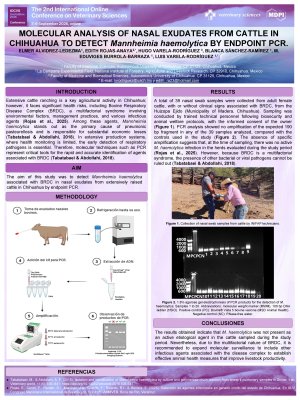
For this purpose, a total of 39 nasal exudates were collected from adult female cattle, with or without clinical signs compatible with BRDC, from Ejido Huizopa (Municipality of Madera, Chihuahua), with informed consent from the owner, in December 2025. DNA extraction was carried out using the FavorPrep™ Viral DNA/RNA Kit, followed by endpoint PCR amplification with Taq DNA Polymerase Master Mix RED. The PCR protocol included an initial denaturation at 95 °C for 5 min, followed by 35 cycles of denaturation at 95 °C for 30 s, annealing at 57 °C for 30 s, and extension at 72 °C for 30 s, with a final extension at 72 °C for 1 min. Primers F3MH (TAC CAT CGC CTT TAC GG) and B3MH (GCC TTT AAC GGT GGT GAT) targeted an expected amplicon size of 190 bp. PCR products were visualized on 1.8% agarose gels.
As a result, no bands corresponding to the expected product size appeared in any of the analyzed samples.
In conclusion, M. haemolytica DNA was not detected in the analyzed nasal exudates during the sampling period. However, these results require cautious interpretation due to the limited sample size and the restriction of sampling to a single location and time point. Further molecular surveillance that includes additional pathogens associated with BRDC is recommended to support early detection of potential outbreaks and to enable the implementation of preventive measures that improve cattle health and productivity in the region.
Keywords
Mannheimia haemolytica
Bovine respiratory disease complex (BRDC)
Endpoint PCR
Molecular detection
Nasal exudates
Extensive cattle production
Poster
Poster Alvidrez_Elmer IOCVS 2026.pdf
One Health Pharmacotherapy of Zoonotic Giardiasis in Dogs and Cats: A Systematic Review
A Bacteriophage Holin-Derived Antimicrobial Peptide with Membrane-Disruptive Activity and Therapeutic Efficacy Against MDR Pseudomonas aeruginosa Burn Wound Infections