Event submissions
Published
This submission belongs to the session S3. Antimicrobial Resistance and Food Safety: A One Health Perspective of the event The 2nd International Online Conference on Veterinary Sciences
Published date
02 Sep, 2026
Academic Editor
'%3e%3cpath%20d='M12.6657%2010.9104C12.4185%2010.325%2012.0599%209.79327%2011.6097%209.34482C11.1609%208.89508%2010.6293%208.5365%2010.0442%208.28888C10.0389%208.28626%2010.0337%208.28495%2010.0285%208.28233C10.8446%207.69279%2011.3752%206.73249%2011.3752%205.64904C11.3752%203.8542%209.92103%202.39999%208.1262%202.39999C6.33136%202.39999%204.87715%203.8542%204.87715%205.64904C4.87715%206.73249%205.40774%207.69279%206.22393%208.28364C6.21869%208.28626%206.21345%208.28757%206.20821%208.29019C5.62129%208.5378%205.09463%208.89284%204.64265%209.34613C4.1929%209.79493%203.83432%2010.3266%203.58671%2010.9117C3.34345%2011.4845%203.21226%2012.0987%203.20023%2012.7209C3.19988%2012.7349%203.20233%2012.7488%203.20744%2012.7619C3.21255%2012.7749%203.22022%2012.7867%203.22998%2012.7968C3.23975%2012.8068%203.25142%2012.8147%203.26431%2012.8202C3.2772%2012.8256%203.29105%2012.8284%203.30504%2012.8284H4.09109C4.14874%2012.8284%204.19459%2012.7825%204.1959%2012.7262C4.2221%2011.7148%204.62823%2010.7676%205.34617%2010.0497C6.08899%209.30683%207.0755%208.89808%208.1262%208.89808C9.17689%208.89808%2010.1634%209.30683%2010.9062%2010.0497C11.6242%2010.7676%2012.0303%2011.7148%2012.0565%2012.7262C12.0578%2012.7838%2012.1037%2012.8284%2012.1613%2012.8284H12.9474C12.9613%2012.8284%2012.9752%2012.8256%2012.9881%2012.8202C13.001%2012.8147%2013.0126%2012.8068%2013.0224%2012.7968C13.0322%2012.7867%2013.0398%2012.7749%2013.0449%2012.7619C13.0501%2012.7488%2013.0525%2012.7349%2013.0522%2012.7209C13.0391%2012.0947%2012.9094%2011.4855%2012.6657%2010.9104ZM8.1262%207.9024C7.52486%207.9024%206.9589%207.6679%206.53312%207.24211C6.10733%206.81633%205.87283%206.25037%205.87283%205.64904C5.87283%205.0477%206.10733%204.48174%206.53312%204.05596C6.9589%203.63018%207.52486%203.39567%208.1262%203.39567C8.72753%203.39567%209.29349%203.63018%209.71927%204.05596C10.1451%204.48174%2010.3796%205.0477%2010.3796%205.64904C10.3796%206.25037%2010.1451%206.81633%209.71927%207.24211C9.29349%207.6679%208.72753%207.9024%208.1262%207.9024Z'%20fill='%235D1EE1'/%3e%3c/g%3e%3c/svg%3e) BeiBei Li
BeiBei LiCitation
Purushotham R V, Sameer Shrivastava, Sonal Saxena, Sabhapathi Nagappan, Pradeep kumar, Saminathan M, Abhinav kumar, Sanjay Kumar Singh, Satyabrata Dandapat, A Bacteriophage Holin-Derived Antimicrobial Peptide with Membrane-Disruptive Activity and Therapeutic Efficacy Against MDR Pseudomonas aeruginosa Burn Wound Infections, in Proceedings of The 2nd International Online Conference on Veterinary Sciences, 7 September–9 September 2026, MDPI: Basel, Switzerland
Share
Email
Facebook
Twitter
LinkedIn
A Bacteriophage Holin-Derived Antimicrobial Peptide with Membrane-Disruptive Activity and Therapeutic Efficacy Against MDR Pseudomonas aeruginosa Burn Wound Infections
'%3e%3cpath%20d='M12.6647%2010.9104C12.4176%2010.325%2012.0589%209.7933%2011.6088%209.34485C11.16%208.89511%2010.6283%208.53653%2010.0432%208.28891C10.038%208.28629%2010.0327%208.28498%2010.0275%208.28236C10.8437%207.69282%2011.3743%206.73252%2011.3743%205.64907C11.3743%203.85423%209.92005%202.40002%208.12522%202.40002C6.33038%202.40002%204.87618%203.85423%204.87618%205.64907C4.87618%206.73252%205.40677%207.69282%206.22296%208.28367C6.21772%208.28629%206.21248%208.2876%206.20724%208.29022C5.62031%208.53783%205.09365%208.89287%204.64167%209.34616C4.19192%209.79496%203.83334%2010.3266%203.58573%2010.9117C3.34247%2011.4846%203.21128%2012.0987%203.19925%2012.721C3.1989%2012.735%203.20135%2012.7489%203.20646%2012.7619C3.21157%2012.7749%203.21924%2012.7868%203.22901%2012.7968C3.23877%2012.8068%203.25045%2012.8148%203.26334%2012.8202C3.27623%2012.8256%203.29007%2012.8284%203.30406%2012.8284H4.09012C4.14776%2012.8284%204.19362%2012.7825%204.19493%2012.7262C4.22113%2011.7148%204.62726%2010.7676%205.34519%2010.0497C6.08802%209.30686%207.07452%208.89811%208.12522%208.89811C9.17592%208.89811%2010.1624%209.30686%2010.9052%2010.0497C11.6232%2010.7676%2012.0293%2011.7148%2012.0555%2012.7262C12.0568%2012.7839%2012.1027%2012.8284%2012.1603%2012.8284H12.9464C12.9604%2012.8284%2012.9742%2012.8256%2012.9871%2012.8202C13%2012.8148%2013.0117%2012.8068%2013.0214%2012.7968C13.0312%2012.7868%2013.0389%2012.7749%2013.044%2012.7619C13.0491%2012.7489%2013.0515%2012.735%2013.0512%2012.721C13.0381%2012.0947%2012.9084%2011.4856%2012.6647%2010.9104ZM8.12522%207.90243C7.52388%207.90243%206.95792%207.66793%206.53214%207.24215C6.10636%206.81636%205.87185%206.2504%205.87185%205.64907C5.87185%205.04773%206.10636%204.48177%206.53214%204.05599C6.95792%203.63021%207.52388%203.3957%208.12522%203.3957C8.72655%203.3957%209.29252%203.63021%209.7183%204.05599C10.1441%204.48177%2010.3786%205.04773%2010.3786%205.64907C10.3786%206.2504%2010.1441%206.81636%209.7183%207.24215C9.29252%207.66793%208.72655%207.90243%208.12522%207.90243Z'%20fill='%235D1EE1'/%3e%3c/g%3e%3c/svg%3e)
Purushotham R V 1
Sameer Shrivastava 1
Sonal Saxena 1
Sabhapathi Nagappan 1
Pradeep kumar 1

Saminathan M 2
Abhinav kumar 3

Sanjay Kumar Singh 4
Satyabrata Dandapat 1
1. Veterinary Immunology Section, ICAR-Indian Veterinary Research Institute, Izatnagar, Bareilly, Uttar Pradesh, 243122, India
2. Division of Virology, ICAR-Indian Veterinary Research Institute, Mukteshwar campus, Uttarakhand, 263138, India
3. School of Artificial Intelligence and Data Engineering, Indian Institute of Technology, Ropar, 140001, India
4. Department of Computer Science and Engineering, Indian Institute of Technology(BHU), Varanasi, 221001, India
Abstract
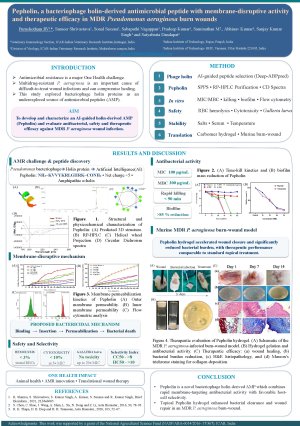
Introduction: Multidrug-resistant (MDR) Pseudomonas aeruginosa is a major cause of burn wound infections and represents a significant antimicrobial resistance challenge. Antimicrobial peptides (AMPs) derived from bacteriophage proteins offer a promising alternative to conventional antibiotics. This study aimed to identify and evaluate a novel bacteriophage holin-derived AMP against MDR P. aeruginosa.
Methods: An artificial intelligence-guided approach was employed to identify AMP, a 12-amino-acid cationic peptide derived from a Pseudomonas bacteriophage holin protein. Antibacterial, antibiofilm, membrane-disruption, stability, hemocompatibility, and cytotoxicity assays were performed. Therapeutic efficacy was further evaluated using a carbomer hydrogel formulation in a murine burn wound infection model caused by MDR P. aeruginosa.
Results: AMP exhibited potent antibacterial and antibiofilm activity against P. aeruginosa, achieving complete bacterial killing within 90 min. Mechanistic studies demonstrated concentration- and time-dependent membrane permeabilization and disruption. The peptide showed minimal cytotoxicity, high hemocompatibility, and retained activity under physiologically relevant salt, serum, and temperature conditions. In vivo, topical administration of AMP-hydrogel significantly reduced bacterial burden, accelerated wound closure, enhanced collagen deposition, and favorably modulated inflammatory cytokine responses compared with untreated controls.
Conclusions: The findings highlight bacteriophage holins as an underexplored source of antimicrobial peptides and demonstrate the potential of a novel AI-designed holin-derived peptide as a stable, biocompatible, and effective therapeutic candidate for managing MDR P. aeruginosa wound infections within a One Health framework addressing antimicrobial resistance.
Keywords
Antimicrobial resistance
bacteriophage holin
antimicrobial peptide
Pseudomonas aeruginosa
burn wound infection
wound healing.
Poster
IOCVS_2026_Pepholin_Purushotham.pdf
Molecular analysis of nasal exudates from cattle in Chihuahua to detect Mannheimia haemolytica by endpoint PCR
A Systematic Review of Methicillin‑Resistant Staphylococcus aureus (MRSA) Surgical Site Infections in Companion Animals and Their Human Contacts: A One Health Perspective