Event submissions
Published
This submission belongs to the session S2. Surveillance and Epidemiological Modelling at the Human–Animal–Environment Interface of the event The 2nd International Online Conference on Veterinary Sciences
Published date
02 Sep, 2026
Academic Editor
'%3e%3cpath%20d='M12.6657%2010.9104C12.4185%2010.325%2012.0599%209.79327%2011.6097%209.34482C11.1609%208.89508%2010.6293%208.5365%2010.0442%208.28888C10.0389%208.28626%2010.0337%208.28495%2010.0285%208.28233C10.8446%207.69279%2011.3752%206.73249%2011.3752%205.64904C11.3752%203.8542%209.92103%202.39999%208.1262%202.39999C6.33136%202.39999%204.87715%203.8542%204.87715%205.64904C4.87715%206.73249%205.40774%207.69279%206.22393%208.28364C6.21869%208.28626%206.21345%208.28757%206.20821%208.29019C5.62129%208.5378%205.09463%208.89284%204.64265%209.34613C4.1929%209.79493%203.83432%2010.3266%203.58671%2010.9117C3.34345%2011.4845%203.21226%2012.0987%203.20023%2012.7209C3.19988%2012.7349%203.20233%2012.7488%203.20744%2012.7619C3.21255%2012.7749%203.22022%2012.7867%203.22998%2012.7968C3.23975%2012.8068%203.25142%2012.8147%203.26431%2012.8202C3.2772%2012.8256%203.29105%2012.8284%203.30504%2012.8284H4.09109C4.14874%2012.8284%204.19459%2012.7825%204.1959%2012.7262C4.2221%2011.7148%204.62823%2010.7676%205.34617%2010.0497C6.08899%209.30683%207.0755%208.89808%208.1262%208.89808C9.17689%208.89808%2010.1634%209.30683%2010.9062%2010.0497C11.6242%2010.7676%2012.0303%2011.7148%2012.0565%2012.7262C12.0578%2012.7838%2012.1037%2012.8284%2012.1613%2012.8284H12.9474C12.9613%2012.8284%2012.9752%2012.8256%2012.9881%2012.8202C13.001%2012.8147%2013.0126%2012.8068%2013.0224%2012.7968C13.0322%2012.7867%2013.0398%2012.7749%2013.0449%2012.7619C13.0501%2012.7488%2013.0525%2012.7349%2013.0522%2012.7209C13.0391%2012.0947%2012.9094%2011.4855%2012.6657%2010.9104ZM8.1262%207.9024C7.52486%207.9024%206.9589%207.6679%206.53312%207.24211C6.10733%206.81633%205.87283%206.25037%205.87283%205.64904C5.87283%205.0477%206.10733%204.48174%206.53312%204.05596C6.9589%203.63018%207.52486%203.39567%208.1262%203.39567C8.72753%203.39567%209.29349%203.63018%209.71927%204.05596C10.1451%204.48174%2010.3796%205.0477%2010.3796%205.64904C10.3796%206.25037%2010.1451%206.81633%209.71927%207.24211C9.29349%207.6679%208.72753%207.9024%208.1262%207.9024Z'%20fill='%235D1EE1'/%3e%3c/g%3e%3c/svg%3e) Francesco Mira
Francesco MiraCitation
Ali Amini Harandi, Alireza Ansari Mahabadi, Amin Ahmadi, Seyed Arman Ahmadi, Mohammad Hossein Pakrooh, Mobile Genetic Elements Driving the Cross-Sector Dissemination of ESBL-Producing Enterobacteriaceae Across Human, Animal and Environmental Interfaces: A One Health Systematic Review, in Proceedings of The 2nd International Online Conference on Veterinary Sciences, 7 September–9 September 2026, MDPI: Basel, Switzerland
Share
Email
Facebook
Twitter
LinkedIn
Mobile Genetic Elements Driving the Cross-Sector Dissemination of ESBL-Producing Enterobacteriaceae Across Human, Animal and Environmental Interfaces: A One Health Systematic Review
'%3e%3cpath%20d='M12.6647%2010.9104C12.4176%2010.325%2012.0589%209.7933%2011.6088%209.34485C11.16%208.89511%2010.6283%208.53653%2010.0432%208.28891C10.038%208.28629%2010.0327%208.28498%2010.0275%208.28236C10.8437%207.69282%2011.3743%206.73252%2011.3743%205.64907C11.3743%203.85423%209.92005%202.40002%208.12522%202.40002C6.33038%202.40002%204.87618%203.85423%204.87618%205.64907C4.87618%206.73252%205.40677%207.69282%206.22296%208.28367C6.21772%208.28629%206.21248%208.2876%206.20724%208.29022C5.62031%208.53783%205.09365%208.89287%204.64167%209.34616C4.19192%209.79496%203.83334%2010.3266%203.58573%2010.9117C3.34247%2011.4846%203.21128%2012.0987%203.19925%2012.721C3.1989%2012.735%203.20135%2012.7489%203.20646%2012.7619C3.21157%2012.7749%203.21924%2012.7868%203.22901%2012.7968C3.23877%2012.8068%203.25045%2012.8148%203.26334%2012.8202C3.27623%2012.8256%203.29007%2012.8284%203.30406%2012.8284H4.09012C4.14776%2012.8284%204.19362%2012.7825%204.19493%2012.7262C4.22113%2011.7148%204.62726%2010.7676%205.34519%2010.0497C6.08802%209.30686%207.07452%208.89811%208.12522%208.89811C9.17592%208.89811%2010.1624%209.30686%2010.9052%2010.0497C11.6232%2010.7676%2012.0293%2011.7148%2012.0555%2012.7262C12.0568%2012.7839%2012.1027%2012.8284%2012.1603%2012.8284H12.9464C12.9604%2012.8284%2012.9742%2012.8256%2012.9871%2012.8202C13%2012.8148%2013.0117%2012.8068%2013.0214%2012.7968C13.0312%2012.7868%2013.0389%2012.7749%2013.044%2012.7619C13.0491%2012.7489%2013.0515%2012.735%2013.0512%2012.721C13.0381%2012.0947%2012.9084%2011.4856%2012.6647%2010.9104ZM8.12522%207.90243C7.52388%207.90243%206.95792%207.66793%206.53214%207.24215C6.10636%206.81636%205.87185%206.2504%205.87185%205.64907C5.87185%205.04773%206.10636%204.48177%206.53214%204.05599C6.95792%203.63021%207.52388%203.3957%208.12522%203.3957C8.72655%203.3957%209.29252%203.63021%209.7183%204.05599C10.1441%204.48177%2010.3786%205.04773%2010.3786%205.64907C10.3786%206.2504%2010.1441%206.81636%209.7183%207.24215C9.29252%207.66793%208.72655%207.90243%208.12522%207.90243Z'%20fill='%235D1EE1'/%3e%3c/g%3e%3c/svg%3e)
Ali Amini Harandi 1
Alireza Ansari Mahabadi 1
Amin Ahmadi 1
Seyed Arman Ahmadi 1
Mohammad Hossein Pakrooh 1,2
1. Faculty of Veterinary Medicine, Shahrekord University, Chaharmahal & Bakhtiari, Iran
2. Institute of Intercontinental Student Veterinary (ISRI-RETM), Technology Development Center, Shahrekord University, Chaharmahal & Bakhtiari, Iran
Abstract
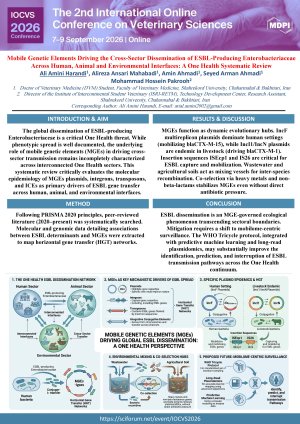
Introduction: The global dissemination of ESBL-producing Enterobacteriaceae is a critical One Health threat. While phenotypic spread is well documented, the underlying role of mobile genetic elements (MGEs) in driving cross-sector transmission remains incompletely characterized across interconnected One Health sectors. This systematic review critically evaluates the molecular epidemiology of MGEs plasmids, integrons, transposons, and ICEs as primary drivers of ESBL gene transfer across human, animal, and environmental interfaces.
Methods: Following PRISMA 2020 principles, peer-reviewed literature (2020–present) was systematically searched. Molecular and genomic data detailing associations between ESBL determinants and MGEs were extracted to map horizontal gene transfer (HGT) networks.
Results: MGEs function as dynamic evolutionary hubs. IncF multireplicon plasmids dominate human settings (mobilizing blaCTX-M-15), while IncI1/IncN plasmids are endemic in livestock (driving blaCTX-M-1). Insertion sequences ISEcp1 and IS26 are critical for ESBL capture and mobilization. Wastewater and agricultural soils act as mixing vessels for inter-species recombination. Co-selection via heavy metals and non-beta-lactams stabilizes MGEs even without direct antibiotic pressure.
Conclusions: ESBL dissemination is an MGE-governed ecological phenomenon transcending sectoral boundaries. Mitigation requires a shift to mobilome-centric surveillance. The WHO Tricycle protocol, integrated with predictive machine learning and long-read plasmidomics, may substantially improve the identification, prediction, and interruption of ESBL transmission pathways across the One Health continuum.
Keywords
Extended-Spectrum Beta-Lactamase (ESBL)
Mobile Genetic Elements (MGEs)
One Health
Genomic Epidemiology
Horizontal Gene Transfer (HGT)
Poster
Mobile Genetic.pdf
Evaluating Veterinary Stakeholder Readiness for Standardized Clinical Terminologies to Improve Surveillance and One Health Collaboration
Molecular Detection of Trypanosoma evansi and Trypanosoma vivax in Household Dogs from Semnan Province, Iran: Implications for One Health Surveillance at the Wildlife–Livestock–Human Interface