Event submissions
Published
This submission belongs to the session S1. One Health Approaches to Emerging Zoonotic Threats of the event The 2nd International Online Conference on Veterinary Sciences
Published date
02 Sep, 2026
Academic Editor
'%3e%3cpath%20d='M12.6657%2010.9104C12.4185%2010.325%2012.0599%209.79327%2011.6097%209.34482C11.1609%208.89508%2010.6293%208.5365%2010.0442%208.28888C10.0389%208.28626%2010.0337%208.28495%2010.0285%208.28233C10.8446%207.69279%2011.3752%206.73249%2011.3752%205.64904C11.3752%203.8542%209.92103%202.39999%208.1262%202.39999C6.33136%202.39999%204.87715%203.8542%204.87715%205.64904C4.87715%206.73249%205.40774%207.69279%206.22393%208.28364C6.21869%208.28626%206.21345%208.28757%206.20821%208.29019C5.62129%208.5378%205.09463%208.89284%204.64265%209.34613C4.1929%209.79493%203.83432%2010.3266%203.58671%2010.9117C3.34345%2011.4845%203.21226%2012.0987%203.20023%2012.7209C3.19988%2012.7349%203.20233%2012.7488%203.20744%2012.7619C3.21255%2012.7749%203.22022%2012.7867%203.22998%2012.7968C3.23975%2012.8068%203.25142%2012.8147%203.26431%2012.8202C3.2772%2012.8256%203.29105%2012.8284%203.30504%2012.8284H4.09109C4.14874%2012.8284%204.19459%2012.7825%204.1959%2012.7262C4.2221%2011.7148%204.62823%2010.7676%205.34617%2010.0497C6.08899%209.30683%207.0755%208.89808%208.1262%208.89808C9.17689%208.89808%2010.1634%209.30683%2010.9062%2010.0497C11.6242%2010.7676%2012.0303%2011.7148%2012.0565%2012.7262C12.0578%2012.7838%2012.1037%2012.8284%2012.1613%2012.8284H12.9474C12.9613%2012.8284%2012.9752%2012.8256%2012.9881%2012.8202C13.001%2012.8147%2013.0126%2012.8068%2013.0224%2012.7968C13.0322%2012.7867%2013.0398%2012.7749%2013.0449%2012.7619C13.0501%2012.7488%2013.0525%2012.7349%2013.0522%2012.7209C13.0391%2012.0947%2012.9094%2011.4855%2012.6657%2010.9104ZM8.1262%207.9024C7.52486%207.9024%206.9589%207.6679%206.53312%207.24211C6.10733%206.81633%205.87283%206.25037%205.87283%205.64904C5.87283%205.0477%206.10733%204.48174%206.53312%204.05596C6.9589%203.63018%207.52486%203.39567%208.1262%203.39567C8.72753%203.39567%209.29349%203.63018%209.71927%204.05596C10.1451%204.48174%2010.3796%205.0477%2010.3796%205.64904C10.3796%206.25037%2010.1451%206.81633%209.71927%207.24211C9.29349%207.6679%208.72753%207.9024%208.1262%207.9024Z'%20fill='%235D1EE1'/%3e%3c/g%3e%3c/svg%3e) Vittorio Sarchese
Vittorio SarcheseCitation
Rosaria Disclafani, Paola Galluzzo, Giorgia Schirò, Antonio Vella, Gioanluca Gioia, Gioacchino Patitò, Jessica Falanga, Oleana Olga Prato, Salvatrice Vizzini, Vincenzo Monteverde, Salvatore Dara, Isolation of Yersinia enterocolitica in Caretta caretta nesting sites along the western coast of Sicily, in Proceedings of The 2nd International Online Conference on Veterinary Sciences, 7 September–9 September 2026, MDPI: Basel, Switzerland
Share
Email
Facebook
Twitter
LinkedIn
Isolation of Yersinia enterocolitica in Caretta caretta nesting sites along the western coast of Sicily
'%3e%3cpath%20d='M12.6647%2010.9104C12.4176%2010.325%2012.0589%209.7933%2011.6088%209.34485C11.16%208.89511%2010.6283%208.53653%2010.0432%208.28891C10.038%208.28629%2010.0327%208.28498%2010.0275%208.28236C10.8437%207.69282%2011.3743%206.73252%2011.3743%205.64907C11.3743%203.85423%209.92005%202.40002%208.12522%202.40002C6.33038%202.40002%204.87618%203.85423%204.87618%205.64907C4.87618%206.73252%205.40677%207.69282%206.22296%208.28367C6.21772%208.28629%206.21248%208.2876%206.20724%208.29022C5.62031%208.53783%205.09365%208.89287%204.64167%209.34616C4.19192%209.79496%203.83334%2010.3266%203.58573%2010.9117C3.34247%2011.4846%203.21128%2012.0987%203.19925%2012.721C3.1989%2012.735%203.20135%2012.7489%203.20646%2012.7619C3.21157%2012.7749%203.21924%2012.7868%203.22901%2012.7968C3.23877%2012.8068%203.25045%2012.8148%203.26334%2012.8202C3.27623%2012.8256%203.29007%2012.8284%203.30406%2012.8284H4.09012C4.14776%2012.8284%204.19362%2012.7825%204.19493%2012.7262C4.22113%2011.7148%204.62726%2010.7676%205.34519%2010.0497C6.08802%209.30686%207.07452%208.89811%208.12522%208.89811C9.17592%208.89811%2010.1624%209.30686%2010.9052%2010.0497C11.6232%2010.7676%2012.0293%2011.7148%2012.0555%2012.7262C12.0568%2012.7839%2012.1027%2012.8284%2012.1603%2012.8284H12.9464C12.9604%2012.8284%2012.9742%2012.8256%2012.9871%2012.8202C13%2012.8148%2013.0117%2012.8068%2013.0214%2012.7968C13.0312%2012.7868%2013.0389%2012.7749%2013.044%2012.7619C13.0491%2012.7489%2013.0515%2012.735%2013.0512%2012.721C13.0381%2012.0947%2012.9084%2011.4856%2012.6647%2010.9104ZM8.12522%207.90243C7.52388%207.90243%206.95792%207.66793%206.53214%207.24215C6.10636%206.81636%205.87185%206.2504%205.87185%205.64907C5.87185%205.04773%206.10636%204.48177%206.53214%204.05599C6.95792%203.63021%207.52388%203.3957%208.12522%203.3957C8.72655%203.3957%209.29252%203.63021%209.7183%204.05599C10.1441%204.48177%2010.3786%205.04773%2010.3786%205.64907C10.3786%206.2504%2010.1441%206.81636%209.7183%207.24215C9.29252%207.66793%208.72655%207.90243%208.12522%207.90243Z'%20fill='%235D1EE1'/%3e%3c/g%3e%3c/svg%3e)
Rosaria Disclafani 1,2
Paola Galluzzo 1
Giorgia Schirò 1
Antonio Vella 3
Gioanluca Gioia 1
Gioacchino Patitò 1
Jessica Falanga 1
Oleana Olga Prato 4
Salvatrice Vizzini 2,5
Vincenzo Monteverde 1
Salvatore Dara 1
1. National Reference Center on Welfare, Monitoring and Diagnostics of Sea Turtle Diseases, 90129 Palermo, Italy
2. Center for Sustainability and Ecological Transition, University of Palermo, 90133 Palermo, Italy
3. Experimental Zooprophylactic Institute of Sicily “A. Mirri”, 90129 Palermo, Italy
4. WWF Italia, Via Po, 25c, 00198 Roma, Italy
5. Department of Earth and Marine Sciences, University of Palermo, Via Archirafi 18,90123 Palermo, Italy
Abstract
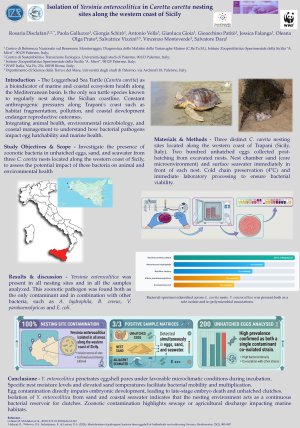
The loggerhead sea turtle (Caretta caretta) is the only sea turtle species known to nest along the Sicilian coast. Given its vulnerability and the constant threats posed by human activities, monitoring these nesting sites is crucial for conservation efforts. Adopting a One Health approach, this study evaluated the presence of zoonotic bacteria in unhatched eggs, sand, and seawater from three C. caretta nests located along the western coast of Sicily, to assess the potential impact of these bacteria on animal and environmental health
Two hundred unhatched eggs, sand from the nests and seawater in front of the nests were analyzed from three nests located along coast of Trapani (Sicily, Italy). Samples were plated on selective and differential agar media and incubated at 37°C for 24h.
The identification of isolated strains was carried out with the biochemical APIÒ system. Microbiological analyses showed that Yersinia enterocolitica was present in all nesting sites and in all the samples analyzed. This zoonotic pathogen was found both as the only contaminant and in combination with other bacteria, such as A. hydrophila, B. cereus, V. parahaemolyticus and E. coli.
The presence of Y. enterocolitica in sea turtle nests was associated with embryonic mortality due to its ability to penetrate the pores of the shell under specific environmental conditions of humidity and temperature. The isolation of this pathogen suggests that it may play a role in the reproductive success of C. caretta in this area. The isolation of Y. enterocolitica from sand and seawater could indicate a source of environmental or anthropogenic contamination. The coastal areas of Sicily are often subject to anthropogenic pressures. Understanding the interaction between these zoonotic pathogens and the nest microenvironment is essential for developing conservation strategies aimed at mitigating embryonic mortality and protecting this vulnerable species along the Sicilian coast.
Keywords
Caretta caretta
pathogenic bacteria
sea turtles eggs
Poster
Rosaria Disclafani_Poster.pdf
In vitro evaluation of synergistic antimicrobial effect of lactoferrin and nisin along with penicillin and gentamicin, and potential application in mastitis treatment
Characterisation of the microbiome and resistome in the loggerhead sea turtle (Caretta caretta) in the Mediterranean basin