Event submissions
Published
This submission belongs to the session S2. Surveillance and Epidemiological Modelling at the Human–Animal–Environment Interface of the event The 2nd International Online Conference on Veterinary Sciences
Published date
02 Sep, 2026
Academic Editor
'%3e%3cpath%20d='M12.6657%2010.9104C12.4185%2010.325%2012.0599%209.79327%2011.6097%209.34482C11.1609%208.89508%2010.6293%208.5365%2010.0442%208.28888C10.0389%208.28626%2010.0337%208.28495%2010.0285%208.28233C10.8446%207.69279%2011.3752%206.73249%2011.3752%205.64904C11.3752%203.8542%209.92103%202.39999%208.1262%202.39999C6.33136%202.39999%204.87715%203.8542%204.87715%205.64904C4.87715%206.73249%205.40774%207.69279%206.22393%208.28364C6.21869%208.28626%206.21345%208.28757%206.20821%208.29019C5.62129%208.5378%205.09463%208.89284%204.64265%209.34613C4.1929%209.79493%203.83432%2010.3266%203.58671%2010.9117C3.34345%2011.4845%203.21226%2012.0987%203.20023%2012.7209C3.19988%2012.7349%203.20233%2012.7488%203.20744%2012.7619C3.21255%2012.7749%203.22022%2012.7867%203.22998%2012.7968C3.23975%2012.8068%203.25142%2012.8147%203.26431%2012.8202C3.2772%2012.8256%203.29105%2012.8284%203.30504%2012.8284H4.09109C4.14874%2012.8284%204.19459%2012.7825%204.1959%2012.7262C4.2221%2011.7148%204.62823%2010.7676%205.34617%2010.0497C6.08899%209.30683%207.0755%208.89808%208.1262%208.89808C9.17689%208.89808%2010.1634%209.30683%2010.9062%2010.0497C11.6242%2010.7676%2012.0303%2011.7148%2012.0565%2012.7262C12.0578%2012.7838%2012.1037%2012.8284%2012.1613%2012.8284H12.9474C12.9613%2012.8284%2012.9752%2012.8256%2012.9881%2012.8202C13.001%2012.8147%2013.0126%2012.8068%2013.0224%2012.7968C13.0322%2012.7867%2013.0398%2012.7749%2013.0449%2012.7619C13.0501%2012.7488%2013.0525%2012.7349%2013.0522%2012.7209C13.0391%2012.0947%2012.9094%2011.4855%2012.6657%2010.9104ZM8.1262%207.9024C7.52486%207.9024%206.9589%207.6679%206.53312%207.24211C6.10733%206.81633%205.87283%206.25037%205.87283%205.64904C5.87283%205.0477%206.10733%204.48174%206.53312%204.05596C6.9589%203.63018%207.52486%203.39567%208.1262%203.39567C8.72753%203.39567%209.29349%203.63018%209.71927%204.05596C10.1451%204.48174%2010.3796%205.0477%2010.3796%205.64904C10.3796%206.25037%2010.1451%206.81633%209.71927%207.24211C9.29349%207.6679%208.72753%207.9024%208.1262%207.9024Z'%20fill='%235D1EE1'/%3e%3c/g%3e%3c/svg%3e) Francesco Mira
Francesco MiraCitation
Chike C Ebido, Temitope D Melefa, Ifeanyi Oscar Aguzie, Rapture Okwudilichukwu, Faustina Nwokedike, ENERGY METABOLISM AND IMMUNE RESPONSES IN AFRICAN CATFISH (CLARIAS GARIEPINUS) JUVENILES EXPOSED TO NAPROXEN, in Proceedings of The 2nd International Online Conference on Veterinary Sciences, 7 September–9 September 2026, MDPI: Basel, Switzerland
Share
Email
Facebook
Twitter
LinkedIn
ENERGY METABOLISM AND IMMUNE RESPONSES IN AFRICAN CATFISH (CLARIAS GARIEPINUS) JUVENILES EXPOSED TO NAPROXEN
'%3e%3cpath%20d='M12.6647%2010.9104C12.4176%2010.325%2012.0589%209.7933%2011.6088%209.34485C11.16%208.89511%2010.6283%208.53653%2010.0432%208.28891C10.038%208.28629%2010.0327%208.28498%2010.0275%208.28236C10.8437%207.69282%2011.3743%206.73252%2011.3743%205.64907C11.3743%203.85423%209.92005%202.40002%208.12522%202.40002C6.33038%202.40002%204.87618%203.85423%204.87618%205.64907C4.87618%206.73252%205.40677%207.69282%206.22296%208.28367C6.21772%208.28629%206.21248%208.2876%206.20724%208.29022C5.62031%208.53783%205.09365%208.89287%204.64167%209.34616C4.19192%209.79496%203.83334%2010.3266%203.58573%2010.9117C3.34247%2011.4846%203.21128%2012.0987%203.19925%2012.721C3.1989%2012.735%203.20135%2012.7489%203.20646%2012.7619C3.21157%2012.7749%203.21924%2012.7868%203.22901%2012.7968C3.23877%2012.8068%203.25045%2012.8148%203.26334%2012.8202C3.27623%2012.8256%203.29007%2012.8284%203.30406%2012.8284H4.09012C4.14776%2012.8284%204.19362%2012.7825%204.19493%2012.7262C4.22113%2011.7148%204.62726%2010.7676%205.34519%2010.0497C6.08802%209.30686%207.07452%208.89811%208.12522%208.89811C9.17592%208.89811%2010.1624%209.30686%2010.9052%2010.0497C11.6232%2010.7676%2012.0293%2011.7148%2012.0555%2012.7262C12.0568%2012.7839%2012.1027%2012.8284%2012.1603%2012.8284H12.9464C12.9604%2012.8284%2012.9742%2012.8256%2012.9871%2012.8202C13%2012.8148%2013.0117%2012.8068%2013.0214%2012.7968C13.0312%2012.7868%2013.0389%2012.7749%2013.044%2012.7619C13.0491%2012.7489%2013.0515%2012.735%2013.0512%2012.721C13.0381%2012.0947%2012.9084%2011.4856%2012.6647%2010.9104ZM8.12522%207.90243C7.52388%207.90243%206.95792%207.66793%206.53214%207.24215C6.10636%206.81636%205.87185%206.2504%205.87185%205.64907C5.87185%205.04773%206.10636%204.48177%206.53214%204.05599C6.95792%203.63021%207.52388%203.3957%208.12522%203.3957C8.72655%203.3957%209.29252%203.63021%209.7183%204.05599C10.1441%204.48177%2010.3786%205.04773%2010.3786%205.64907C10.3786%206.2504%2010.1441%206.81636%209.7183%207.24215C9.29252%207.66793%208.72655%207.90243%208.12522%207.90243Z'%20fill='%235D1EE1'/%3e%3c/g%3e%3c/svg%3e)
Chike C Ebido 1
Temitope D Melefa 1
Ifeanyi Oscar Aguzie 1
Rapture Okwudilichukwu 1
Faustina Nwokedike 1
1. Department of Zoology and Environmental Biology, University of Nigeria, Nsukka, Enugu State, Nigeria
Abstract
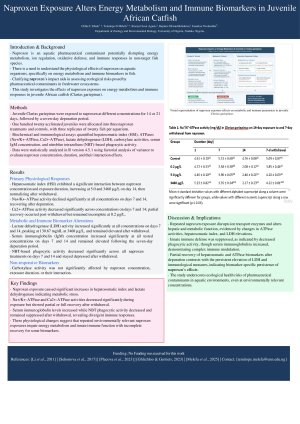
The presence and potential adverse effects of pharmaceutical contaminants, particularly non-steroidal anti-inflammatory drugs (NSAIDs) such as naproxen (NAP) are becoming a serious matter of environmental concern as they have increasingly been detected in aquatic ecosystems. This study investigated alterations in hepatosomatic index, lactase dehydrogenase, Ca2+ATPase, Na+/K+ATPase, carboxylase, respiratory burst activity and serum immunoglobulin to unravel the impact of environmentally relevant concentrations of NAP exposure on energy metabolism and immune responses in the African catfish (Clarias gariepinus) juveniles. C. gariepinus juveniles were exposed to 0 µg/L, 0.2 µg/L, 5 µg/L, and 3460 µg/L of naproxen for 14 days, which was followed by a 7-day depuration period. Results indicated a concentration and duration-dependent significant increase in hepatosomatic index and lactate dehydrogenase levels in the groups exposed to NAP when compared to the control. Although there were no observed effects of the drug exposure on carboxylase levels in the exposed group, we, however, observed that naproxen exposure led to a significant reduction in Ca2+ATPase, Na+/K+ATPase, respiratory burst activity and serum immunoglobulin levels. The effects of the drug on many of the studied parameters were reversed after the 7-day depuration period. These findings highlight the potential ecological risks associated with the presence of NAP in aquatic environments, even at realistic environmental concentrations, as continuous exposure to the drug may negatively impact energy metabolism and the immune responses of non-target aquatic organisms, thereby endangering their overall health. The guidelines for the use and handling of experimental animals as approved by the University of Nigeria ethical committee were followed throughout the experiments. The experimental fish were given the appropriate humane care, and water was changed every alternate day.
Keywords
Naproxen
Clarias gariepinus
Energy Metabolism
Immune Response
Adverse Effects
Poster
EBIDO et al 2026_POSTER.pdf
Characterisation of the microbiome and resistome in the loggerhead sea turtle (Caretta caretta) in the Mediterranean basin
Can Canine Papillomavirus Be Oncogenic in Humans? A Bioinformatics Assessment of E6 Oncoprotein–p53 Interaction Across Host Species