Event submissions
Published
This submission belongs to the session S3. Antimicrobial Resistance and Food Safety: A One Health Perspective of the event The 2nd International Online Conference on Veterinary Sciences
Published date
02 Sep, 2026
Academic Editor
'%3e%3cpath%20d='M12.6657%2010.9104C12.4185%2010.325%2012.0599%209.79327%2011.6097%209.34482C11.1609%208.89508%2010.6293%208.5365%2010.0442%208.28888C10.0389%208.28626%2010.0337%208.28495%2010.0285%208.28233C10.8446%207.69279%2011.3752%206.73249%2011.3752%205.64904C11.3752%203.8542%209.92103%202.39999%208.1262%202.39999C6.33136%202.39999%204.87715%203.8542%204.87715%205.64904C4.87715%206.73249%205.40774%207.69279%206.22393%208.28364C6.21869%208.28626%206.21345%208.28757%206.20821%208.29019C5.62129%208.5378%205.09463%208.89284%204.64265%209.34613C4.1929%209.79493%203.83432%2010.3266%203.58671%2010.9117C3.34345%2011.4845%203.21226%2012.0987%203.20023%2012.7209C3.19988%2012.7349%203.20233%2012.7488%203.20744%2012.7619C3.21255%2012.7749%203.22022%2012.7867%203.22998%2012.7968C3.23975%2012.8068%203.25142%2012.8147%203.26431%2012.8202C3.2772%2012.8256%203.29105%2012.8284%203.30504%2012.8284H4.09109C4.14874%2012.8284%204.19459%2012.7825%204.1959%2012.7262C4.2221%2011.7148%204.62823%2010.7676%205.34617%2010.0497C6.08899%209.30683%207.0755%208.89808%208.1262%208.89808C9.17689%208.89808%2010.1634%209.30683%2010.9062%2010.0497C11.6242%2010.7676%2012.0303%2011.7148%2012.0565%2012.7262C12.0578%2012.7838%2012.1037%2012.8284%2012.1613%2012.8284H12.9474C12.9613%2012.8284%2012.9752%2012.8256%2012.9881%2012.8202C13.001%2012.8147%2013.0126%2012.8068%2013.0224%2012.7968C13.0322%2012.7867%2013.0398%2012.7749%2013.0449%2012.7619C13.0501%2012.7488%2013.0525%2012.7349%2013.0522%2012.7209C13.0391%2012.0947%2012.9094%2011.4855%2012.6657%2010.9104ZM8.1262%207.9024C7.52486%207.9024%206.9589%207.6679%206.53312%207.24211C6.10733%206.81633%205.87283%206.25037%205.87283%205.64904C5.87283%205.0477%206.10733%204.48174%206.53312%204.05596C6.9589%203.63018%207.52486%203.39567%208.1262%203.39567C8.72753%203.39567%209.29349%203.63018%209.71927%204.05596C10.1451%204.48174%2010.3796%205.0477%2010.3796%205.64904C10.3796%206.25037%2010.1451%206.81633%209.71927%207.24211C9.29349%207.6679%208.72753%207.9024%208.1262%207.9024Z'%20fill='%235D1EE1'/%3e%3c/g%3e%3c/svg%3e) Ruichao Li
Ruichao LiCitation
Mahtab Mohammad Zadeh, Mohammad Saleh Safari, The Role of Insect-Based Animal Feed in the Transmission of Antimicrobial-Resistant Salmonella: A One Health Perspective, in Proceedings of The 2nd International Online Conference on Veterinary Sciences, 7 September–9 September 2026, MDPI: Basel, Switzerland
Share
Email
Facebook
Twitter
LinkedIn
The Role of Insect-Based Animal Feed in the Transmission of Antimicrobial-Resistant Salmonella: A One Health Perspective
'%3e%3cpath%20d='M12.6647%2010.9104C12.4176%2010.325%2012.0589%209.7933%2011.6088%209.34485C11.16%208.89511%2010.6283%208.53653%2010.0432%208.28891C10.038%208.28629%2010.0327%208.28498%2010.0275%208.28236C10.8437%207.69282%2011.3743%206.73252%2011.3743%205.64907C11.3743%203.85423%209.92005%202.40002%208.12522%202.40002C6.33038%202.40002%204.87618%203.85423%204.87618%205.64907C4.87618%206.73252%205.40677%207.69282%206.22296%208.28367C6.21772%208.28629%206.21248%208.2876%206.20724%208.29022C5.62031%208.53783%205.09365%208.89287%204.64167%209.34616C4.19192%209.79496%203.83334%2010.3266%203.58573%2010.9117C3.34247%2011.4846%203.21128%2012.0987%203.19925%2012.721C3.1989%2012.735%203.20135%2012.7489%203.20646%2012.7619C3.21157%2012.7749%203.21924%2012.7868%203.22901%2012.7968C3.23877%2012.8068%203.25045%2012.8148%203.26334%2012.8202C3.27623%2012.8256%203.29007%2012.8284%203.30406%2012.8284H4.09012C4.14776%2012.8284%204.19362%2012.7825%204.19493%2012.7262C4.22113%2011.7148%204.62726%2010.7676%205.34519%2010.0497C6.08802%209.30686%207.07452%208.89811%208.12522%208.89811C9.17592%208.89811%2010.1624%209.30686%2010.9052%2010.0497C11.6232%2010.7676%2012.0293%2011.7148%2012.0555%2012.7262C12.0568%2012.7839%2012.1027%2012.8284%2012.1603%2012.8284H12.9464C12.9604%2012.8284%2012.9742%2012.8256%2012.9871%2012.8202C13%2012.8148%2013.0117%2012.8068%2013.0214%2012.7968C13.0312%2012.7868%2013.0389%2012.7749%2013.044%2012.7619C13.0491%2012.7489%2013.0515%2012.735%2013.0512%2012.721C13.0381%2012.0947%2012.9084%2011.4856%2012.6647%2010.9104ZM8.12522%207.90243C7.52388%207.90243%206.95792%207.66793%206.53214%207.24215C6.10636%206.81636%205.87185%206.2504%205.87185%205.64907C5.87185%205.04773%206.10636%204.48177%206.53214%204.05599C6.95792%203.63021%207.52388%203.3957%208.12522%203.3957C8.72655%203.3957%209.29252%203.63021%209.7183%204.05599C10.1441%204.48177%2010.3786%205.04773%2010.3786%205.64907C10.3786%206.2504%2010.1441%206.81636%209.7183%207.24215C9.29252%207.66793%208.72655%207.90243%208.12522%207.90243Z'%20fill='%235D1EE1'/%3e%3c/g%3e%3c/svg%3e)
Mahtab Mohammad Zadeh 1
Mohammad Saleh Safari 2
1. Department of Anatomy and Embryology, Faculty of Veterinary Medicine, University of Tehran, Tehran, Iran
2. Department of Pathobiology, Faculty of Veterinary, Bu_Ali Sina University, Hamedan, Iran
Abstract
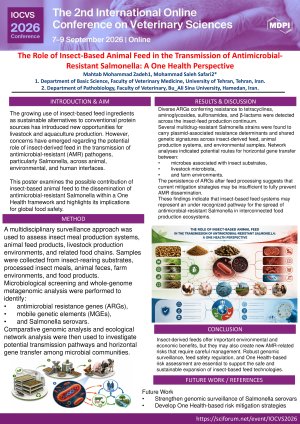
Introduction: The increasing adoption of insect-based feed ingredients as sustainable alternatives to conventional protein sources has transformed modern livestock and aquaculture production systems. However, concerns have emerged regarding the potential role of insect-derived feeds in the dissemination of antimicrobial-resistant (AMR) pathogens, particularly Salmonella, across animal, environmental, and human interfaces. This study investigated the potential contribution of insect-based animal feed to the transmission of antimicrobial-resistant Salmonella within a One Health framework and assessed associated implications for global food safety.
Methods: A multidisciplinary surveillance approach was employed to evaluate insect meal production systems, animal feed products, livestock production environments, and associated food chains. Samples from insect rearing substrates, processed insect meals, animal feces, farm environments, and food products were subjected to microbiological screening and whole-genome metagenomic analyses. Antimicrobial resistance genes (ARGs), mobile genetic elements (MGEs), and Salmonella serovars were identified using bioinformatic pipelines. Potential transmission pathways were assessed through comparative genomic and ecological network analyses.
Results: Diverse ARGs conferring resistance to tetracyclines, aminoglycosides, sulfonamides, and β-lactams were detected throughout the insect-feed production continuum. Several multidrug-resistant Salmonella strains carried plasmid-associated resistance determinants and shared genetic signatures across insect-derived feed, animal production systems, and environmental samples. Network analyses revealed potential routes for horizontal gene transfer between microbial communities associated with insect substrates, livestock microbiota, and farm environments. The persistence of ARGs following feed processing highlighted potential challenges in mitigating AMR dissemination.
Discussion: The findings suggest that insect-based feed systems may represent an underrecognized pathway for the transmission of antimicrobial-resistant Salmonella within interconnected food production ecosystems. While insect-derived feeds offer substantial environmental and economic benefits, robust surveillance strategies are required to minimize AMR-related risks. Integrating genomic monitoring, feed safety regulations, and One Health-based risk assessment frameworks will be essential for ensuring the sustainable and safe expansion of insect-based feed technologies.
Keywords
Antimicrobial resistance
Salmonella
insect-based feed
One Health
food safety
Poster
The Role of Insect-Based Animal Feed in the Transmission of Antimicrobial-Resistant Salmonella A One Health Perspective.pdf
Can Canine Papillomavirus Be Oncogenic in Humans? A Bioinformatics Assessment of E6 Oncoprotein–p53 Interaction Across Host Species
SUCCESSFUL GS ANTIVIRAL THERAPY IN A JUVENILE CAT WITH NEUROLOGICAL AND OCULAR FELINE INFECTIOUS PERITONITIS: A CASE REPORT