Event submissions
Published
This submission belongs to the session S1. One Health Approaches to Emerging Zoonotic Threats of the event The 2nd International Online Conference on Veterinary Sciences
Published date
02 Sep, 2026
Academic Editor
'%3e%3cpath%20d='M12.6657%2010.9104C12.4185%2010.325%2012.0599%209.79327%2011.6097%209.34482C11.1609%208.89508%2010.6293%208.5365%2010.0442%208.28888C10.0389%208.28626%2010.0337%208.28495%2010.0285%208.28233C10.8446%207.69279%2011.3752%206.73249%2011.3752%205.64904C11.3752%203.8542%209.92103%202.39999%208.1262%202.39999C6.33136%202.39999%204.87715%203.8542%204.87715%205.64904C4.87715%206.73249%205.40774%207.69279%206.22393%208.28364C6.21869%208.28626%206.21345%208.28757%206.20821%208.29019C5.62129%208.5378%205.09463%208.89284%204.64265%209.34613C4.1929%209.79493%203.83432%2010.3266%203.58671%2010.9117C3.34345%2011.4845%203.21226%2012.0987%203.20023%2012.7209C3.19988%2012.7349%203.20233%2012.7488%203.20744%2012.7619C3.21255%2012.7749%203.22022%2012.7867%203.22998%2012.7968C3.23975%2012.8068%203.25142%2012.8147%203.26431%2012.8202C3.2772%2012.8256%203.29105%2012.8284%203.30504%2012.8284H4.09109C4.14874%2012.8284%204.19459%2012.7825%204.1959%2012.7262C4.2221%2011.7148%204.62823%2010.7676%205.34617%2010.0497C6.08899%209.30683%207.0755%208.89808%208.1262%208.89808C9.17689%208.89808%2010.1634%209.30683%2010.9062%2010.0497C11.6242%2010.7676%2012.0303%2011.7148%2012.0565%2012.7262C12.0578%2012.7838%2012.1037%2012.8284%2012.1613%2012.8284H12.9474C12.9613%2012.8284%2012.9752%2012.8256%2012.9881%2012.8202C13.001%2012.8147%2013.0126%2012.8068%2013.0224%2012.7968C13.0322%2012.7867%2013.0398%2012.7749%2013.0449%2012.7619C13.0501%2012.7488%2013.0525%2012.7349%2013.0522%2012.7209C13.0391%2012.0947%2012.9094%2011.4855%2012.6657%2010.9104ZM8.1262%207.9024C7.52486%207.9024%206.9589%207.6679%206.53312%207.24211C6.10733%206.81633%205.87283%206.25037%205.87283%205.64904C5.87283%205.0477%206.10733%204.48174%206.53312%204.05596C6.9589%203.63018%207.52486%203.39567%208.1262%203.39567C8.72753%203.39567%209.29349%203.63018%209.71927%204.05596C10.1451%204.48174%2010.3796%205.0477%2010.3796%205.64904C10.3796%206.25037%2010.1451%206.81633%209.71927%207.24211C9.29349%207.6679%208.72753%207.9024%208.1262%207.9024Z'%20fill='%235D1EE1'/%3e%3c/g%3e%3c/svg%3e) Vittorio Sarchese
Vittorio SarcheseCitation
Mary Jananeh, Touran Tahmasbi, Leyla Roshani, Samin Shariati majd, Fazel Shirzad, SUCCESSFUL GS ANTIVIRAL THERAPY IN A JUVENILE CAT WITH NEUROLOGICAL AND OCULAR FELINE INFECTIOUS PERITONITIS: A CASE REPORT, in Proceedings of The 2nd International Online Conference on Veterinary Sciences, 7 September–9 September 2026, MDPI: Basel, Switzerland
Share
Email
Facebook
Twitter
LinkedIn
SUCCESSFUL GS ANTIVIRAL THERAPY IN A JUVENILE CAT WITH NEUROLOGICAL AND OCULAR FELINE INFECTIOUS PERITONITIS: A CASE REPORT
'%3e%3cpath%20d='M12.6647%2010.9104C12.4176%2010.325%2012.0589%209.7933%2011.6088%209.34485C11.16%208.89511%2010.6283%208.53653%2010.0432%208.28891C10.038%208.28629%2010.0327%208.28498%2010.0275%208.28236C10.8437%207.69282%2011.3743%206.73252%2011.3743%205.64907C11.3743%203.85423%209.92005%202.40002%208.12522%202.40002C6.33038%202.40002%204.87618%203.85423%204.87618%205.64907C4.87618%206.73252%205.40677%207.69282%206.22296%208.28367C6.21772%208.28629%206.21248%208.2876%206.20724%208.29022C5.62031%208.53783%205.09365%208.89287%204.64167%209.34616C4.19192%209.79496%203.83334%2010.3266%203.58573%2010.9117C3.34247%2011.4846%203.21128%2012.0987%203.19925%2012.721C3.1989%2012.735%203.20135%2012.7489%203.20646%2012.7619C3.21157%2012.7749%203.21924%2012.7868%203.22901%2012.7968C3.23877%2012.8068%203.25045%2012.8148%203.26334%2012.8202C3.27623%2012.8256%203.29007%2012.8284%203.30406%2012.8284H4.09012C4.14776%2012.8284%204.19362%2012.7825%204.19493%2012.7262C4.22113%2011.7148%204.62726%2010.7676%205.34519%2010.0497C6.08802%209.30686%207.07452%208.89811%208.12522%208.89811C9.17592%208.89811%2010.1624%209.30686%2010.9052%2010.0497C11.6232%2010.7676%2012.0293%2011.7148%2012.0555%2012.7262C12.0568%2012.7839%2012.1027%2012.8284%2012.1603%2012.8284H12.9464C12.9604%2012.8284%2012.9742%2012.8256%2012.9871%2012.8202C13%2012.8148%2013.0117%2012.8068%2013.0214%2012.7968C13.0312%2012.7868%2013.0389%2012.7749%2013.044%2012.7619C13.0491%2012.7489%2013.0515%2012.735%2013.0512%2012.721C13.0381%2012.0947%2012.9084%2011.4856%2012.6647%2010.9104ZM8.12522%207.90243C7.52388%207.90243%206.95792%207.66793%206.53214%207.24215C6.10636%206.81636%205.87185%206.2504%205.87185%205.64907C5.87185%205.04773%206.10636%204.48177%206.53214%204.05599C6.95792%203.63021%207.52388%203.3957%208.12522%203.3957C8.72655%203.3957%209.29252%203.63021%209.7183%204.05599C10.1441%204.48177%2010.3786%205.04773%2010.3786%205.64907C10.3786%206.2504%2010.1441%206.81636%209.7183%207.24215C9.29252%207.66793%208.72655%207.90243%208.12522%207.90243Z'%20fill='%235D1EE1'/%3e%3c/g%3e%3c/svg%3e)
Mary Jananeh 1
Touran Tahmasbi 2
Leyla Roshani 3
Samin Shariati majd 4
Fazel Shirzad 4
1. Jananeh Pet Clinic, Ahvaz, Iran
2. Comparative Anatomy, University of Tehran, Tehran, Iran
3. Shimi Darou Parsian Co, Tehran, Iran
4. Science and Research Branch, Azad University, Tehran, Iran
Abstract
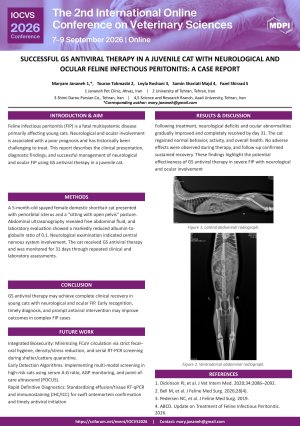
Introduction: Feline infectious peritonitis (FIP) is a fatal, multisystemic disease primarily affecting young cats, often presenting with neurological and ocular manifestations. Background & Objectives: Cases involving the nervous and ocular systems historically carry a poor prognosis due to limited treatment options. This report aims to describe the clinical presentation, diagnostic findings, and successful management of neurological and ocular FIP using GS antiviral therapy in a juvenile cat.Methods: A 5-month-old spayed female domestic shorthair cat presented with periorbital icterus and a “sitting with open pelvis” posture. Abdominal ultrasonography revealed free fluid, while laboratory tests showed a markedly reduced albumin-to-globulin ratio of 0.1. Neurological examination identified signs consistent with central nervous system involvement. The cat was treated with GS antiviral therapy and monitored over 31 days, with repeated clinical and laboratory assessments.Results: Following treatment, neurological deficits and ocular abnormalities gradually resolved and were completely absent by day 31. The cat regained normal behavior, activity, and overall health. No adverse effects were observed during therapy. Follow-up confirmed sustained recovery, highlighting the potential of GS antiviral therapy for severe FIP cases.Conclusion: GS antiviral therapy can achieve complete recovery in young cats with neurological and ocular FIP. Early recognition of clinical signs, timely diagnosis, and prompt antiviral intervention are crucial for favorable outcomes. This case supports the efficacy of GS antiviral agents in managing complex FIP and emphasizes the importance of early therapeutic strategies in veterinary practice.
Keywords
Feline infectious ,FIP
cat
ultrasonography
neurology,
Poster
IOCVS2026_Poster finall.pdf
The Role of Insect-Based Animal Feed in the Transmission of Antimicrobial-Resistant Salmonella: A One Health Perspective
Title: Hematologic Mycoplasma Infection in Four Persian and British Cats: Clinical and Laboratory Findings