Event submissions
Published
This submission belongs to the session S1. One Health Approaches to Emerging Zoonotic Threats of the event The 2nd International Online Conference on Veterinary Sciences
Published date
02 Sep, 2026
Academic Editor
'%3e%3cpath%20d='M12.6657%2010.9104C12.4185%2010.325%2012.0599%209.79327%2011.6097%209.34482C11.1609%208.89508%2010.6293%208.5365%2010.0442%208.28888C10.0389%208.28626%2010.0337%208.28495%2010.0285%208.28233C10.8446%207.69279%2011.3752%206.73249%2011.3752%205.64904C11.3752%203.8542%209.92103%202.39999%208.1262%202.39999C6.33136%202.39999%204.87715%203.8542%204.87715%205.64904C4.87715%206.73249%205.40774%207.69279%206.22393%208.28364C6.21869%208.28626%206.21345%208.28757%206.20821%208.29019C5.62129%208.5378%205.09463%208.89284%204.64265%209.34613C4.1929%209.79493%203.83432%2010.3266%203.58671%2010.9117C3.34345%2011.4845%203.21226%2012.0987%203.20023%2012.7209C3.19988%2012.7349%203.20233%2012.7488%203.20744%2012.7619C3.21255%2012.7749%203.22022%2012.7867%203.22998%2012.7968C3.23975%2012.8068%203.25142%2012.8147%203.26431%2012.8202C3.2772%2012.8256%203.29105%2012.8284%203.30504%2012.8284H4.09109C4.14874%2012.8284%204.19459%2012.7825%204.1959%2012.7262C4.2221%2011.7148%204.62823%2010.7676%205.34617%2010.0497C6.08899%209.30683%207.0755%208.89808%208.1262%208.89808C9.17689%208.89808%2010.1634%209.30683%2010.9062%2010.0497C11.6242%2010.7676%2012.0303%2011.7148%2012.0565%2012.7262C12.0578%2012.7838%2012.1037%2012.8284%2012.1613%2012.8284H12.9474C12.9613%2012.8284%2012.9752%2012.8256%2012.9881%2012.8202C13.001%2012.8147%2013.0126%2012.8068%2013.0224%2012.7968C13.0322%2012.7867%2013.0398%2012.7749%2013.0449%2012.7619C13.0501%2012.7488%2013.0525%2012.7349%2013.0522%2012.7209C13.0391%2012.0947%2012.9094%2011.4855%2012.6657%2010.9104ZM8.1262%207.9024C7.52486%207.9024%206.9589%207.6679%206.53312%207.24211C6.10733%206.81633%205.87283%206.25037%205.87283%205.64904C5.87283%205.0477%206.10733%204.48174%206.53312%204.05596C6.9589%203.63018%207.52486%203.39567%208.1262%203.39567C8.72753%203.39567%209.29349%203.63018%209.71927%204.05596C10.1451%204.48174%2010.3796%205.0477%2010.3796%205.64904C10.3796%206.25037%2010.1451%206.81633%209.71927%207.24211C9.29349%207.6679%208.72753%207.9024%208.1262%207.9024Z'%20fill='%235D1EE1'/%3e%3c/g%3e%3c/svg%3e) Vittorio Sarchese
Vittorio SarcheseCitation
Asmaa Nasr, Mustafa Ozan Atasoy, Mohammed A. Rohaim, Waqas Khokhar, Nikki Copeland, Christopher C. Broder, Muhammad Munir, Effectiveness of N6-methyladenosine (m6A) and Innate Immunity as Barriers to the Emergence of Cedar Henipavirus in Rousettus aegyptiacus Cells, in Proceedings of The 2nd International Online Conference on Veterinary Sciences, 7 September–9 September 2026, MDPI: Basel, Switzerland
Share
Email
Facebook
Twitter
LinkedIn
Effectiveness of N6-methyladenosine (m6A) and Innate Immunity as Barriers to the Emergence of Cedar Henipavirus in Rousettus aegyptiacus Cells
'%3e%3cpath%20d='M12.6647%2010.9104C12.4176%2010.325%2012.0589%209.7933%2011.6088%209.34485C11.16%208.89511%2010.6283%208.53653%2010.0432%208.28891C10.038%208.28629%2010.0327%208.28498%2010.0275%208.28236C10.8437%207.69282%2011.3743%206.73252%2011.3743%205.64907C11.3743%203.85423%209.92005%202.40002%208.12522%202.40002C6.33038%202.40002%204.87618%203.85423%204.87618%205.64907C4.87618%206.73252%205.40677%207.69282%206.22296%208.28367C6.21772%208.28629%206.21248%208.2876%206.20724%208.29022C5.62031%208.53783%205.09365%208.89287%204.64167%209.34616C4.19192%209.79496%203.83334%2010.3266%203.58573%2010.9117C3.34247%2011.4846%203.21128%2012.0987%203.19925%2012.721C3.1989%2012.735%203.20135%2012.7489%203.20646%2012.7619C3.21157%2012.7749%203.21924%2012.7868%203.22901%2012.7968C3.23877%2012.8068%203.25045%2012.8148%203.26334%2012.8202C3.27623%2012.8256%203.29007%2012.8284%203.30406%2012.8284H4.09012C4.14776%2012.8284%204.19362%2012.7825%204.19493%2012.7262C4.22113%2011.7148%204.62726%2010.7676%205.34519%2010.0497C6.08802%209.30686%207.07452%208.89811%208.12522%208.89811C9.17592%208.89811%2010.1624%209.30686%2010.9052%2010.0497C11.6232%2010.7676%2012.0293%2011.7148%2012.0555%2012.7262C12.0568%2012.7839%2012.1027%2012.8284%2012.1603%2012.8284H12.9464C12.9604%2012.8284%2012.9742%2012.8256%2012.9871%2012.8202C13%2012.8148%2013.0117%2012.8068%2013.0214%2012.7968C13.0312%2012.7868%2013.0389%2012.7749%2013.044%2012.7619C13.0491%2012.7489%2013.0515%2012.735%2013.0512%2012.721C13.0381%2012.0947%2012.9084%2011.4856%2012.6647%2010.9104ZM8.12522%207.90243C7.52388%207.90243%206.95792%207.66793%206.53214%207.24215C6.10636%206.81636%205.87185%206.2504%205.87185%205.64907C5.87185%205.04773%206.10636%204.48177%206.53214%204.05599C6.95792%203.63021%207.52388%203.3957%208.12522%203.3957C8.72655%203.3957%209.29252%203.63021%209.7183%204.05599C10.1441%204.48177%2010.3786%205.04773%2010.3786%205.64907C10.3786%206.2504%2010.1441%206.81636%209.7183%207.24215C9.29252%207.66793%208.72655%207.90243%208.12522%207.90243Z'%20fill='%235D1EE1'/%3e%3c/g%3e%3c/svg%3e)
Asmaa Nasr 1,2

Mustafa Ozan Atasoy 3

Mohammed A. Rohaim 1,4
Waqas Khokhar 5
Nikki Copeland 1

Christopher C. Broder 6
Muhammad Munir 1
1. Division of Biomedical and Life Sciences, Lancaster University, Lancaster, UK
2. Department of Zoonoses, Faculty of Veterinary Medicine, Cairo University, Giza, Egypt
3. Department of Veterinary Virology, Faculty of Veterinary Medicine, Cumhuriyet University, Sivas, Turkey
4. Department of Virology, Faculty of Veterinary Medicine, Cairo University, Giza, Egypt
5. School of Sciences, Psychology, Arts &Humanities, Computing, Engineering & Sports, Canterbury Christ Church University, Canterbury, UK
6. Department of Microbiology and Immunology, Uniformed Services University, Bethesda, MD, USA
Abstract
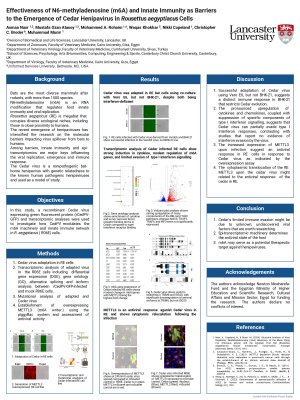
The Egyptian fruit bat (Rousettus aegyptiacus) is a pteropodid bat closely related to Pteropus alecto, the natural reservoir of the pathogenic henipaviruses Nipah virus and Hendra virus. Cedar virus (CedPV) is a less pathogenic henipavirus that is used as a model to study the pathogenesis of Nipah and Hendra viruses due to its genetic and phylogenetic relatedness. N6-methyladenosine (m6A) is an important cellular RNA modification and regulates the replication of many viruses through cellular proteins that add (writers), remove (erasers), and recognise (readers) this modification on RNA. Innate immunity constitutes the primary arm of host defence against viral infection.
In this study, a recombinant Cedar virus expressing green fluorescent protein (rCedPV-GFP) and transcriptomic analyses were used to investigate whether m6A modification and innate immunity act as effective barriers to CedPV emergence and replication in R. aegyptiacus cells. Infection of R. aegyptiacus cells with rCedPV-GFP resulted in abortive infection, with the virus unable to be passaged in bat cells. However, the virus was able to adapt to R. aegyptiacus cells using Vero E6 cells, but not BHK-21 cells, despite both cell lines supporting high viral titers. RNA-seq analysis revealed adaptive mutations in CedPV replication genes, particularly in the polymerase gene and its nucleocapsid template, but not in the immune-evasion gene. Nevertheless, gene expression profiling of infected R. aegyptiacus cells showed limited suppression of the interferon response. In contrast, m6A machinery exhibited modest upregulation, with the writer protein METTL3 showing the greatest increase in expression. Overexpression of METTL3 strongly inhibited CedPV replication. However, evidence of viral hijacking of METTL3 was observed through the translocation of the protein from the nucleus to the cytoplasm following the viral infection. These findings establish m6A and innate immune responses as important barriers to CedPV infection and replication in R. aegyptiacus cells.
Keywords
Rousettus aegyptiacus
m6A
METTL3
innate immunity
Cedar virus.
Poster
Poster conference.pdf
Detection of Bovine Tuberculosis in Animals Using Interferon-Gamma Release Assay and Its Public Health Relevance in the One Health Approach
Surveillance for influenza A virus H5-specific antibodies in Canada Geese (Branta canadensis) in Pennsylvania