Event submissions
Published
This submission belongs to the session S1. One Health Approaches to Emerging Zoonotic Threats of the event The 2nd International Online Conference on Veterinary Sciences
Published date
02 Sep, 2026
Academic Editor
'%3e%3cpath%20d='M12.6657%2010.9104C12.4185%2010.325%2012.0599%209.79327%2011.6097%209.34482C11.1609%208.89508%2010.6293%208.5365%2010.0442%208.28888C10.0389%208.28626%2010.0337%208.28495%2010.0285%208.28233C10.8446%207.69279%2011.3752%206.73249%2011.3752%205.64904C11.3752%203.8542%209.92103%202.39999%208.1262%202.39999C6.33136%202.39999%204.87715%203.8542%204.87715%205.64904C4.87715%206.73249%205.40774%207.69279%206.22393%208.28364C6.21869%208.28626%206.21345%208.28757%206.20821%208.29019C5.62129%208.5378%205.09463%208.89284%204.64265%209.34613C4.1929%209.79493%203.83432%2010.3266%203.58671%2010.9117C3.34345%2011.4845%203.21226%2012.0987%203.20023%2012.7209C3.19988%2012.7349%203.20233%2012.7488%203.20744%2012.7619C3.21255%2012.7749%203.22022%2012.7867%203.22998%2012.7968C3.23975%2012.8068%203.25142%2012.8147%203.26431%2012.8202C3.2772%2012.8256%203.29105%2012.8284%203.30504%2012.8284H4.09109C4.14874%2012.8284%204.19459%2012.7825%204.1959%2012.7262C4.2221%2011.7148%204.62823%2010.7676%205.34617%2010.0497C6.08899%209.30683%207.0755%208.89808%208.1262%208.89808C9.17689%208.89808%2010.1634%209.30683%2010.9062%2010.0497C11.6242%2010.7676%2012.0303%2011.7148%2012.0565%2012.7262C12.0578%2012.7838%2012.1037%2012.8284%2012.1613%2012.8284H12.9474C12.9613%2012.8284%2012.9752%2012.8256%2012.9881%2012.8202C13.001%2012.8147%2013.0126%2012.8068%2013.0224%2012.7968C13.0322%2012.7867%2013.0398%2012.7749%2013.0449%2012.7619C13.0501%2012.7488%2013.0525%2012.7349%2013.0522%2012.7209C13.0391%2012.0947%2012.9094%2011.4855%2012.6657%2010.9104ZM8.1262%207.9024C7.52486%207.9024%206.9589%207.6679%206.53312%207.24211C6.10733%206.81633%205.87283%206.25037%205.87283%205.64904C5.87283%205.0477%206.10733%204.48174%206.53312%204.05596C6.9589%203.63018%207.52486%203.39567%208.1262%203.39567C8.72753%203.39567%209.29349%203.63018%209.71927%204.05596C10.1451%204.48174%2010.3796%205.0477%2010.3796%205.64904C10.3796%206.25037%2010.1451%206.81633%209.71927%207.24211C9.29349%207.6679%208.72753%207.9024%208.1262%207.9024Z'%20fill='%235D1EE1'/%3e%3c/g%3e%3c/svg%3e) Vittorio Sarchese
Vittorio SarcheseCitation
Mahsa Tavangar, Seyyed Sattar Tohidifar, Masoud Ghorbanpoor, Mahdi Salimi, Salmonella Surveillance in Wild Raptors: Evidence from Wildlife Rehabilitation Centers in Iran, in Proceedings of The 2nd International Online Conference on Veterinary Sciences, 7 September–9 September 2026, MDPI: Basel, Switzerland
Share
Email
Facebook
Twitter
LinkedIn
Salmonella Surveillance in Wild Raptors: Evidence from Wildlife Rehabilitation Centers in Iran
'%3e%3cpath%20d='M12.6647%2010.9104C12.4176%2010.325%2012.0589%209.7933%2011.6088%209.34485C11.16%208.89511%2010.6283%208.53653%2010.0432%208.28891C10.038%208.28629%2010.0327%208.28498%2010.0275%208.28236C10.8437%207.69282%2011.3743%206.73252%2011.3743%205.64907C11.3743%203.85423%209.92005%202.40002%208.12522%202.40002C6.33038%202.40002%204.87618%203.85423%204.87618%205.64907C4.87618%206.73252%205.40677%207.69282%206.22296%208.28367C6.21772%208.28629%206.21248%208.2876%206.20724%208.29022C5.62031%208.53783%205.09365%208.89287%204.64167%209.34616C4.19192%209.79496%203.83334%2010.3266%203.58573%2010.9117C3.34247%2011.4846%203.21128%2012.0987%203.19925%2012.721C3.1989%2012.735%203.20135%2012.7489%203.20646%2012.7619C3.21157%2012.7749%203.21924%2012.7868%203.22901%2012.7968C3.23877%2012.8068%203.25045%2012.8148%203.26334%2012.8202C3.27623%2012.8256%203.29007%2012.8284%203.30406%2012.8284H4.09012C4.14776%2012.8284%204.19362%2012.7825%204.19493%2012.7262C4.22113%2011.7148%204.62726%2010.7676%205.34519%2010.0497C6.08802%209.30686%207.07452%208.89811%208.12522%208.89811C9.17592%208.89811%2010.1624%209.30686%2010.9052%2010.0497C11.6232%2010.7676%2012.0293%2011.7148%2012.0555%2012.7262C12.0568%2012.7839%2012.1027%2012.8284%2012.1603%2012.8284H12.9464C12.9604%2012.8284%2012.9742%2012.8256%2012.9871%2012.8202C13%2012.8148%2013.0117%2012.8068%2013.0214%2012.7968C13.0312%2012.7868%2013.0389%2012.7749%2013.044%2012.7619C13.0491%2012.7489%2013.0515%2012.735%2013.0512%2012.721C13.0381%2012.0947%2012.9084%2011.4856%2012.6647%2010.9104ZM8.12522%207.90243C7.52388%207.90243%206.95792%207.66793%206.53214%207.24215C6.10636%206.81636%205.87185%206.2504%205.87185%205.64907C5.87185%205.04773%206.10636%204.48177%206.53214%204.05599C6.95792%203.63021%207.52388%203.3957%208.12522%203.3957C8.72655%203.3957%209.29252%203.63021%209.7183%204.05599C10.1441%204.48177%2010.3786%205.04773%2010.3786%205.64907C10.3786%206.2504%2010.1441%206.81636%209.7183%207.24215C9.29252%207.66793%208.72655%207.90243%208.12522%207.90243Z'%20fill='%235D1EE1'/%3e%3c/g%3e%3c/svg%3e)
Mahsa Tavangar 1
Seyyed Sattar Tohidifar 2
Masoud Ghorbanpoor 3
Mahdi Salimi 4
1. Faculty of Veterinary Medicine, Shahrekord University, Shahrekord, Iran
2. Department of Clinical Sciences, Faculty of Veterinary Medicine, Shahrekord University, Shahrekord, Iran
3. Department of Pathobiology, Faculty of Veterinary Medicine, Shahrekord University, Shahrekord, Iran
4. DVM, Isfahan Department of Environment, Isfahan, Iran
Abstract
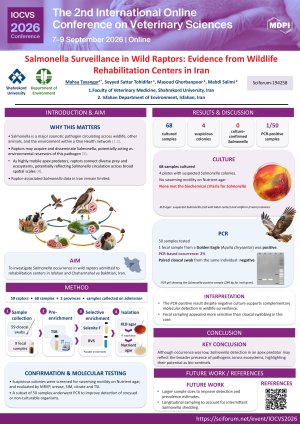
Introduction: Salmonella is a leading zoonotic pathogen worldwide. Wildlife species can act as silent reservoirs, disseminating the pathogen through environmental contamination and posing indirect risks to livestock and public health. Among wildlife, raptors are particularly valuable bio-sentinels; their position as apex predators and high spatial mobility expose them to pathogens across multiple trophic levels. Despite their epidemiological relevance, data on raptor-associated Salmonella in Iran remain scarce. This study investigated Salmonella occurrence in wild raptors admitted to wildlife rehabilitation centers in Isfahan and Chaharmahal va Bakhtiari provinces, Iran.
Methods: A total of 68 samples (59 cloacal swabs and 9 fecal samples) were collected from 59 raptors of multiple species upon admission, before any feeding or therapeutic intervention. All samples underwent bacterial culture following standard Salmonella isolation protocols: pre-enrichment in TSB, parallel selective enrichment in Selenite F and RVS broths, and plating on XLD agar. Suspicious colonies were subcultured on nutrient agar to screen for swarming motility before biochemical confirmation (MRVP, urease, SIM, Simon's citrate, and TSI). A subset of 50 samples was additionally analyzed by PCR to enhance diagnostic sensitivity.
Results: Four suspicious colonies were recovered across all 68 cultured samples; none fulfilled the biochemical criteria for Salmonella. Among the 50 samples analyzed by PCR, one fecal sample from a Golden Eagle (Aquila chrysaetos) tested positive, while the paired cloacal swab from the same individual was negative, indicating a PCR-based Salmonella occurrence of 2%.
Conclusions: These findings suggest that culture alone may underestimate Salmonella occurrence in wildlife, underscoring the value of complementary molecular detection in surveillance programs. Furthermore, fecal samples appeared more sensitive than cloacal swabs in Salmonella detection. Although overall occurrence was low, Salmonella detection in a Golden Eagle, an apex predator, signals active pathogen circulation in the ecosystem and highlights a zoonotic risk at the wildlife–environment interface, reinforcing the value of raptor-based One Health surveillance.
Keywords
Salmonella
raptors
wildlife surveillance
zoonosis
One Health
PCR
bio-sentinel
Iran
Poster
Salmonella_Poster.pdf
Prevalence, Antimicrobial Resistance, and Genomic Analysis of Yersinia enterocolitica from Livestock Farms in Qinghai, China
Protective assessment of oral immunization against genotype II using a new ASFV live attenuated vaccine prototype in wild boar