Event submissions
Published
This submission belongs to the session S3. Antimicrobial Resistance and Food Safety: A One Health Perspective of the event The 2nd International Online Conference on Veterinary Sciences
Published date
02 Sep, 2026
Academic Editor
'%3e%3cpath%20d='M12.6657%2010.9104C12.4185%2010.325%2012.0599%209.79327%2011.6097%209.34482C11.1609%208.89508%2010.6293%208.5365%2010.0442%208.28888C10.0389%208.28626%2010.0337%208.28495%2010.0285%208.28233C10.8446%207.69279%2011.3752%206.73249%2011.3752%205.64904C11.3752%203.8542%209.92103%202.39999%208.1262%202.39999C6.33136%202.39999%204.87715%203.8542%204.87715%205.64904C4.87715%206.73249%205.40774%207.69279%206.22393%208.28364C6.21869%208.28626%206.21345%208.28757%206.20821%208.29019C5.62129%208.5378%205.09463%208.89284%204.64265%209.34613C4.1929%209.79493%203.83432%2010.3266%203.58671%2010.9117C3.34345%2011.4845%203.21226%2012.0987%203.20023%2012.7209C3.19988%2012.7349%203.20233%2012.7488%203.20744%2012.7619C3.21255%2012.7749%203.22022%2012.7867%203.22998%2012.7968C3.23975%2012.8068%203.25142%2012.8147%203.26431%2012.8202C3.2772%2012.8256%203.29105%2012.8284%203.30504%2012.8284H4.09109C4.14874%2012.8284%204.19459%2012.7825%204.1959%2012.7262C4.2221%2011.7148%204.62823%2010.7676%205.34617%2010.0497C6.08899%209.30683%207.0755%208.89808%208.1262%208.89808C9.17689%208.89808%2010.1634%209.30683%2010.9062%2010.0497C11.6242%2010.7676%2012.0303%2011.7148%2012.0565%2012.7262C12.0578%2012.7838%2012.1037%2012.8284%2012.1613%2012.8284H12.9474C12.9613%2012.8284%2012.9752%2012.8256%2012.9881%2012.8202C13.001%2012.8147%2013.0126%2012.8068%2013.0224%2012.7968C13.0322%2012.7867%2013.0398%2012.7749%2013.0449%2012.7619C13.0501%2012.7488%2013.0525%2012.7349%2013.0522%2012.7209C13.0391%2012.0947%2012.9094%2011.4855%2012.6657%2010.9104ZM8.1262%207.9024C7.52486%207.9024%206.9589%207.6679%206.53312%207.24211C6.10733%206.81633%205.87283%206.25037%205.87283%205.64904C5.87283%205.0477%206.10733%204.48174%206.53312%204.05596C6.9589%203.63018%207.52486%203.39567%208.1262%203.39567C8.72753%203.39567%209.29349%203.63018%209.71927%204.05596C10.1451%204.48174%2010.3796%205.0477%2010.3796%205.64904C10.3796%206.25037%2010.1451%206.81633%209.71927%207.24211C9.29349%207.6679%208.72753%207.9024%208.1262%207.9024Z'%20fill='%235D1EE1'/%3e%3c/g%3e%3c/svg%3e) Ruichao Li
Ruichao LiCitation
Bárbara Kornin Gabardo, Elisana Julek, Luiza Madureira Grochowicz, Emanuele Eugenio, Kauã Colaço Schier, Leonardo Ereno Tadielo, Julia Arantes Galvão, Assessment of Microbiological Quality of Artisanal Raw Milk Cheeses and Their Manufacturing Process in Eastern Paraná, in Proceedings of The 2nd International Online Conference on Veterinary Sciences, 7 September–9 September 2026, MDPI: Basel, Switzerland
Share
Email
Facebook
Twitter
LinkedIn
Assessment of Microbiological Quality of Artisanal Raw Milk Cheeses and Their Manufacturing Process in Eastern Paraná
'%3e%3cpath%20d='M12.6647%2010.9104C12.4176%2010.325%2012.0589%209.7933%2011.6088%209.34485C11.16%208.89511%2010.6283%208.53653%2010.0432%208.28891C10.038%208.28629%2010.0327%208.28498%2010.0275%208.28236C10.8437%207.69282%2011.3743%206.73252%2011.3743%205.64907C11.3743%203.85423%209.92005%202.40002%208.12522%202.40002C6.33038%202.40002%204.87618%203.85423%204.87618%205.64907C4.87618%206.73252%205.40677%207.69282%206.22296%208.28367C6.21772%208.28629%206.21248%208.2876%206.20724%208.29022C5.62031%208.53783%205.09365%208.89287%204.64167%209.34616C4.19192%209.79496%203.83334%2010.3266%203.58573%2010.9117C3.34247%2011.4846%203.21128%2012.0987%203.19925%2012.721C3.1989%2012.735%203.20135%2012.7489%203.20646%2012.7619C3.21157%2012.7749%203.21924%2012.7868%203.22901%2012.7968C3.23877%2012.8068%203.25045%2012.8148%203.26334%2012.8202C3.27623%2012.8256%203.29007%2012.8284%203.30406%2012.8284H4.09012C4.14776%2012.8284%204.19362%2012.7825%204.19493%2012.7262C4.22113%2011.7148%204.62726%2010.7676%205.34519%2010.0497C6.08802%209.30686%207.07452%208.89811%208.12522%208.89811C9.17592%208.89811%2010.1624%209.30686%2010.9052%2010.0497C11.6232%2010.7676%2012.0293%2011.7148%2012.0555%2012.7262C12.0568%2012.7839%2012.1027%2012.8284%2012.1603%2012.8284H12.9464C12.9604%2012.8284%2012.9742%2012.8256%2012.9871%2012.8202C13%2012.8148%2013.0117%2012.8068%2013.0214%2012.7968C13.0312%2012.7868%2013.0389%2012.7749%2013.044%2012.7619C13.0491%2012.7489%2013.0515%2012.735%2013.0512%2012.721C13.0381%2012.0947%2012.9084%2011.4856%2012.6647%2010.9104ZM8.12522%207.90243C7.52388%207.90243%206.95792%207.66793%206.53214%207.24215C6.10636%206.81636%205.87185%206.2504%205.87185%205.64907C5.87185%205.04773%206.10636%204.48177%206.53214%204.05599C6.95792%203.63021%207.52388%203.3957%208.12522%203.3957C8.72655%203.3957%209.29252%203.63021%209.7183%204.05599C10.1441%204.48177%2010.3786%205.04773%2010.3786%205.64907C10.3786%206.2504%2010.1441%206.81636%209.7183%207.24215C9.29252%207.66793%208.72655%207.90243%208.12522%207.90243Z'%20fill='%235D1EE1'/%3e%3c/g%3e%3c/svg%3e)
Bárbara Kornin Gabardo 1
Elisana Julek 2
Luiza Madureira Grochowicz 1
Emanuele Eugenio 1
Kauã Colaço Schier 1
Leonardo Ereno Tadielo 3

Julia Arantes Galvão 1,2
1. Quality Control and Food Safety Laboratory, Federal University of Paraná, Curitiba/Paraná, Brazil
2. Veterinary Sciences, Federal University of Paraná, Curitiba/Paraná, Brazil
3. Veterinary Sciences, Santa Catarina State University, Lages/Santa Catarina, Brazil
Abstract
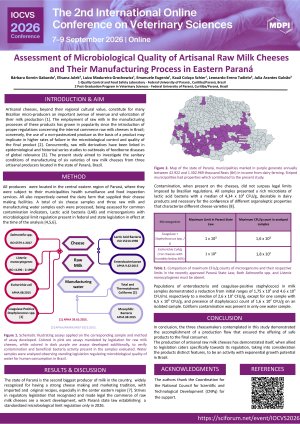
Artisanal cheeses, beyond their regional cultural value, constitute for many Brazilian micro-producers an important avenue of revenue and valorization of their milk production. The employment of raw milk in the manufacturing processes of these products has grown in popularity since the introduction of proper regulations concerning the internal commerce raw milk cheeses in Brazil; conversely, the use of a non-pasteurized produce as the basis of a product may implicate in higher rates of failure in the microbiological control and quality of the final product. Concurrently, raw milk derivatives have been linked in epidemiological and historical series studies to outbreaks of foodborne diseases of global relevance. The present study aimed to investigate the sanitary conditions of manufacturing of six varieties of raw milk cheeses from three artisanal producers located in the state of Paraná, Brazil. A total of six cheese samples and three raw milk and manufacturing water samples each were processed. Contamination, when present on the cheeses, did not surpass legal limits imposed by Brazilian regulations; all samples presented a rich microbiota of lactic acid bacteria with a median of 4,34 x 10⁶ CFU/g, desirable in dairy products and necessary for the conference of different organoleptic properties that characterize different cheese varieties. Populations of enterobacteria and coagulase-positive staphylococci in milk samples demonstrated a reduction from initial ranges of 1,75 x 10³ and 4.6 x 10³ CFU/mL respectively to a median of 2,6 x 101 CFU/g, except for one sample with 6,5 x 10⁶ CFU/g, and presence of staphylococci count of 1,6 x 10² CFU/g on an isolated sample. Coliform contamination was present in only one water sample. In conclusion, the three cheesemakers contemplated in this study demonstrated the accomplishment of a production flow that ensured the offering of safe products to the final consumer.
Keywords
Autochthonous microbiota
Dairy Products
Indicator Microorganisms
Poster
poster iocvs 2026-1.pdf
Antimicrobial-Resistant Foodborne Bacteria in Algeria: A Systematic Review at the Animal–Food–Human Interface
Molecular Survey of Zoonotic Rickettsia spp. in Wildlife, Companion Animals and Arthropod Vectors in Sicily: A One Health Approach