Event submissions
Published
This submission belongs to the session S2. Surveillance and Epidemiological Modelling at the Human–Animal–Environment Interface of the event The 2nd International Online Conference on Veterinary Sciences
Published date
02 Sep, 2026
Academic Editor
'%3e%3cpath%20d='M12.6657%2010.9104C12.4185%2010.325%2012.0599%209.79327%2011.6097%209.34482C11.1609%208.89508%2010.6293%208.5365%2010.0442%208.28888C10.0389%208.28626%2010.0337%208.28495%2010.0285%208.28233C10.8446%207.69279%2011.3752%206.73249%2011.3752%205.64904C11.3752%203.8542%209.92103%202.39999%208.1262%202.39999C6.33136%202.39999%204.87715%203.8542%204.87715%205.64904C4.87715%206.73249%205.40774%207.69279%206.22393%208.28364C6.21869%208.28626%206.21345%208.28757%206.20821%208.29019C5.62129%208.5378%205.09463%208.89284%204.64265%209.34613C4.1929%209.79493%203.83432%2010.3266%203.58671%2010.9117C3.34345%2011.4845%203.21226%2012.0987%203.20023%2012.7209C3.19988%2012.7349%203.20233%2012.7488%203.20744%2012.7619C3.21255%2012.7749%203.22022%2012.7867%203.22998%2012.7968C3.23975%2012.8068%203.25142%2012.8147%203.26431%2012.8202C3.2772%2012.8256%203.29105%2012.8284%203.30504%2012.8284H4.09109C4.14874%2012.8284%204.19459%2012.7825%204.1959%2012.7262C4.2221%2011.7148%204.62823%2010.7676%205.34617%2010.0497C6.08899%209.30683%207.0755%208.89808%208.1262%208.89808C9.17689%208.89808%2010.1634%209.30683%2010.9062%2010.0497C11.6242%2010.7676%2012.0303%2011.7148%2012.0565%2012.7262C12.0578%2012.7838%2012.1037%2012.8284%2012.1613%2012.8284H12.9474C12.9613%2012.8284%2012.9752%2012.8256%2012.9881%2012.8202C13.001%2012.8147%2013.0126%2012.8068%2013.0224%2012.7968C13.0322%2012.7867%2013.0398%2012.7749%2013.0449%2012.7619C13.0501%2012.7488%2013.0525%2012.7349%2013.0522%2012.7209C13.0391%2012.0947%2012.9094%2011.4855%2012.6657%2010.9104ZM8.1262%207.9024C7.52486%207.9024%206.9589%207.6679%206.53312%207.24211C6.10733%206.81633%205.87283%206.25037%205.87283%205.64904C5.87283%205.0477%206.10733%204.48174%206.53312%204.05596C6.9589%203.63018%207.52486%203.39567%208.1262%203.39567C8.72753%203.39567%209.29349%203.63018%209.71927%204.05596C10.1451%204.48174%2010.3796%205.0477%2010.3796%205.64904C10.3796%206.25037%2010.1451%206.81633%209.71927%207.24211C9.29349%207.6679%208.72753%207.9024%208.1262%207.9024Z'%20fill='%235D1EE1'/%3e%3c/g%3e%3c/svg%3e) Patrick Butaye
Patrick ButayeCitation
Santina Di Bella, Valeria Blanda, Virginia Talarico, Dario Bonomo, Cristina Panteghini, Francesca Gucciardi, Antonina Princiotta, Giuseppa Purpari, Elisa Maria Petta, Valeria Vaglica, Davide Pepe, Annalisa Guercio, Molecular Survey of Zoonotic Rickettsia spp. in Wildlife, Companion Animals and Arthropod Vectors in Sicily: A One Health Approach, in Proceedings of The 2nd International Online Conference on Veterinary Sciences, 7 September–9 September 2026, MDPI: Basel, Switzerland
Share
Email
Facebook
Twitter
LinkedIn
Molecular Survey of Zoonotic Rickettsia spp. in Wildlife, Companion Animals and Arthropod Vectors in Sicily: A One Health Approach
'%3e%3cpath%20d='M12.6647%2010.9104C12.4176%2010.325%2012.0589%209.7933%2011.6088%209.34485C11.16%208.89511%2010.6283%208.53653%2010.0432%208.28891C10.038%208.28629%2010.0327%208.28498%2010.0275%208.28236C10.8437%207.69282%2011.3743%206.73252%2011.3743%205.64907C11.3743%203.85423%209.92005%202.40002%208.12522%202.40002C6.33038%202.40002%204.87618%203.85423%204.87618%205.64907C4.87618%206.73252%205.40677%207.69282%206.22296%208.28367C6.21772%208.28629%206.21248%208.2876%206.20724%208.29022C5.62031%208.53783%205.09365%208.89287%204.64167%209.34616C4.19192%209.79496%203.83334%2010.3266%203.58573%2010.9117C3.34247%2011.4846%203.21128%2012.0987%203.19925%2012.721C3.1989%2012.735%203.20135%2012.7489%203.20646%2012.7619C3.21157%2012.7749%203.21924%2012.7868%203.22901%2012.7968C3.23877%2012.8068%203.25045%2012.8148%203.26334%2012.8202C3.27623%2012.8256%203.29007%2012.8284%203.30406%2012.8284H4.09012C4.14776%2012.8284%204.19362%2012.7825%204.19493%2012.7262C4.22113%2011.7148%204.62726%2010.7676%205.34519%2010.0497C6.08802%209.30686%207.07452%208.89811%208.12522%208.89811C9.17592%208.89811%2010.1624%209.30686%2010.9052%2010.0497C11.6232%2010.7676%2012.0293%2011.7148%2012.0555%2012.7262C12.0568%2012.7839%2012.1027%2012.8284%2012.1603%2012.8284H12.9464C12.9604%2012.8284%2012.9742%2012.8256%2012.9871%2012.8202C13%2012.8148%2013.0117%2012.8068%2013.0214%2012.7968C13.0312%2012.7868%2013.0389%2012.7749%2013.044%2012.7619C13.0491%2012.7489%2013.0515%2012.735%2013.0512%2012.721C13.0381%2012.0947%2012.9084%2011.4856%2012.6647%2010.9104ZM8.12522%207.90243C7.52388%207.90243%206.95792%207.66793%206.53214%207.24215C6.10636%206.81636%205.87185%206.2504%205.87185%205.64907C5.87185%205.04773%206.10636%204.48177%206.53214%204.05599C6.95792%203.63021%207.52388%203.3957%208.12522%203.3957C8.72655%203.3957%209.29252%203.63021%209.7183%204.05599C10.1441%204.48177%2010.3786%205.04773%2010.3786%205.64907C10.3786%206.2504%2010.1441%206.81636%209.7183%207.24215C9.29252%207.66793%208.72655%207.90243%208.12522%207.90243Z'%20fill='%235D1EE1'/%3e%3c/g%3e%3c/svg%3e)
Santina Di Bella 1
Valeria Blanda 1
Virginia Talarico 1
Dario Bonomo 1
Cristina Panteghini 1
Francesca Gucciardi 1
Antonina Princiotta 1
Giuseppa Purpari 1
Elisa Maria Petta 1
Valeria Vaglica 1
Davide Pepe 1
Annalisa Guercio 1
1. Istituto Zooprofilattico Sperimentale della Sicilia “A. Mirri”, 90129 Palermo, Italy
Abstract
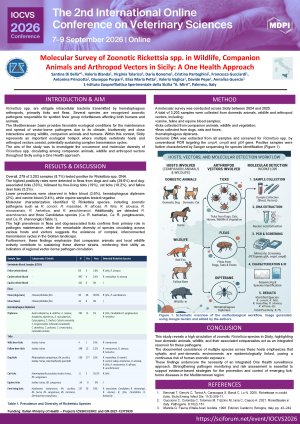
Rickettsia spp. are arthropod-borne intracellular bacteria of growing concern for animal and human health. Sicily (southern Italy), owing to its climate, biodiversity, and strategic location in the Mediterranean basin, provides favorable conditions for vector circulation and pathogen maintenance. This study investigated the occurrence and diversity of Rickettsia spp. across multiple hosts and vectors.
Between 2024 and 2025, a molecular survey was conducted across Sicily. A total of 3,203 samples were collected throughout all seasons and included blood from companion animals, ticks from companion animals, wildlife and vegetation, fleas from dogs, cats and foxes, and hematophagous dipterans. Following nucleic acid extraction, samples were screened for Rickettsia spp. by PCR targeting the gltA, ompA and ompB genes. Selected amplicons were further characterized by sequencing for species identification.
Overall, 279/3,203 samples (8.7%) tested positive for Rickettsia spp. The highest positivity rates were observed in fleas from dogs and cats (39.6%, 38/96) and dog-associated ticks (33%, 177/536), followed by free-living ticks (19%, 26/137), ticks from cats (18.2%, 2/11), and fallow deer ticks (5.2%, 13/248); one positive sample was detected among ticks collected from wild boars. Lower prevalences were found in feline blood (3.6%), hematophagous dipterans (2%), and canine blood (0.4%), whereas equine blood, horse ticks and fox fleas tested negative. Molecular characterization identified R. conorii, R. africae, R. felis, R. asemboensis, R. massiliae, R. slovaca, R. aeschlimannii, R. monacensis, R. helvetica, Candidatus R. barbariae, Candidatus R. yungkouensis and Candidatus R. shennongii. Pathogenic species were detected in vectors associated with both domestic animals and wildlife, suggesting complex transmission networks and potential zoonotic exposure.
The remarkable diversity of Rickettsia spp. circulating in Sicily highlights the complexity of transmission cycles linking wildlife, vectors and peri-domestic environments. Continuous multi-host and multi-vector surveillance within a One Health framework is essential to improve risk assessment and strengthen preparedness against emerging tick-borne zoonoses in the Mediterranean region.
Funding: Italian Ministry of Health – Projects IZSSI03/23RC and GR-2021-12373930
Keywords
Rickettsia spp
wildlife,
companion animals
Arthropod Vectors.
Poster
Di Bella et al. 2026 - Rickettsia.pdf
Assessment of Microbiological Quality of Artisanal Raw Milk Cheeses and Their Manufacturing Process in Eastern Paraná
Maternal, colostrum management, and environmental factors associated with clinical signs of neonatal disease in calves from Yolombó, Antioquia, Colombia: a pilot study with a One Health approach