Event submissions
Published
This submission belongs to the session S2. Surveillance and Epidemiological Modelling at the Human–Animal–Environment Interface of the event The 2nd International Online Conference on Veterinary Sciences
Published date
02 Sep, 2026
Academic Editor
'%3e%3cpath%20d='M12.6657%2010.9104C12.4185%2010.325%2012.0599%209.79327%2011.6097%209.34482C11.1609%208.89508%2010.6293%208.5365%2010.0442%208.28888C10.0389%208.28626%2010.0337%208.28495%2010.0285%208.28233C10.8446%207.69279%2011.3752%206.73249%2011.3752%205.64904C11.3752%203.8542%209.92103%202.39999%208.1262%202.39999C6.33136%202.39999%204.87715%203.8542%204.87715%205.64904C4.87715%206.73249%205.40774%207.69279%206.22393%208.28364C6.21869%208.28626%206.21345%208.28757%206.20821%208.29019C5.62129%208.5378%205.09463%208.89284%204.64265%209.34613C4.1929%209.79493%203.83432%2010.3266%203.58671%2010.9117C3.34345%2011.4845%203.21226%2012.0987%203.20023%2012.7209C3.19988%2012.7349%203.20233%2012.7488%203.20744%2012.7619C3.21255%2012.7749%203.22022%2012.7867%203.22998%2012.7968C3.23975%2012.8068%203.25142%2012.8147%203.26431%2012.8202C3.2772%2012.8256%203.29105%2012.8284%203.30504%2012.8284H4.09109C4.14874%2012.8284%204.19459%2012.7825%204.1959%2012.7262C4.2221%2011.7148%204.62823%2010.7676%205.34617%2010.0497C6.08899%209.30683%207.0755%208.89808%208.1262%208.89808C9.17689%208.89808%2010.1634%209.30683%2010.9062%2010.0497C11.6242%2010.7676%2012.0303%2011.7148%2012.0565%2012.7262C12.0578%2012.7838%2012.1037%2012.8284%2012.1613%2012.8284H12.9474C12.9613%2012.8284%2012.9752%2012.8256%2012.9881%2012.8202C13.001%2012.8147%2013.0126%2012.8068%2013.0224%2012.7968C13.0322%2012.7867%2013.0398%2012.7749%2013.0449%2012.7619C13.0501%2012.7488%2013.0525%2012.7349%2013.0522%2012.7209C13.0391%2012.0947%2012.9094%2011.4855%2012.6657%2010.9104ZM8.1262%207.9024C7.52486%207.9024%206.9589%207.6679%206.53312%207.24211C6.10733%206.81633%205.87283%206.25037%205.87283%205.64904C5.87283%205.0477%206.10733%204.48174%206.53312%204.05596C6.9589%203.63018%207.52486%203.39567%208.1262%203.39567C8.72753%203.39567%209.29349%203.63018%209.71927%204.05596C10.1451%204.48174%2010.3796%205.0477%2010.3796%205.64904C10.3796%206.25037%2010.1451%206.81633%209.71927%207.24211C9.29349%207.6679%208.72753%207.9024%208.1262%207.9024Z'%20fill='%235D1EE1'/%3e%3c/g%3e%3c/svg%3e) Francesco Mira
Francesco MiraCitation
Reza Fayaz, Parisa Ghazanfaripanah, One Health Epidemiology of Toxoplasma gondii in Felids, Small Ruminants, and Environmental Sources: A Systematic Review and Meta-Analysis, in Proceedings of The 2nd International Online Conference on Veterinary Sciences, 7 September–9 September 2026, MDPI: Basel, Switzerland
Share
Email
Facebook
Twitter
LinkedIn
One Health Epidemiology of Toxoplasma gondii in Felids, Small Ruminants, and Environmental Sources: A Systematic Review and Meta-Analysis
'%3e%3cpath%20d='M12.6647%2010.9104C12.4176%2010.325%2012.0589%209.7933%2011.6088%209.34485C11.16%208.89511%2010.6283%208.53653%2010.0432%208.28891C10.038%208.28629%2010.0327%208.28498%2010.0275%208.28236C10.8437%207.69282%2011.3743%206.73252%2011.3743%205.64907C11.3743%203.85423%209.92005%202.40002%208.12522%202.40002C6.33038%202.40002%204.87618%203.85423%204.87618%205.64907C4.87618%206.73252%205.40677%207.69282%206.22296%208.28367C6.21772%208.28629%206.21248%208.2876%206.20724%208.29022C5.62031%208.53783%205.09365%208.89287%204.64167%209.34616C4.19192%209.79496%203.83334%2010.3266%203.58573%2010.9117C3.34247%2011.4846%203.21128%2012.0987%203.19925%2012.721C3.1989%2012.735%203.20135%2012.7489%203.20646%2012.7619C3.21157%2012.7749%203.21924%2012.7868%203.22901%2012.7968C3.23877%2012.8068%203.25045%2012.8148%203.26334%2012.8202C3.27623%2012.8256%203.29007%2012.8284%203.30406%2012.8284H4.09012C4.14776%2012.8284%204.19362%2012.7825%204.19493%2012.7262C4.22113%2011.7148%204.62726%2010.7676%205.34519%2010.0497C6.08802%209.30686%207.07452%208.89811%208.12522%208.89811C9.17592%208.89811%2010.1624%209.30686%2010.9052%2010.0497C11.6232%2010.7676%2012.0293%2011.7148%2012.0555%2012.7262C12.0568%2012.7839%2012.1027%2012.8284%2012.1603%2012.8284H12.9464C12.9604%2012.8284%2012.9742%2012.8256%2012.9871%2012.8202C13%2012.8148%2013.0117%2012.8068%2013.0214%2012.7968C13.0312%2012.7868%2013.0389%2012.7749%2013.044%2012.7619C13.0491%2012.7489%2013.0515%2012.735%2013.0512%2012.721C13.0381%2012.0947%2012.9084%2011.4856%2012.6647%2010.9104ZM8.12522%207.90243C7.52388%207.90243%206.95792%207.66793%206.53214%207.24215C6.10636%206.81636%205.87185%206.2504%205.87185%205.64907C5.87185%205.04773%206.10636%204.48177%206.53214%204.05599C6.95792%203.63021%207.52388%203.3957%208.12522%203.3957C8.72655%203.3957%209.29252%203.63021%209.7183%204.05599C10.1441%204.48177%2010.3786%205.04773%2010.3786%205.64907C10.3786%206.2504%2010.1441%206.81636%209.7183%207.24215C9.29252%207.66793%208.72655%207.90243%208.12522%207.90243Z'%20fill='%235D1EE1'/%3e%3c/g%3e%3c/svg%3e)
Reza Fayaz 1
Parisa Ghazanfaripanah 1
1. Faculty of Veterinary Medicine, Urmia Branch, Islamic Azad University, Urmia, Iran
Abstract
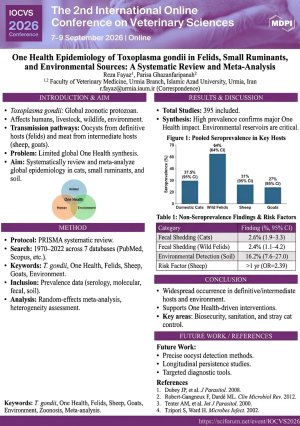
Background: Toxoplasma gondii is a globally distributed zoonotic protozoan parasite infecting humans, livestock, wildlife, and environmental reservoirs. Felids are the definitive hosts shedding environmentally resistant oocysts, whereas sheep and goats are important intermediate hosts associated with foodborne transmission. Despite numerous regional studies, a comprehensive global One Health synthesis remains limited. This study evaluated the global epidemiology of T. gondii in felids, small ruminants, and environmental sources through a systematic review and meta-analysis.
Methods: A systematic literature search was conducted according to PRISMA guidelines using seven databases, including PubMed, Scopus, Web of Science, ScienceDirect, Google Scholar, and regional databases, for studies published between 1970 and 2022. Studies reporting serological, molecular, fecal, or environmental detection of T. gondii in domestic cats, wild felids, sheep, goats, and soil samples were included. Data on location, host species, diagnostic methods, sample size, prevalence, and risk factors were extracted. Random-effects meta-analysis was performed; heterogeneity was assessed using Cochran’s Q and I² statistics, and subgroup, risk-factor, and publication-bias analyses were conducted where applicable.
Results: A total of 395 studies met the inclusion criteria. The pooled seroprevalence of T. gondii was 37.5% (95% CI: 34.7–40.3) in domestic cats and 64.0% (95% CI: 60.0–67.9) in wild felids. The pooled prevalence of fecal oocyst shedding was 2.6% (95% CI: 1.9–3.3) and 2.4% (95% CI: 1.1–4.2), respectively. T. gondii was detected in 16.2% (95% CI: 7.66–27.03) of soil samples. In livestock, pooled seroprevalence was 31% (95% CI: 25.9–35.2) in sheep and 27% (95% CI: 14.0–42.5) in goats. Sheep older than one year had higher odds of infection (OR=2.39; 95% CI: 1.05–5.46), whereas no significant sex-related differences were identified.
Conclusions: The widespread occurrence of T. gondii in felids, small ruminants, and contaminated soil highlights the importance of environmental reservoirs and foodborne transmission pathways. These findings support integrated One Health surveillance, improved biosecurity, environmental sanitation, and stray cat control to reduce zoonotic transmission and enhance food safety.
Keywords
Toxoplasma gondii
One Health
Felids
Sheep
Goats
Environmental contamination
Zoonosis
Systematic review
Meta-analysis
Veterinary public health
Poster
Reza Fayaz _ Poster.pdf
Nanoparticle-Mediated Interventions for Antimicrobial Resistance in Dairy Farms: A Systematic Review from a One Health Perspective
Florfenicol Pharmacokinetics and Pharmacodynamics in Food-Producing Animals: A Systematic Review