Event submissions
Published
This submission belongs to the session S3. Antimicrobial Resistance and Food Safety: A One Health Perspective of the event The 2nd International Online Conference on Veterinary Sciences
Published date
02 Sep, 2026
Academic Editor
'%3e%3cpath%20d='M12.6657%2010.9104C12.4185%2010.325%2012.0599%209.79327%2011.6097%209.34482C11.1609%208.89508%2010.6293%208.5365%2010.0442%208.28888C10.0389%208.28626%2010.0337%208.28495%2010.0285%208.28233C10.8446%207.69279%2011.3752%206.73249%2011.3752%205.64904C11.3752%203.8542%209.92103%202.39999%208.1262%202.39999C6.33136%202.39999%204.87715%203.8542%204.87715%205.64904C4.87715%206.73249%205.40774%207.69279%206.22393%208.28364C6.21869%208.28626%206.21345%208.28757%206.20821%208.29019C5.62129%208.5378%205.09463%208.89284%204.64265%209.34613C4.1929%209.79493%203.83432%2010.3266%203.58671%2010.9117C3.34345%2011.4845%203.21226%2012.0987%203.20023%2012.7209C3.19988%2012.7349%203.20233%2012.7488%203.20744%2012.7619C3.21255%2012.7749%203.22022%2012.7867%203.22998%2012.7968C3.23975%2012.8068%203.25142%2012.8147%203.26431%2012.8202C3.2772%2012.8256%203.29105%2012.8284%203.30504%2012.8284H4.09109C4.14874%2012.8284%204.19459%2012.7825%204.1959%2012.7262C4.2221%2011.7148%204.62823%2010.7676%205.34617%2010.0497C6.08899%209.30683%207.0755%208.89808%208.1262%208.89808C9.17689%208.89808%2010.1634%209.30683%2010.9062%2010.0497C11.6242%2010.7676%2012.0303%2011.7148%2012.0565%2012.7262C12.0578%2012.7838%2012.1037%2012.8284%2012.1613%2012.8284H12.9474C12.9613%2012.8284%2012.9752%2012.8256%2012.9881%2012.8202C13.001%2012.8147%2013.0126%2012.8068%2013.0224%2012.7968C13.0322%2012.7867%2013.0398%2012.7749%2013.0449%2012.7619C13.0501%2012.7488%2013.0525%2012.7349%2013.0522%2012.7209C13.0391%2012.0947%2012.9094%2011.4855%2012.6657%2010.9104ZM8.1262%207.9024C7.52486%207.9024%206.9589%207.6679%206.53312%207.24211C6.10733%206.81633%205.87283%206.25037%205.87283%205.64904C5.87283%205.0477%206.10733%204.48174%206.53312%204.05596C6.9589%203.63018%207.52486%203.39567%208.1262%203.39567C8.72753%203.39567%209.29349%203.63018%209.71927%204.05596C10.1451%204.48174%2010.3796%205.0477%2010.3796%205.64904C10.3796%206.25037%2010.1451%206.81633%209.71927%207.24211C9.29349%207.6679%208.72753%207.9024%208.1262%207.9024Z'%20fill='%235D1EE1'/%3e%3c/g%3e%3c/svg%3e) Ruichao Li
Ruichao LiCitation
Sakineh Khanamani Falahatipour, Atefeh - Heidar ammameh, Florfenicol Pharmacokinetics and Pharmacodynamics in Food-Producing Animals: A Systematic Review, in Proceedings of The 2nd International Online Conference on Veterinary Sciences, 7 September–9 September 2026, MDPI: Basel, Switzerland
Share
Email
Facebook
Twitter
LinkedIn
Florfenicol Pharmacokinetics and Pharmacodynamics in Food-Producing Animals: A Systematic Review
'%3e%3cpath%20d='M12.6647%2010.9104C12.4176%2010.325%2012.0589%209.7933%2011.6088%209.34485C11.16%208.89511%2010.6283%208.53653%2010.0432%208.28891C10.038%208.28629%2010.0327%208.28498%2010.0275%208.28236C10.8437%207.69282%2011.3743%206.73252%2011.3743%205.64907C11.3743%203.85423%209.92005%202.40002%208.12522%202.40002C6.33038%202.40002%204.87618%203.85423%204.87618%205.64907C4.87618%206.73252%205.40677%207.69282%206.22296%208.28367C6.21772%208.28629%206.21248%208.2876%206.20724%208.29022C5.62031%208.53783%205.09365%208.89287%204.64167%209.34616C4.19192%209.79496%203.83334%2010.3266%203.58573%2010.9117C3.34247%2011.4846%203.21128%2012.0987%203.19925%2012.721C3.1989%2012.735%203.20135%2012.7489%203.20646%2012.7619C3.21157%2012.7749%203.21924%2012.7868%203.22901%2012.7968C3.23877%2012.8068%203.25045%2012.8148%203.26334%2012.8202C3.27623%2012.8256%203.29007%2012.8284%203.30406%2012.8284H4.09012C4.14776%2012.8284%204.19362%2012.7825%204.19493%2012.7262C4.22113%2011.7148%204.62726%2010.7676%205.34519%2010.0497C6.08802%209.30686%207.07452%208.89811%208.12522%208.89811C9.17592%208.89811%2010.1624%209.30686%2010.9052%2010.0497C11.6232%2010.7676%2012.0293%2011.7148%2012.0555%2012.7262C12.0568%2012.7839%2012.1027%2012.8284%2012.1603%2012.8284H12.9464C12.9604%2012.8284%2012.9742%2012.8256%2012.9871%2012.8202C13%2012.8148%2013.0117%2012.8068%2013.0214%2012.7968C13.0312%2012.7868%2013.0389%2012.7749%2013.044%2012.7619C13.0491%2012.7489%2013.0515%2012.735%2013.0512%2012.721C13.0381%2012.0947%2012.9084%2011.4856%2012.6647%2010.9104ZM8.12522%207.90243C7.52388%207.90243%206.95792%207.66793%206.53214%207.24215C6.10636%206.81636%205.87185%206.2504%205.87185%205.64907C5.87185%205.04773%206.10636%204.48177%206.53214%204.05599C6.95792%203.63021%207.52388%203.3957%208.12522%203.3957C8.72655%203.3957%209.29252%203.63021%209.7183%204.05599C10.1441%204.48177%2010.3786%205.04773%2010.3786%205.64907C10.3786%206.2504%2010.1441%206.81636%209.7183%207.24215C9.29252%207.66793%208.72655%207.90243%208.12522%207.90243Z'%20fill='%235D1EE1'/%3e%3c/g%3e%3c/svg%3e)
Sakineh Khanamani Falahatipour 1
Atefeh - Heidar ammameh 2
1. Department of Comparative Biosciences, Faculty of Veterinary Medicine, University of Tehran, Tehran, Iran
2. Department of Pharmacology, Faculty of Veterinary Medicine, University of Tehran, Tehran, Iran
Abstract
Introduction
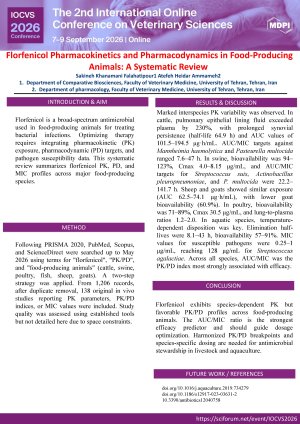
Florfenicol is a broad-spectrum antimicrobial used in food-producing animals for treating bacterial infections. Optimizing therapy requires integrating pharmacokinetic (PK) exposure, pharmacodynamic (PD) targets, and pathogen susceptibility data. This systematic review summarizes florfenicol PK, PD, and MIC profiles across major food-producing species.
Methods
Following PRISMA 2020, PubMed, Scopus, and ScienceDirect were searched up to May 2026 using terms for "florfenicol", "PK/PD", and "food-producing animals" (cattle, swine, poultry, fish, sheep, goats). A two-step strategy was applied. From 1,206 records, after duplicate removal, 138 original in vivo studies reporting PK parameters, PK/PD indices, or MIC values were included. Study quality was assessed using established tools but not detailed here due to space constraints.
Results
Marked interspecies PK variability was observed. In cattle, pulmonary epithelial lining fluid exceeded plasma by 230%, with prolonged synovial persistence (half-life 64.9 h) and AUC values of 101.5–194.5 μg·h/mL. AUC/MIC targets against Mannheimia haemolytica and Pasteurella multocida ranged 7.6–47 h. In swine, bioavailability was 94–123%, Cmax 4.0–8.15 μg/mL, and AUC/MIC targets for Streptococcus suis, Actinobacillus pleuropneumoniae, and P. multocida were 22.2–141.7 h. Sheep and goats showed similar exposure (AUC 62.5–74.1 μg·h/mL), with lower goat bioavailability (60.9%). In poultry, bioavailability was 71–89%, Cmax 30.5 μg/mL, and lung-to-plasma ratios 1.2–2.0. In aquatic species, temperature-dependent disposition was key. Elimination half-lives were 8.1–43 h, bioavailability 57–91%. MIC values for susceptible pathogens were 0.25–1 μg/mL, reaching 128 μg/mL for Streptococcus agalactiae. Across all species, AUC/MIC was the PK/PD index most strongly associated with efficacy.
Conclusion
Florfenicol exhibits species-dependent PK but favorable PK/PD profiles across food-producing animals. The AUC/MIC ratio is the strongest efficacy predictor and should guide dosage optimization. Harmonized PK/PD breakpoints and species-specific dosing are needed for antimicrobial stewardship in livestock and aquaculture.
The authors declare no conflicts of interest.
Keywords
Keywords: AUC/MIC ratio
Florfenicol
Food-producing animals
PK/PD
Systematic review
Poster
atefeh heidar ammameh- 2.pdf
One Health Epidemiology of Toxoplasma gondii in Felids, Small Ruminants, and Environmental Sources: A Systematic Review and Meta-Analysis
Natural compounds with potential acaricidal activity against Rhipicephalus microplus: molecular docking screening of glutathione S-transferase inhibitors