Event submissions
Published
This submission belongs to the session S1. One Health Approaches to Emerging Zoonotic Threats of the event The 2nd International Online Conference on Veterinary Sciences
Published date
02 Sep, 2026
Academic Editor
'%3e%3cpath%20d='M12.6657%2010.9104C12.4185%2010.325%2012.0599%209.79327%2011.6097%209.34482C11.1609%208.89508%2010.6293%208.5365%2010.0442%208.28888C10.0389%208.28626%2010.0337%208.28495%2010.0285%208.28233C10.8446%207.69279%2011.3752%206.73249%2011.3752%205.64904C11.3752%203.8542%209.92103%202.39999%208.1262%202.39999C6.33136%202.39999%204.87715%203.8542%204.87715%205.64904C4.87715%206.73249%205.40774%207.69279%206.22393%208.28364C6.21869%208.28626%206.21345%208.28757%206.20821%208.29019C5.62129%208.5378%205.09463%208.89284%204.64265%209.34613C4.1929%209.79493%203.83432%2010.3266%203.58671%2010.9117C3.34345%2011.4845%203.21226%2012.0987%203.20023%2012.7209C3.19988%2012.7349%203.20233%2012.7488%203.20744%2012.7619C3.21255%2012.7749%203.22022%2012.7867%203.22998%2012.7968C3.23975%2012.8068%203.25142%2012.8147%203.26431%2012.8202C3.2772%2012.8256%203.29105%2012.8284%203.30504%2012.8284H4.09109C4.14874%2012.8284%204.19459%2012.7825%204.1959%2012.7262C4.2221%2011.7148%204.62823%2010.7676%205.34617%2010.0497C6.08899%209.30683%207.0755%208.89808%208.1262%208.89808C9.17689%208.89808%2010.1634%209.30683%2010.9062%2010.0497C11.6242%2010.7676%2012.0303%2011.7148%2012.0565%2012.7262C12.0578%2012.7838%2012.1037%2012.8284%2012.1613%2012.8284H12.9474C12.9613%2012.8284%2012.9752%2012.8256%2012.9881%2012.8202C13.001%2012.8147%2013.0126%2012.8068%2013.0224%2012.7968C13.0322%2012.7867%2013.0398%2012.7749%2013.0449%2012.7619C13.0501%2012.7488%2013.0525%2012.7349%2013.0522%2012.7209C13.0391%2012.0947%2012.9094%2011.4855%2012.6657%2010.9104ZM8.1262%207.9024C7.52486%207.9024%206.9589%207.6679%206.53312%207.24211C6.10733%206.81633%205.87283%206.25037%205.87283%205.64904C5.87283%205.0477%206.10733%204.48174%206.53312%204.05596C6.9589%203.63018%207.52486%203.39567%208.1262%203.39567C8.72753%203.39567%209.29349%203.63018%209.71927%204.05596C10.1451%204.48174%2010.3796%205.0477%2010.3796%205.64904C10.3796%206.25037%2010.1451%206.81633%209.71927%207.24211C9.29349%207.6679%208.72753%207.9024%208.1262%207.9024Z'%20fill='%235D1EE1'/%3e%3c/g%3e%3c/svg%3e) Vittorio Sarchese
Vittorio SarcheseCitation
William Matheus Coelho Rodrigues, Mariana Nascimento Moraes Rego, Marianna Jesus Fernandes Pereira, Alexandra Martins dos Santos Soares, Natural compounds with potential acaricidal activity against Rhipicephalus microplus: molecular docking screening of glutathione S-transferase inhibitors, in Proceedings of The 2nd International Online Conference on Veterinary Sciences, 7 September–9 September 2026, MDPI: Basel, Switzerland
Share
Email
Facebook
Twitter
LinkedIn
Natural compounds with potential acaricidal activity against Rhipicephalus microplus: molecular docking screening of glutathione S-transferase inhibitors
'%3e%3cpath%20d='M12.6647%2010.9104C12.4176%2010.325%2012.0589%209.7933%2011.6088%209.34485C11.16%208.89511%2010.6283%208.53653%2010.0432%208.28891C10.038%208.28629%2010.0327%208.28498%2010.0275%208.28236C10.8437%207.69282%2011.3743%206.73252%2011.3743%205.64907C11.3743%203.85423%209.92005%202.40002%208.12522%202.40002C6.33038%202.40002%204.87618%203.85423%204.87618%205.64907C4.87618%206.73252%205.40677%207.69282%206.22296%208.28367C6.21772%208.28629%206.21248%208.2876%206.20724%208.29022C5.62031%208.53783%205.09365%208.89287%204.64167%209.34616C4.19192%209.79496%203.83334%2010.3266%203.58573%2010.9117C3.34247%2011.4846%203.21128%2012.0987%203.19925%2012.721C3.1989%2012.735%203.20135%2012.7489%203.20646%2012.7619C3.21157%2012.7749%203.21924%2012.7868%203.22901%2012.7968C3.23877%2012.8068%203.25045%2012.8148%203.26334%2012.8202C3.27623%2012.8256%203.29007%2012.8284%203.30406%2012.8284H4.09012C4.14776%2012.8284%204.19362%2012.7825%204.19493%2012.7262C4.22113%2011.7148%204.62726%2010.7676%205.34519%2010.0497C6.08802%209.30686%207.07452%208.89811%208.12522%208.89811C9.17592%208.89811%2010.1624%209.30686%2010.9052%2010.0497C11.6232%2010.7676%2012.0293%2011.7148%2012.0555%2012.7262C12.0568%2012.7839%2012.1027%2012.8284%2012.1603%2012.8284H12.9464C12.9604%2012.8284%2012.9742%2012.8256%2012.9871%2012.8202C13%2012.8148%2013.0117%2012.8068%2013.0214%2012.7968C13.0312%2012.7868%2013.0389%2012.7749%2013.044%2012.7619C13.0491%2012.7489%2013.0515%2012.735%2013.0512%2012.721C13.0381%2012.0947%2012.9084%2011.4856%2012.6647%2010.9104ZM8.12522%207.90243C7.52388%207.90243%206.95792%207.66793%206.53214%207.24215C6.10636%206.81636%205.87185%206.2504%205.87185%205.64907C5.87185%205.04773%206.10636%204.48177%206.53214%204.05599C6.95792%203.63021%207.52388%203.3957%208.12522%203.3957C8.72655%203.3957%209.29252%203.63021%209.7183%204.05599C10.1441%204.48177%2010.3786%205.04773%2010.3786%205.64907C10.3786%206.2504%2010.1441%206.81636%209.7183%207.24215C9.29252%207.66793%208.72655%207.90243%208.12522%207.90243Z'%20fill='%235D1EE1'/%3e%3c/g%3e%3c/svg%3e)
William Matheus Coelho Rodrigues 1
Mariana Nascimento Moraes Rego 1
Marianna Jesus Fernandes Pereira 1
Alexandra Martins dos Santos Soares 1,2
1. Laboratory of Immunophysiology, Ensino Integrado, Bloco 1, Sala 1A. Universidade Federal do Maranhão. São Luís, MA, Brazil.
2. Amazonian Biodiversity and Biotechnology - Bionorte, Universidade Federal do Maranhão, São Luís, MA, Brazil.
Abstract
The cattle tick Rhipicephalus microplus is one of the most important ectoparasites affecting livestock worldwide, causing substantial economic losses through reduced animal productivity, pathogen transmission, and the costs associated with chemical control. The intensive use of acaricides has contributed to the emergence of resistant tick populations and environmental contamination, underscoring the need for innovative, sustainable control strategies aligned with the One Health approach. In this context, glutathione S-transferase (GST), an enzyme involved in detoxification and acaricide resistance, has emerged as a promising molecular target for developing new acaricidal compounds. Therefore, this study aimed to identify natural compounds with potential inhibitory activity against GST of R. microplus using molecular docking approaches. The three-dimensional structure of GST from R. microplus was obtained from the AlphaFold Protein Structure Database. A total of 1,000 natural compounds were retrieved from the Natural Products Atlas. Molecular docking simulations were performed at the GST H-site using Molegro Virtual Docker. Compounds were ranked according to MolDock Score values, and the best docking poses were further evaluated for intermolecular interactions and ADMET properties. The ten best-ranked compounds showed MolDock Scores ranging from −156.264 to −137.364. Several compounds exhibited favorable predicted pharmacokinetic profiles, including high intestinal absorption and absence of AMES toxicity or skin sensitization. Notably, none of the ten top-ranked compounds has previously been reported as a GST inhibitor of R. microplus or evaluated for acaricidal activity against this tick species. These findings identify novel natural compounds with predicted affinity for GST and highlight their potential as candidates for future in vitro and in vivo studies. By supporting the development of acaricidal agents with innovative mechanisms of action, these compounds may contribute to reducing reliance on conventional acaricides, mitigating environmental contamination, slowing the selection of resistant tick populations, and promoting more sustainable livestock production.
Keywords
Ticks
virtual screening
detoxification
drug discovery.
Poster
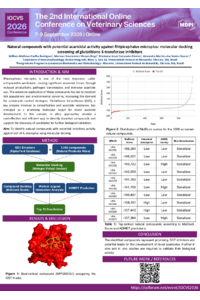
poster_One Health Approaches to Emerging Zoonotic Threats_William Matheus Coelho Rodrigues.pdf
Florfenicol Pharmacokinetics and Pharmacodynamics in Food-Producing Animals: A Systematic Review
Epidemiological Surveillance of Babesia gibsoni in Slovakia: Transmission Routes and Modelling Risk in High-Risk Dog Breeds