Event submissions
Published
This submission belongs to the session S3. Antimicrobial Resistance and Food Safety: A One Health Perspective of the event The 2nd International Online Conference on Veterinary Sciences
Published date
02 Sep, 2026
Academic Editor
'%3e%3cpath%20d='M12.6657%2010.9104C12.4185%2010.325%2012.0599%209.79327%2011.6097%209.34482C11.1609%208.89508%2010.6293%208.5365%2010.0442%208.28888C10.0389%208.28626%2010.0337%208.28495%2010.0285%208.28233C10.8446%207.69279%2011.3752%206.73249%2011.3752%205.64904C11.3752%203.8542%209.92103%202.39999%208.1262%202.39999C6.33136%202.39999%204.87715%203.8542%204.87715%205.64904C4.87715%206.73249%205.40774%207.69279%206.22393%208.28364C6.21869%208.28626%206.21345%208.28757%206.20821%208.29019C5.62129%208.5378%205.09463%208.89284%204.64265%209.34613C4.1929%209.79493%203.83432%2010.3266%203.58671%2010.9117C3.34345%2011.4845%203.21226%2012.0987%203.20023%2012.7209C3.19988%2012.7349%203.20233%2012.7488%203.20744%2012.7619C3.21255%2012.7749%203.22022%2012.7867%203.22998%2012.7968C3.23975%2012.8068%203.25142%2012.8147%203.26431%2012.8202C3.2772%2012.8256%203.29105%2012.8284%203.30504%2012.8284H4.09109C4.14874%2012.8284%204.19459%2012.7825%204.1959%2012.7262C4.2221%2011.7148%204.62823%2010.7676%205.34617%2010.0497C6.08899%209.30683%207.0755%208.89808%208.1262%208.89808C9.17689%208.89808%2010.1634%209.30683%2010.9062%2010.0497C11.6242%2010.7676%2012.0303%2011.7148%2012.0565%2012.7262C12.0578%2012.7838%2012.1037%2012.8284%2012.1613%2012.8284H12.9474C12.9613%2012.8284%2012.9752%2012.8256%2012.9881%2012.8202C13.001%2012.8147%2013.0126%2012.8068%2013.0224%2012.7968C13.0322%2012.7867%2013.0398%2012.7749%2013.0449%2012.7619C13.0501%2012.7488%2013.0525%2012.7349%2013.0522%2012.7209C13.0391%2012.0947%2012.9094%2011.4855%2012.6657%2010.9104ZM8.1262%207.9024C7.52486%207.9024%206.9589%207.6679%206.53312%207.24211C6.10733%206.81633%205.87283%206.25037%205.87283%205.64904C5.87283%205.0477%206.10733%204.48174%206.53312%204.05596C6.9589%203.63018%207.52486%203.39567%208.1262%203.39567C8.72753%203.39567%209.29349%203.63018%209.71927%204.05596C10.1451%204.48174%2010.3796%205.0477%2010.3796%205.64904C10.3796%206.25037%2010.1451%206.81633%209.71927%207.24211C9.29349%207.6679%208.72753%207.9024%208.1262%207.9024Z'%20fill='%235D1EE1'/%3e%3c/g%3e%3c/svg%3e) Ruichao Li
Ruichao LiCitation
Morteza Poormohammad, Pegah Valitabar, Negar Shahverdian, Mahya Yousefi, Milad Hamzehali Tehrani, Prevalence, Geographic Distribution, and Risk Factors of Antimicrobial-Resistant Bacteria in Companion Animals in Iran: A Cross-Sectional One Health Study, in Proceedings of The 2nd International Online Conference on Veterinary Sciences, 7 September–9 September 2026, MDPI: Basel, Switzerland
Share
Email
Facebook
Twitter
LinkedIn
Prevalence, Geographic Distribution, and Risk Factors of Antimicrobial-Resistant Bacteria in Companion Animals in Iran: A Cross-Sectional One Health Study
'%3e%3cpath%20d='M12.6647%2010.9104C12.4176%2010.325%2012.0589%209.7933%2011.6088%209.34485C11.16%208.89511%2010.6283%208.53653%2010.0432%208.28891C10.038%208.28629%2010.0327%208.28498%2010.0275%208.28236C10.8437%207.69282%2011.3743%206.73252%2011.3743%205.64907C11.3743%203.85423%209.92005%202.40002%208.12522%202.40002C6.33038%202.40002%204.87618%203.85423%204.87618%205.64907C4.87618%206.73252%205.40677%207.69282%206.22296%208.28367C6.21772%208.28629%206.21248%208.2876%206.20724%208.29022C5.62031%208.53783%205.09365%208.89287%204.64167%209.34616C4.19192%209.79496%203.83334%2010.3266%203.58573%2010.9117C3.34247%2011.4846%203.21128%2012.0987%203.19925%2012.721C3.1989%2012.735%203.20135%2012.7489%203.20646%2012.7619C3.21157%2012.7749%203.21924%2012.7868%203.22901%2012.7968C3.23877%2012.8068%203.25045%2012.8148%203.26334%2012.8202C3.27623%2012.8256%203.29007%2012.8284%203.30406%2012.8284H4.09012C4.14776%2012.8284%204.19362%2012.7825%204.19493%2012.7262C4.22113%2011.7148%204.62726%2010.7676%205.34519%2010.0497C6.08802%209.30686%207.07452%208.89811%208.12522%208.89811C9.17592%208.89811%2010.1624%209.30686%2010.9052%2010.0497C11.6232%2010.7676%2012.0293%2011.7148%2012.0555%2012.7262C12.0568%2012.7839%2012.1027%2012.8284%2012.1603%2012.8284H12.9464C12.9604%2012.8284%2012.9742%2012.8256%2012.9871%2012.8202C13%2012.8148%2013.0117%2012.8068%2013.0214%2012.7968C13.0312%2012.7868%2013.0389%2012.7749%2013.044%2012.7619C13.0491%2012.7489%2013.0515%2012.735%2013.0512%2012.721C13.0381%2012.0947%2012.9084%2011.4856%2012.6647%2010.9104ZM8.12522%207.90243C7.52388%207.90243%206.95792%207.66793%206.53214%207.24215C6.10636%206.81636%205.87185%206.2504%205.87185%205.64907C5.87185%205.04773%206.10636%204.48177%206.53214%204.05599C6.95792%203.63021%207.52388%203.3957%208.12522%203.3957C8.72655%203.3957%209.29252%203.63021%209.7183%204.05599C10.1441%204.48177%2010.3786%205.04773%2010.3786%205.64907C10.3786%206.2504%2010.1441%206.81636%209.7183%207.24215C9.29252%207.66793%208.72655%207.90243%208.12522%207.90243Z'%20fill='%235D1EE1'/%3e%3c/g%3e%3c/svg%3e)
Morteza Poormohammad 1
Pegah Valitabar 2
Negar Shahverdian 1
Mahya Yousefi 3
Milad Hamzehali Tehrani 4
1. Faculty of Veterinary Medicine, Karaj Branch, Islamic Azad University, Karaj, Iran
2. Department of Avian Diseases, Faculty of Veterinary Medicine, Tehran University, Tehran, Iran
3. Department of Internal Medicine, Faculty of Veterinary Medicine, Science and Research Branch, Islamic Azad University, Tehran, Iran
4. Department of Pathobiology, Faculty of Veterinary Medicine, Science and Research Branch, Islamic Azad University, Tehran, Iran
Abstract
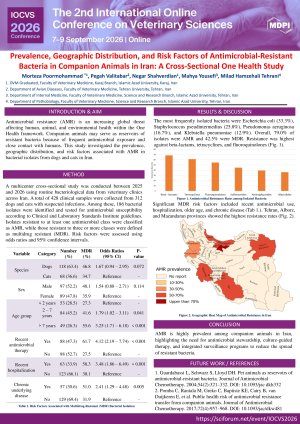
Introduction: Antimicrobial resistance (AMR) is an increasing global threat affecting human, animal, and environmental health within the One Health framework. Companion animals may serve as reservoirs of resistant bacteria because of frequent antimicrobial exposure and close contact with humans. This study investigated the prevalence, geographic distribution, and risk factors associated with AMR in bacterial isolates from dogs and cats in Iran.
Materials and Methods: A multicenter cross-sectional study was conducted between 2025 and 2026 using routine bacteriological data from veterinary clinics across Iran. A total of 428 clinical samples were collected from 312 dogs and cats with suspected infections. Among these, 186 bacterial isolates were identified and tested for antimicrobial susceptibility according to Clinical and Laboratory Standards Institute guidelines. Isolates resistant to at least one antimicrobial class were classified as AMR, while those resistant to three or more classes were defined as multidrug resistant (MDR). Risk factors were assessed using odds ratios and 95% confidence intervals.
Results: The most frequently isolated bacteria were Escherichia coli (33.3%), Staphylococcus pseudintermedius (25.8%), Pseudomonas aeruginosa (16.7%), and Klebsiella pneumoniae (12.9%). Overall, 79.0% of isolates were AMR and 42.5% were MDR. Resistance was highest against beta-lactams, tetracyclines, and fluoroquinolones. Significant MDR risk factors included recent antimicrobial use, hospitalization, older age, and chronic disease. Tehran, Alborz, and Mazandaran provinces showed the highest resistance rates.
Conclusions: AMR is highly prevalent among companion animals in Iran, highlighting the need for antimicrobial stewardship, culture-guided therapy, and integrated surveillance programs to reduce the spread of resistant bacteria.
Keywords
Antimicrobial Resistance
Companion Animals
One Health
Prevalence
Geographic Distribution
Risk Factors
Iran
Poster
Antimicrobial-Resistant Bacteria in Companion Animals in Iran.pdf
Crisaborole resensitizes KPC-producing Gram-negative bacteria to carbapenems
Diversity and Zoonotic Potential of Anaplasma spp. in Domestic Animals and Their Associated Ticks in Sicily: A One Health Perspective