Event submissions
Published
This submission belongs to the session S1. One Health Approaches to Emerging Zoonotic Threats of the event The 2nd International Online Conference on Veterinary Sciences
Published date
02 Sep, 2026
Academic Editor
'%3e%3cpath%20d='M12.6657%2010.9104C12.4185%2010.325%2012.0599%209.79327%2011.6097%209.34482C11.1609%208.89508%2010.6293%208.5365%2010.0442%208.28888C10.0389%208.28626%2010.0337%208.28495%2010.0285%208.28233C10.8446%207.69279%2011.3752%206.73249%2011.3752%205.64904C11.3752%203.8542%209.92103%202.39999%208.1262%202.39999C6.33136%202.39999%204.87715%203.8542%204.87715%205.64904C4.87715%206.73249%205.40774%207.69279%206.22393%208.28364C6.21869%208.28626%206.21345%208.28757%206.20821%208.29019C5.62129%208.5378%205.09463%208.89284%204.64265%209.34613C4.1929%209.79493%203.83432%2010.3266%203.58671%2010.9117C3.34345%2011.4845%203.21226%2012.0987%203.20023%2012.7209C3.19988%2012.7349%203.20233%2012.7488%203.20744%2012.7619C3.21255%2012.7749%203.22022%2012.7867%203.22998%2012.7968C3.23975%2012.8068%203.25142%2012.8147%203.26431%2012.8202C3.2772%2012.8256%203.29105%2012.8284%203.30504%2012.8284H4.09109C4.14874%2012.8284%204.19459%2012.7825%204.1959%2012.7262C4.2221%2011.7148%204.62823%2010.7676%205.34617%2010.0497C6.08899%209.30683%207.0755%208.89808%208.1262%208.89808C9.17689%208.89808%2010.1634%209.30683%2010.9062%2010.0497C11.6242%2010.7676%2012.0303%2011.7148%2012.0565%2012.7262C12.0578%2012.7838%2012.1037%2012.8284%2012.1613%2012.8284H12.9474C12.9613%2012.8284%2012.9752%2012.8256%2012.9881%2012.8202C13.001%2012.8147%2013.0126%2012.8068%2013.0224%2012.7968C13.0322%2012.7867%2013.0398%2012.7749%2013.0449%2012.7619C13.0501%2012.7488%2013.0525%2012.7349%2013.0522%2012.7209C13.0391%2012.0947%2012.9094%2011.4855%2012.6657%2010.9104ZM8.1262%207.9024C7.52486%207.9024%206.9589%207.6679%206.53312%207.24211C6.10733%206.81633%205.87283%206.25037%205.87283%205.64904C5.87283%205.0477%206.10733%204.48174%206.53312%204.05596C6.9589%203.63018%207.52486%203.39567%208.1262%203.39567C8.72753%203.39567%209.29349%203.63018%209.71927%204.05596C10.1451%204.48174%2010.3796%205.0477%2010.3796%205.64904C10.3796%206.25037%2010.1451%206.81633%209.71927%207.24211C9.29349%207.6679%208.72753%207.9024%208.1262%207.9024Z'%20fill='%235D1EE1'/%3e%3c/g%3e%3c/svg%3e) Vittorio Sarchese
Vittorio SarcheseCitation
Santina Di Bella, Martina D'Anna, Cristina Panteghini, Virginia Talarico, Dario Bonomo, Valeria Blanda, Davide Pepe, Francesca Gucciardi, Ettore Napoli, Annalisa Guercio, Diversity and Zoonotic Potential of Anaplasma spp. in Domestic Animals and Their Associated Ticks in Sicily: A One Health Perspective, in Proceedings of The 2nd International Online Conference on Veterinary Sciences, 7 September–9 September 2026, MDPI: Basel, Switzerland
Share
Email
Facebook
Twitter
LinkedIn
Diversity and Zoonotic Potential of Anaplasma spp. in Domestic Animals and Their Associated Ticks in Sicily: A One Health Perspective
'%3e%3cpath%20d='M12.6647%2010.9104C12.4176%2010.325%2012.0589%209.7933%2011.6088%209.34485C11.16%208.89511%2010.6283%208.53653%2010.0432%208.28891C10.038%208.28629%2010.0327%208.28498%2010.0275%208.28236C10.8437%207.69282%2011.3743%206.73252%2011.3743%205.64907C11.3743%203.85423%209.92005%202.40002%208.12522%202.40002C6.33038%202.40002%204.87618%203.85423%204.87618%205.64907C4.87618%206.73252%205.40677%207.69282%206.22296%208.28367C6.21772%208.28629%206.21248%208.2876%206.20724%208.29022C5.62031%208.53783%205.09365%208.89287%204.64167%209.34616C4.19192%209.79496%203.83334%2010.3266%203.58573%2010.9117C3.34247%2011.4846%203.21128%2012.0987%203.19925%2012.721C3.1989%2012.735%203.20135%2012.7489%203.20646%2012.7619C3.21157%2012.7749%203.21924%2012.7868%203.22901%2012.7968C3.23877%2012.8068%203.25045%2012.8148%203.26334%2012.8202C3.27623%2012.8256%203.29007%2012.8284%203.30406%2012.8284H4.09012C4.14776%2012.8284%204.19362%2012.7825%204.19493%2012.7262C4.22113%2011.7148%204.62726%2010.7676%205.34519%2010.0497C6.08802%209.30686%207.07452%208.89811%208.12522%208.89811C9.17592%208.89811%2010.1624%209.30686%2010.9052%2010.0497C11.6232%2010.7676%2012.0293%2011.7148%2012.0555%2012.7262C12.0568%2012.7839%2012.1027%2012.8284%2012.1603%2012.8284H12.9464C12.9604%2012.8284%2012.9742%2012.8256%2012.9871%2012.8202C13%2012.8148%2013.0117%2012.8068%2013.0214%2012.7968C13.0312%2012.7868%2013.0389%2012.7749%2013.044%2012.7619C13.0491%2012.7489%2013.0515%2012.735%2013.0512%2012.721C13.0381%2012.0947%2012.9084%2011.4856%2012.6647%2010.9104ZM8.12522%207.90243C7.52388%207.90243%206.95792%207.66793%206.53214%207.24215C6.10636%206.81636%205.87185%206.2504%205.87185%205.64907C5.87185%205.04773%206.10636%204.48177%206.53214%204.05599C6.95792%203.63021%207.52388%203.3957%208.12522%203.3957C8.72655%203.3957%209.29252%203.63021%209.7183%204.05599C10.1441%204.48177%2010.3786%205.04773%2010.3786%205.64907C10.3786%206.2504%2010.1441%206.81636%209.7183%207.24215C9.29252%207.66793%208.72655%207.90243%208.12522%207.90243Z'%20fill='%235D1EE1'/%3e%3c/g%3e%3c/svg%3e)
Santina Di Bella 1
Martina D'Anna 1
Cristina Panteghini 1
Virginia Talarico 1
Dario Bonomo 1
Valeria Blanda 1
Davide Pepe 1
Francesca Gucciardi 1
Ettore Napoli 2
Annalisa Guercio 1
1. Istituto Zooprofilattico Sperimentale della Sicilia “A. Mirri”, 90129 Palermo, Italy
2. Department of Veterinary Sciences, University of Messina, Viale Giovanni Palatuci 13, 98168 Messina, Italy
Abstract
Introduction
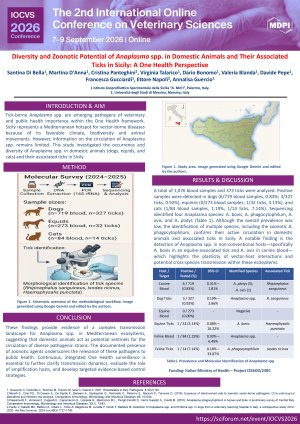
Tick-borne pathogens of the genus Anaplasma are of increasing concern within the One Health framework because of their impact on animal and human health. Sicily is a Mediterranean hotspot for vector-borne diseases due to its climate, biodiversity, and animal movements; however, data on the circulation of Anaplasma spp. in domestic animals and associated ticks remain limited. Dogs, equids, and cats can serve as sentinels of pathogen circulation. This study investigated the occurrence and diversity of Anaplasma spp. in these hosts and their ticks in Sicily.
Materials and Methods
Between 2024 and 2025, a molecular survey was conducted in the Sicilian provinces of Palermo, Messina, Siracusa, Agrigento, Trapani, and Catania. Samples were collected throughout all seasons. Blood samples from dogs (n=719), equids (n=273), and cats (n=84), together with ticks collected from the same animals (dogs: n=327; equids: n=32; cats: n=14), were analyzed. Ticks were identified as Rhipicephalus sanguineus, Ixodes ricinus, and Haemaphysalis punctata. DNA was extracted and screened by PCR targeting the 16S rRNA gene; positive amplicons were sequenced.
Results
Anaplasma DNA was detected in 6/719 canine blood samples (0.83%; 95%CI: 0.31–1.81%) and 3/327 dog ticks (0.92%; 95%CI: 0.19–2.66%). All equine blood samples were negative, whereas 1/32 ticks from equids tested positive (3.13%; 95%CI: 0.08–16.22%). In cats, positivity was detected in 1/84 blood samples (1.19%; 95%CI: 0.03–6.46%) and 1/14 ticks (7.14%; 95%CI: 0.18–33.87%). Sequencing identified A. bovis, A. phagocytophilum, A. ovis, and A. platys. Given the low number of positives and wide confidence intervals, these findings should be interpreted cautiously.
Conclusions
The detection of multiple Anaplasma species, including the zoonotic pathogen A. phagocytophilum, demonstrates their circulation in Sicily and suggests active host–tick transmission cycles. These preliminary findings highlight the need for integrated One Health surveillance to better understand transmission dynamics and support control strategies in Mediterranean ecosystems.
Funding: Italian Ministry of Healt, Project IZSSI03/23RC.
Keywords
Anaplasma spp
dogs
cats
equids
ticks
Poster
Di Bella et al. 2026 Anaplasma.pdf
Prevalence, Geographic Distribution, and Risk Factors of Antimicrobial-Resistant Bacteria in Companion Animals in Iran: A Cross-Sectional One Health Study
Assessment of Oxidative Stress in Clinical Bovine Leukosis and Asymptomatic Seropositive Cattle