Event submissions
Published
This submission belongs to the session S1. One Health Approaches to Emerging Zoonotic Threats of the event The 2nd International Online Conference on Veterinary Sciences
Published date
02 Sep, 2026
Academic Editor
'%3e%3cpath%20d='M12.6657%2010.9104C12.4185%2010.325%2012.0599%209.79327%2011.6097%209.34482C11.1609%208.89508%2010.6293%208.5365%2010.0442%208.28888C10.0389%208.28626%2010.0337%208.28495%2010.0285%208.28233C10.8446%207.69279%2011.3752%206.73249%2011.3752%205.64904C11.3752%203.8542%209.92103%202.39999%208.1262%202.39999C6.33136%202.39999%204.87715%203.8542%204.87715%205.64904C4.87715%206.73249%205.40774%207.69279%206.22393%208.28364C6.21869%208.28626%206.21345%208.28757%206.20821%208.29019C5.62129%208.5378%205.09463%208.89284%204.64265%209.34613C4.1929%209.79493%203.83432%2010.3266%203.58671%2010.9117C3.34345%2011.4845%203.21226%2012.0987%203.20023%2012.7209C3.19988%2012.7349%203.20233%2012.7488%203.20744%2012.7619C3.21255%2012.7749%203.22022%2012.7867%203.22998%2012.7968C3.23975%2012.8068%203.25142%2012.8147%203.26431%2012.8202C3.2772%2012.8256%203.29105%2012.8284%203.30504%2012.8284H4.09109C4.14874%2012.8284%204.19459%2012.7825%204.1959%2012.7262C4.2221%2011.7148%204.62823%2010.7676%205.34617%2010.0497C6.08899%209.30683%207.0755%208.89808%208.1262%208.89808C9.17689%208.89808%2010.1634%209.30683%2010.9062%2010.0497C11.6242%2010.7676%2012.0303%2011.7148%2012.0565%2012.7262C12.0578%2012.7838%2012.1037%2012.8284%2012.1613%2012.8284H12.9474C12.9613%2012.8284%2012.9752%2012.8256%2012.9881%2012.8202C13.001%2012.8147%2013.0126%2012.8068%2013.0224%2012.7968C13.0322%2012.7867%2013.0398%2012.7749%2013.0449%2012.7619C13.0501%2012.7488%2013.0525%2012.7349%2013.0522%2012.7209C13.0391%2012.0947%2012.9094%2011.4855%2012.6657%2010.9104ZM8.1262%207.9024C7.52486%207.9024%206.9589%207.6679%206.53312%207.24211C6.10733%206.81633%205.87283%206.25037%205.87283%205.64904C5.87283%205.0477%206.10733%204.48174%206.53312%204.05596C6.9589%203.63018%207.52486%203.39567%208.1262%203.39567C8.72753%203.39567%209.29349%203.63018%209.71927%204.05596C10.1451%204.48174%2010.3796%205.0477%2010.3796%205.64904C10.3796%206.25037%2010.1451%206.81633%209.71927%207.24211C9.29349%207.6679%208.72753%207.9024%208.1262%207.9024Z'%20fill='%235D1EE1'/%3e%3c/g%3e%3c/svg%3e) Vittorio Sarchese
Vittorio SarcheseCitation
Amirreza Khodayari Kamsorkh, Masoud Abedi, Mohammadhossein Mostafavi, Amirmahdi Zobeidi, Sonia Jafarinia, Amirsajad jafari, Transcriptome-Driven Repurposing for Chikungunya Virus: A Connectivity Map Approach, in Proceedings of The 2nd International Online Conference on Veterinary Sciences, 7 September–9 September 2026, MDPI: Basel, Switzerland
Share
Email
Facebook
Twitter
LinkedIn
Transcriptome-Driven Repurposing for Chikungunya Virus: A Connectivity Map Approach
'%3e%3cpath%20d='M12.6647%2010.9104C12.4176%2010.325%2012.0589%209.7933%2011.6088%209.34485C11.16%208.89511%2010.6283%208.53653%2010.0432%208.28891C10.038%208.28629%2010.0327%208.28498%2010.0275%208.28236C10.8437%207.69282%2011.3743%206.73252%2011.3743%205.64907C11.3743%203.85423%209.92005%202.40002%208.12522%202.40002C6.33038%202.40002%204.87618%203.85423%204.87618%205.64907C4.87618%206.73252%205.40677%207.69282%206.22296%208.28367C6.21772%208.28629%206.21248%208.2876%206.20724%208.29022C5.62031%208.53783%205.09365%208.89287%204.64167%209.34616C4.19192%209.79496%203.83334%2010.3266%203.58573%2010.9117C3.34247%2011.4846%203.21128%2012.0987%203.19925%2012.721C3.1989%2012.735%203.20135%2012.7489%203.20646%2012.7619C3.21157%2012.7749%203.21924%2012.7868%203.22901%2012.7968C3.23877%2012.8068%203.25045%2012.8148%203.26334%2012.8202C3.27623%2012.8256%203.29007%2012.8284%203.30406%2012.8284H4.09012C4.14776%2012.8284%204.19362%2012.7825%204.19493%2012.7262C4.22113%2011.7148%204.62726%2010.7676%205.34519%2010.0497C6.08802%209.30686%207.07452%208.89811%208.12522%208.89811C9.17592%208.89811%2010.1624%209.30686%2010.9052%2010.0497C11.6232%2010.7676%2012.0293%2011.7148%2012.0555%2012.7262C12.0568%2012.7839%2012.1027%2012.8284%2012.1603%2012.8284H12.9464C12.9604%2012.8284%2012.9742%2012.8256%2012.9871%2012.8202C13%2012.8148%2013.0117%2012.8068%2013.0214%2012.7968C13.0312%2012.7868%2013.0389%2012.7749%2013.044%2012.7619C13.0491%2012.7489%2013.0515%2012.735%2013.0512%2012.721C13.0381%2012.0947%2012.9084%2011.4856%2012.6647%2010.9104ZM8.12522%207.90243C7.52388%207.90243%206.95792%207.66793%206.53214%207.24215C6.10636%206.81636%205.87185%206.2504%205.87185%205.64907C5.87185%205.04773%206.10636%204.48177%206.53214%204.05599C6.95792%203.63021%207.52388%203.3957%208.12522%203.3957C8.72655%203.3957%209.29252%203.63021%209.7183%204.05599C10.1441%204.48177%2010.3786%205.04773%2010.3786%205.64907C10.3786%206.2504%2010.1441%206.81636%209.7183%207.24215C9.29252%207.66793%208.72655%207.90243%208.12522%207.90243Z'%20fill='%235D1EE1'/%3e%3c/g%3e%3c/svg%3e)
Amirreza Khodayari Kamsorkh 1

Masoud Abedi 1
Mohammadhossein Mostafavi 1
Amirmahdi Zobeidi 1
Sonia Jafarinia 2
Amirsajad jafari 3,4
1. Faculty of Veterinary Medicine, Shahid Bahonar University of Kerman, Kerman, Iran
2. Faculty of Veterinary Medicine, Azad University of Karaj, Alborz, Iran
3. Medicinal and Natural Products Chemistry Research Center, Shiraz University of Medical Sciences, Shiraz, Iran
4. Department of Basic Sciences, School of Veterinary Medicine, Shiraz University, Shiraz, Iran
Abstract
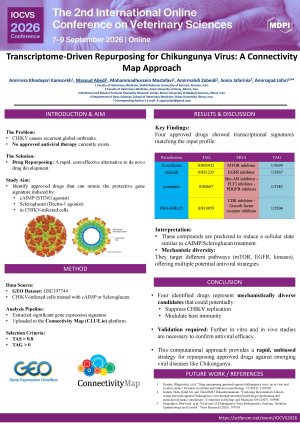
Introduction: Chikungunya virus (CHIKV) causes recurrent outbreaks worldwide with no approved antiviral therapy available. Drug repurposing offers a rapid and cost-effective alternative to de novo drug development. This study aimed to identify existing approved drugs that can reverse or mimic a protective gene expression signature induced by immunomodulatory compounds in CHIKV-infected cells.
Methods: A gene expression profile was derived from CHIKV-infected cells treated with cAIMP (a STING agonist) or scleroglucan (a Dectin‑1 agonist), dataset GeoNCBI GSE197744. The resulting significant gene signature was uploaded to the Connectivity Map platform (www.clue.io). Drugs with a high connectivity score (TAS > 0.8 and TAG > 0) were selected as candidates for repurposing.
Results: The analysis yielded five drugs with transcriptional signatures matching the input profile: everolimus (mTOR inhibitor), afatinib (EGFR/HER2 inhibitor), ponatinib (multi‑kinase inhibitor), PHA‑848125 (dual CDK/tropomyosin receptor kinase inhibitor), and brefeldin‑A (protein transport inhibitor). These compounds are predicted to induce a cellular state like that produced by cAIMP/scleroglucan in infected cells.
Conclusions: The four identified drugs represent mechanistically diverse candidates that could potentially suppress CHIKV replication or modulate host immunity. Further in vitro and in vivo validation is required to confirm their antiviral efficacy. However, this computational approach demonstrates a rapid and unbiased strategy for repurposing approved drugs for emerging viral diseases, such as Chikungunya.
Keywords
Connectivity Map
Zoonosis
GEO
Bioinformatics
Drug Repurposing
Poster
Sciforum-193188-Poster.pdf
Assessment of Oxidative Stress in Clinical Bovine Leukosis and Asymptomatic Seropositive Cattle
Genotypic and Phenotypic Characterization of Listeria Monocytogenes Reveals Challenges to Sanitization Efficacy in Brazilian Food Industries