Event submissions
Published
This submission belongs to the session S1. One Health Approaches to Emerging Zoonotic Threats of the event The 2nd International Online Conference on Veterinary Sciences
Published date
02 Sep, 2026
Academic Editor
'%3e%3cpath%20d='M12.6657%2010.9104C12.4185%2010.325%2012.0599%209.79327%2011.6097%209.34482C11.1609%208.89508%2010.6293%208.5365%2010.0442%208.28888C10.0389%208.28626%2010.0337%208.28495%2010.0285%208.28233C10.8446%207.69279%2011.3752%206.73249%2011.3752%205.64904C11.3752%203.8542%209.92103%202.39999%208.1262%202.39999C6.33136%202.39999%204.87715%203.8542%204.87715%205.64904C4.87715%206.73249%205.40774%207.69279%206.22393%208.28364C6.21869%208.28626%206.21345%208.28757%206.20821%208.29019C5.62129%208.5378%205.09463%208.89284%204.64265%209.34613C4.1929%209.79493%203.83432%2010.3266%203.58671%2010.9117C3.34345%2011.4845%203.21226%2012.0987%203.20023%2012.7209C3.19988%2012.7349%203.20233%2012.7488%203.20744%2012.7619C3.21255%2012.7749%203.22022%2012.7867%203.22998%2012.7968C3.23975%2012.8068%203.25142%2012.8147%203.26431%2012.8202C3.2772%2012.8256%203.29105%2012.8284%203.30504%2012.8284H4.09109C4.14874%2012.8284%204.19459%2012.7825%204.1959%2012.7262C4.2221%2011.7148%204.62823%2010.7676%205.34617%2010.0497C6.08899%209.30683%207.0755%208.89808%208.1262%208.89808C9.17689%208.89808%2010.1634%209.30683%2010.9062%2010.0497C11.6242%2010.7676%2012.0303%2011.7148%2012.0565%2012.7262C12.0578%2012.7838%2012.1037%2012.8284%2012.1613%2012.8284H12.9474C12.9613%2012.8284%2012.9752%2012.8256%2012.9881%2012.8202C13.001%2012.8147%2013.0126%2012.8068%2013.0224%2012.7968C13.0322%2012.7867%2013.0398%2012.7749%2013.0449%2012.7619C13.0501%2012.7488%2013.0525%2012.7349%2013.0522%2012.7209C13.0391%2012.0947%2012.9094%2011.4855%2012.6657%2010.9104ZM8.1262%207.9024C7.52486%207.9024%206.9589%207.6679%206.53312%207.24211C6.10733%206.81633%205.87283%206.25037%205.87283%205.64904C5.87283%205.0477%206.10733%204.48174%206.53312%204.05596C6.9589%203.63018%207.52486%203.39567%208.1262%203.39567C8.72753%203.39567%209.29349%203.63018%209.71927%204.05596C10.1451%204.48174%2010.3796%205.0477%2010.3796%205.64904C10.3796%206.25037%2010.1451%206.81633%209.71927%207.24211C9.29349%207.6679%208.72753%207.9024%208.1262%207.9024Z'%20fill='%235D1EE1'/%3e%3c/g%3e%3c/svg%3e) Chengming Wang
Chengming WangCitation
Amirmahdi Zobeidi, Mohammadhossein Mostafavi, Samin Zarshenas, Farnoush Kamranfard, Amir sajad Jafari, Curcumin vs. Toxoplasma gondii: A Network Pharmacology and Molecular Docking Blueprint for Anti-Parasitic Target Identification, in Proceedings of The 2nd International Online Conference on Veterinary Sciences, 7 September–9 September 2026, MDPI: Basel, Switzerland
Share
Email
Facebook
Twitter
LinkedIn
Curcumin vs. Toxoplasma gondii: A Network Pharmacology and Molecular Docking Blueprint for Anti-Parasitic Target Identification
'%3e%3cpath%20d='M12.6647%2010.9104C12.4176%2010.325%2012.0589%209.7933%2011.6088%209.34485C11.16%208.89511%2010.6283%208.53653%2010.0432%208.28891C10.038%208.28629%2010.0327%208.28498%2010.0275%208.28236C10.8437%207.69282%2011.3743%206.73252%2011.3743%205.64907C11.3743%203.85423%209.92005%202.40002%208.12522%202.40002C6.33038%202.40002%204.87618%203.85423%204.87618%205.64907C4.87618%206.73252%205.40677%207.69282%206.22296%208.28367C6.21772%208.28629%206.21248%208.2876%206.20724%208.29022C5.62031%208.53783%205.09365%208.89287%204.64167%209.34616C4.19192%209.79496%203.83334%2010.3266%203.58573%2010.9117C3.34247%2011.4846%203.21128%2012.0987%203.19925%2012.721C3.1989%2012.735%203.20135%2012.7489%203.20646%2012.7619C3.21157%2012.7749%203.21924%2012.7868%203.22901%2012.7968C3.23877%2012.8068%203.25045%2012.8148%203.26334%2012.8202C3.27623%2012.8256%203.29007%2012.8284%203.30406%2012.8284H4.09012C4.14776%2012.8284%204.19362%2012.7825%204.19493%2012.7262C4.22113%2011.7148%204.62726%2010.7676%205.34519%2010.0497C6.08802%209.30686%207.07452%208.89811%208.12522%208.89811C9.17592%208.89811%2010.1624%209.30686%2010.9052%2010.0497C11.6232%2010.7676%2012.0293%2011.7148%2012.0555%2012.7262C12.0568%2012.7839%2012.1027%2012.8284%2012.1603%2012.8284H12.9464C12.9604%2012.8284%2012.9742%2012.8256%2012.9871%2012.8202C13%2012.8148%2013.0117%2012.8068%2013.0214%2012.7968C13.0312%2012.7868%2013.0389%2012.7749%2013.044%2012.7619C13.0491%2012.7489%2013.0515%2012.735%2013.0512%2012.721C13.0381%2012.0947%2012.9084%2011.4856%2012.6647%2010.9104ZM8.12522%207.90243C7.52388%207.90243%206.95792%207.66793%206.53214%207.24215C6.10636%206.81636%205.87185%206.2504%205.87185%205.64907C5.87185%205.04773%206.10636%204.48177%206.53214%204.05599C6.95792%203.63021%207.52388%203.3957%208.12522%203.3957C8.72655%203.3957%209.29252%203.63021%209.7183%204.05599C10.1441%204.48177%2010.3786%205.04773%2010.3786%205.64907C10.3786%206.2504%2010.1441%206.81636%209.7183%207.24215C9.29252%207.66793%208.72655%207.90243%208.12522%207.90243Z'%20fill='%235D1EE1'/%3e%3c/g%3e%3c/svg%3e)
Amirmahdi Zobeidi 1
Mohammadhossein Mostafavi 1
Samin Zarshenas 2
Farnoush Kamranfard 3
Amir sajad Jafari 3,4
1. Faculty of Veterinary Medicine, Shahid Bahonar University of Kerman, Kerman, Iran
2. Student Research Committee, Shiraz University of Medical Sciences, Shiraz, Iran
3. Department of Basic Sciences, School of Veterinary Medicine, Shiraz University, Shiraz, Iran
4. Medicinal and Natural Products Chemistry Research Center, Shiraz University of Medical Sciences, Shiraz, Iran
Abstract
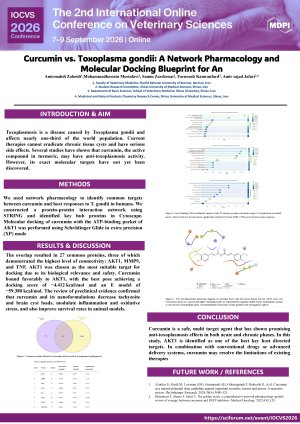
Introduction: Toxoplasmosis is a disease caused by Toxoplasma gondii and affects nearly one third of the world population. Current therapies cannot eradicate chronic tissue cysts and have serious side effects. Several studies confirmed that curcumin, the active compound in turmeric, may have anti toxoplasmosis activities. However, its exact molecular targets are not still discovered.
Methods: We used network pharmacology to identify common targets between curcumin and host responses to T. gondii in human. A protein protein interaction network was constructed by STRING and the key hub proteins were identified using Cytoscape. Molecular docking of curcumin with the ATP binding pocket of AKT1 was performed using Schrödinger Glide in extra precision (XP) mode.
Results: The overlap resulted in 27 common proteins, three of which¬¬ demonstrated the highest level of connectivity: AKT1, MMP9, and TNF. AKT1 was chosen as the most suitable target for docking due to its biological relevance and safety. Curcumin bound favorably to AKT1 with the best pose achieving a docking score of −4.412 kcal/mol and an E model of −59.380 kcal/mol. The review of preclinical evidence confirmed that curcumin and its nanoformulations decrease tachyzoite and brain cyst loads, modulate inflammation and oxidative stress, and also improve survival rates in animal models.
Conclusions: Curcumin is a safe, multi target agent that has shown promising anti-toxoplasmosis effects in both acute and chronic phases. In this study, AKT1 is identified as one of the best key host directed targets. In combination with conventional drugs or advanced delivery systems, curcumin may resolve the limitations of existing therapies.
Keywords
Curcumin
Toxoplasma gondii
Network pharmacology
AKT1
Poster
Jafari.pdf
Retrospective Analysis of Serological Positivity Patterns for Bovine Viral Diarrhea, Infectious Bovine Rhinotracheitis, and Leptospirosis in Brazilian Cattle Herds: Insights from a 16-Year National Dataset
Antimicrobial Stewardship and Food Safety: Effects of Dietary Inclusion of Piper guineense on Organ Safety in Broiler Chickens Reared under Different Housing Systems