Event submissions
Published
This submission belongs to the session S1. One Health Approaches to Emerging Zoonotic Threats of the event The 2nd International Online Conference on Veterinary Sciences
Published date
02 Sep, 2026
Academic Editor
'%3e%3cpath%20d='M12.6657%2010.9104C12.4185%2010.325%2012.0599%209.79327%2011.6097%209.34482C11.1609%208.89508%2010.6293%208.5365%2010.0442%208.28888C10.0389%208.28626%2010.0337%208.28495%2010.0285%208.28233C10.8446%207.69279%2011.3752%206.73249%2011.3752%205.64904C11.3752%203.8542%209.92103%202.39999%208.1262%202.39999C6.33136%202.39999%204.87715%203.8542%204.87715%205.64904C4.87715%206.73249%205.40774%207.69279%206.22393%208.28364C6.21869%208.28626%206.21345%208.28757%206.20821%208.29019C5.62129%208.5378%205.09463%208.89284%204.64265%209.34613C4.1929%209.79493%203.83432%2010.3266%203.58671%2010.9117C3.34345%2011.4845%203.21226%2012.0987%203.20023%2012.7209C3.19988%2012.7349%203.20233%2012.7488%203.20744%2012.7619C3.21255%2012.7749%203.22022%2012.7867%203.22998%2012.7968C3.23975%2012.8068%203.25142%2012.8147%203.26431%2012.8202C3.2772%2012.8256%203.29105%2012.8284%203.30504%2012.8284H4.09109C4.14874%2012.8284%204.19459%2012.7825%204.1959%2012.7262C4.2221%2011.7148%204.62823%2010.7676%205.34617%2010.0497C6.08899%209.30683%207.0755%208.89808%208.1262%208.89808C9.17689%208.89808%2010.1634%209.30683%2010.9062%2010.0497C11.6242%2010.7676%2012.0303%2011.7148%2012.0565%2012.7262C12.0578%2012.7838%2012.1037%2012.8284%2012.1613%2012.8284H12.9474C12.9613%2012.8284%2012.9752%2012.8256%2012.9881%2012.8202C13.001%2012.8147%2013.0126%2012.8068%2013.0224%2012.7968C13.0322%2012.7867%2013.0398%2012.7749%2013.0449%2012.7619C13.0501%2012.7488%2013.0525%2012.7349%2013.0522%2012.7209C13.0391%2012.0947%2012.9094%2011.4855%2012.6657%2010.9104ZM8.1262%207.9024C7.52486%207.9024%206.9589%207.6679%206.53312%207.24211C6.10733%206.81633%205.87283%206.25037%205.87283%205.64904C5.87283%205.0477%206.10733%204.48174%206.53312%204.05596C6.9589%203.63018%207.52486%203.39567%208.1262%203.39567C8.72753%203.39567%209.29349%203.63018%209.71927%204.05596C10.1451%204.48174%2010.3796%205.0477%2010.3796%205.64904C10.3796%206.25037%2010.1451%206.81633%209.71927%207.24211C9.29349%207.6679%208.72753%207.9024%208.1262%207.9024Z'%20fill='%235D1EE1'/%3e%3c/g%3e%3c/svg%3e) Chengming Wang
Chengming WangCitation
Sonia Jafarinia, Amirreza Khodayari Kamsorkh, Masoud Abedi, Amirsajad Jafari, De Novo Discovery of Dual Hantavirus Gc/Gn Inhibitors Using a General-Purpose Generative AI, in Proceedings of The 2nd International Online Conference on Veterinary Sciences, 7 September–9 September 2026, MDPI: Basel, Switzerland
Share
Email
Facebook
Twitter
LinkedIn
De Novo Discovery of Dual Hantavirus Gc/Gn Inhibitors Using a General-Purpose Generative AI
'%3e%3cpath%20d='M12.6647%2010.9104C12.4176%2010.325%2012.0589%209.7933%2011.6088%209.34485C11.16%208.89511%2010.6283%208.53653%2010.0432%208.28891C10.038%208.28629%2010.0327%208.28498%2010.0275%208.28236C10.8437%207.69282%2011.3743%206.73252%2011.3743%205.64907C11.3743%203.85423%209.92005%202.40002%208.12522%202.40002C6.33038%202.40002%204.87618%203.85423%204.87618%205.64907C4.87618%206.73252%205.40677%207.69282%206.22296%208.28367C6.21772%208.28629%206.21248%208.2876%206.20724%208.29022C5.62031%208.53783%205.09365%208.89287%204.64167%209.34616C4.19192%209.79496%203.83334%2010.3266%203.58573%2010.9117C3.34247%2011.4846%203.21128%2012.0987%203.19925%2012.721C3.1989%2012.735%203.20135%2012.7489%203.20646%2012.7619C3.21157%2012.7749%203.21924%2012.7868%203.22901%2012.7968C3.23877%2012.8068%203.25045%2012.8148%203.26334%2012.8202C3.27623%2012.8256%203.29007%2012.8284%203.30406%2012.8284H4.09012C4.14776%2012.8284%204.19362%2012.7825%204.19493%2012.7262C4.22113%2011.7148%204.62726%2010.7676%205.34519%2010.0497C6.08802%209.30686%207.07452%208.89811%208.12522%208.89811C9.17592%208.89811%2010.1624%209.30686%2010.9052%2010.0497C11.6232%2010.7676%2012.0293%2011.7148%2012.0555%2012.7262C12.0568%2012.7839%2012.1027%2012.8284%2012.1603%2012.8284H12.9464C12.9604%2012.8284%2012.9742%2012.8256%2012.9871%2012.8202C13%2012.8148%2013.0117%2012.8068%2013.0214%2012.7968C13.0312%2012.7868%2013.0389%2012.7749%2013.044%2012.7619C13.0491%2012.7489%2013.0515%2012.735%2013.0512%2012.721C13.0381%2012.0947%2012.9084%2011.4856%2012.6647%2010.9104ZM8.12522%207.90243C7.52388%207.90243%206.95792%207.66793%206.53214%207.24215C6.10636%206.81636%205.87185%206.2504%205.87185%205.64907C5.87185%205.04773%206.10636%204.48177%206.53214%204.05599C6.95792%203.63021%207.52388%203.3957%208.12522%203.3957C8.72655%203.3957%209.29252%203.63021%209.7183%204.05599C10.1441%204.48177%2010.3786%205.04773%2010.3786%205.64907C10.3786%206.2504%2010.1441%206.81636%209.7183%207.24215C9.29252%207.66793%208.72655%207.90243%208.12522%207.90243Z'%20fill='%235D1EE1'/%3e%3c/g%3e%3c/svg%3e)
Sonia Jafarinia 1
Amirreza Khodayari Kamsorkh 2

Masoud Abedi 2
Amirsajad Jafari 3,4
1. Faculty of Veterinary Medicine, Azad University of Karaj, Alborz, Iran
2. Faculty of Veterinary Medicine, Shahid Bahonar University of Kerman, Kerman, Iran
3. Medicinal and Natural Products Chemistry Research Center, Shiraz University of Medical Sciences, Shiraz, Iran
4. Department of Basic Sciences, School of Veterinary Medicine, Shiraz University, Shiraz, Iran
Abstract
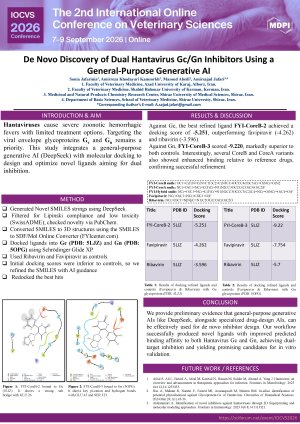
Background: Hantaviruses cause severe zoonotic hemorrhagic fevers with limited treatment options. Targeting the viral envelope glycoproteins Gc and Gn remains a priority. This study integrates a general-purpose generative AI (DeepSeek) with molecular docking to design and optimize novel ligands aiming for dual inhibition.
Methods: Novel SMILES strings were generated using DeepSeek, filtered for Lipinski compliance and low toxicity (SwissADME), and checked for novelty via PubChem. SMILES were converted to 3D structures using the SMILES to SDF/Mol Online Converter (FYIcenter.com). Ligands were docked into Hantavirus Gc (PDB: 5LJZ) and Gn (PDB: 5OPG) using Schrödinger Glide XP, with ribavirin and favipiravir as controls. Initial docking scores were inferior to controls, prompting AI-guided SMILES refinement and re-docking.
Results: Against Gc, the best refined ligand (FYI-CoreB-2) achieved a docking score of -5.251, outperforming favipiravir (-4.262) and ribavirin (-3.596). Against Gn, FYI-CoreB-3 scored -9.220, markedly superior to both controls. Several CoreB and CoreA variants showed enhanced binding relative to reference drugs, confirming successful refinement.
Conclusion: We provide preliminary evidence that general-purpose generative AIs like DeepSeek, alongside specialized drug-design AIs, can be effectively used for de novo inhibitor design. Our workflow produced novel ligands with improved predicted binding affinity to both Hantavirus Gc and Gn, achieving dual-target inhibition and yielding promising candidates for in vitro validation.
Keywords
Zoonotic
AI
Molecular docking
Dual-target inhibition
Drug design
Poster
Sciforum-192116-Poster.pdf
Splenic and Systemic Lymphoma in an FIV‑Positive Cat: A Case Report Highlighting Diagnostic Discordance in Cytology Interpretation
Diversity and Characterization of Lytic Bacteriophage Plaque Morphotypes Targeting Escherichia coli from Anthropized Aquatic Environments in Curitiba, Brazil: Implications for Phage Therapy