Event submissions
Published
This submission belongs to the session S2. Surveillance and Epidemiological Modelling at the Human–Animal–Environment Interface of the event The 2nd International Online Conference on Veterinary Sciences
Published date
02 Sep, 2026
Academic Editor
'%3e%3cpath%20d='M12.6657%2010.9104C12.4185%2010.325%2012.0599%209.79327%2011.6097%209.34482C11.1609%208.89508%2010.6293%208.5365%2010.0442%208.28888C10.0389%208.28626%2010.0337%208.28495%2010.0285%208.28233C10.8446%207.69279%2011.3752%206.73249%2011.3752%205.64904C11.3752%203.8542%209.92103%202.39999%208.1262%202.39999C6.33136%202.39999%204.87715%203.8542%204.87715%205.64904C4.87715%206.73249%205.40774%207.69279%206.22393%208.28364C6.21869%208.28626%206.21345%208.28757%206.20821%208.29019C5.62129%208.5378%205.09463%208.89284%204.64265%209.34613C4.1929%209.79493%203.83432%2010.3266%203.58671%2010.9117C3.34345%2011.4845%203.21226%2012.0987%203.20023%2012.7209C3.19988%2012.7349%203.20233%2012.7488%203.20744%2012.7619C3.21255%2012.7749%203.22022%2012.7867%203.22998%2012.7968C3.23975%2012.8068%203.25142%2012.8147%203.26431%2012.8202C3.2772%2012.8256%203.29105%2012.8284%203.30504%2012.8284H4.09109C4.14874%2012.8284%204.19459%2012.7825%204.1959%2012.7262C4.2221%2011.7148%204.62823%2010.7676%205.34617%2010.0497C6.08899%209.30683%207.0755%208.89808%208.1262%208.89808C9.17689%208.89808%2010.1634%209.30683%2010.9062%2010.0497C11.6242%2010.7676%2012.0303%2011.7148%2012.0565%2012.7262C12.0578%2012.7838%2012.1037%2012.8284%2012.1613%2012.8284H12.9474C12.9613%2012.8284%2012.9752%2012.8256%2012.9881%2012.8202C13.001%2012.8147%2013.0126%2012.8068%2013.0224%2012.7968C13.0322%2012.7867%2013.0398%2012.7749%2013.0449%2012.7619C13.0501%2012.7488%2013.0525%2012.7349%2013.0522%2012.7209C13.0391%2012.0947%2012.9094%2011.4855%2012.6657%2010.9104ZM8.1262%207.9024C7.52486%207.9024%206.9589%207.6679%206.53312%207.24211C6.10733%206.81633%205.87283%206.25037%205.87283%205.64904C5.87283%205.0477%206.10733%204.48174%206.53312%204.05596C6.9589%203.63018%207.52486%203.39567%208.1262%203.39567C8.72753%203.39567%209.29349%203.63018%209.71927%204.05596C10.1451%204.48174%2010.3796%205.0477%2010.3796%205.64904C10.3796%206.25037%2010.1451%206.81633%209.71927%207.24211C9.29349%207.6679%208.72753%207.9024%208.1262%207.9024Z'%20fill='%235D1EE1'/%3e%3c/g%3e%3c/svg%3e) Francesco Mira
Francesco MiraCitation
Héctor Fernández, Lidia Sánchez-Morales, Víctor Luque, Alberto Perelló, Aleksandra Kosowska, Christian Gortázar, Nerea García, José Ángel Barasona, Tania Ayllón, WILD UNGULATES AS SENTINELS OF CRIMEAN-CONGO HEMORRHAGIC FEVER VIRUS CIRCULATION IN SPAIN, in Proceedings of The 2nd International Online Conference on Veterinary Sciences, 7 September–9 September 2026, MDPI: Basel, Switzerland
Share
Email
Facebook
Twitter
LinkedIn
WILD UNGULATES AS SENTINELS OF CRIMEAN-CONGO HEMORRHAGIC FEVER VIRUS CIRCULATION IN SPAIN
'%3e%3cpath%20d='M12.6647%2010.9104C12.4176%2010.325%2012.0589%209.7933%2011.6088%209.34485C11.16%208.89511%2010.6283%208.53653%2010.0432%208.28891C10.038%208.28629%2010.0327%208.28498%2010.0275%208.28236C10.8437%207.69282%2011.3743%206.73252%2011.3743%205.64907C11.3743%203.85423%209.92005%202.40002%208.12522%202.40002C6.33038%202.40002%204.87618%203.85423%204.87618%205.64907C4.87618%206.73252%205.40677%207.69282%206.22296%208.28367C6.21772%208.28629%206.21248%208.2876%206.20724%208.29022C5.62031%208.53783%205.09365%208.89287%204.64167%209.34616C4.19192%209.79496%203.83334%2010.3266%203.58573%2010.9117C3.34247%2011.4846%203.21128%2012.0987%203.19925%2012.721C3.1989%2012.735%203.20135%2012.7489%203.20646%2012.7619C3.21157%2012.7749%203.21924%2012.7868%203.22901%2012.7968C3.23877%2012.8068%203.25045%2012.8148%203.26334%2012.8202C3.27623%2012.8256%203.29007%2012.8284%203.30406%2012.8284H4.09012C4.14776%2012.8284%204.19362%2012.7825%204.19493%2012.7262C4.22113%2011.7148%204.62726%2010.7676%205.34519%2010.0497C6.08802%209.30686%207.07452%208.89811%208.12522%208.89811C9.17592%208.89811%2010.1624%209.30686%2010.9052%2010.0497C11.6232%2010.7676%2012.0293%2011.7148%2012.0555%2012.7262C12.0568%2012.7839%2012.1027%2012.8284%2012.1603%2012.8284H12.9464C12.9604%2012.8284%2012.9742%2012.8256%2012.9871%2012.8202C13%2012.8148%2013.0117%2012.8068%2013.0214%2012.7968C13.0312%2012.7868%2013.0389%2012.7749%2013.044%2012.7619C13.0491%2012.7489%2013.0515%2012.735%2013.0512%2012.721C13.0381%2012.0947%2012.9084%2011.4856%2012.6647%2010.9104ZM8.12522%207.90243C7.52388%207.90243%206.95792%207.66793%206.53214%207.24215C6.10636%206.81636%205.87185%206.2504%205.87185%205.64907C5.87185%205.04773%206.10636%204.48177%206.53214%204.05599C6.95792%203.63021%207.52388%203.3957%208.12522%203.3957C8.72655%203.3957%209.29252%203.63021%209.7183%204.05599C10.1441%204.48177%2010.3786%205.04773%2010.3786%205.64907C10.3786%206.2504%2010.1441%206.81636%209.7183%207.24215C9.29252%207.66793%208.72655%207.90243%208.12522%207.90243Z'%20fill='%235D1EE1'/%3e%3c/g%3e%3c/svg%3e)
Héctor Fernández 1
Lidia Sánchez-Morales 2,3
Víctor Luque 4
Alberto Perelló 4
Aleksandra Kosowska 4
Christian Gortázar 4
Nerea García 2,3

José Ángel Barasona 2,3

Tania Ayllón 2,3
1. Faculty of Veterinary Medicine, Complutense University of Madrid, Madrid, Spain
2. VISAVET Health Surveillance Center, Complutense University of Madrid, Madrid, Spain
3. Department of Animal Health, Faculty of Veterinary Medicine, Complutense University of Madrid, Madrid, Spain
4. Health & Biotechnology (SaBio) Group, Spanish Game & Wildlife Research Institute (IREC), CSIC-UCLM-JCCM, Ciudad Real, Spain
Abstract
Introduction:
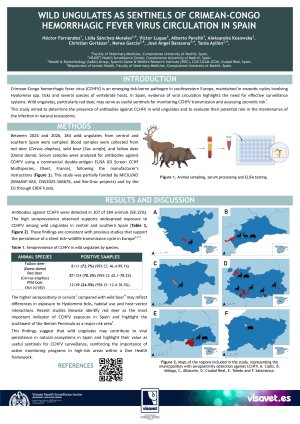
Crimean-Congo hemorrhagic fever virus (CCHFV) is an emerging tick-borne pathogen in southwestern Europe, maintained in enzootic cycles involving Hyalomma spp. ticks and vertebrate hosts. In Spain, evidence of viral circulation highlights the need for effective surveillance systems. Wild ungulates, particularly red deer, may serve as useful sentinels for monitoring CCHFV transmission and assessing zoonotic risk. This study aimed to determine the seroprevalence against CCHFV in wild ungulates and to evaluate their role as reservoirs of the virus in natural ecosystems.
Methods:
Between 2024 and 2026, a total of 184 wild ungulates from central and southern Spain were sampled during hunting activities. The study included red deer (Cervus elaphus), wild boar (Sus scrofa), and fallow deer (Dama dama). Serum samples were analyzed for antibodies against CCHFV using a commercial double-antigen ELISA (ID Screen CCHF Multispecies, IDvet), following the manufacturer’s instructions.
Results:
Antibodies against CCHFV were detected in 107 of 184 animals (58.15%). By species, 87 (70.16%, 95% CI 62.1%–78.2%) of the 124 red deer, 12 (24.49%, 95% CI 12.4%–36.5%) of the 49 wild boar, and 8 (72.73%, 95% CI 46.4%–99.1%) of the 11 fallow deer analyzed were seropositive. Evidence of CCHFV exposure was found across all sampling sites.
Conclusions:
The high seroprevalence observed supports widespread exposure to CCHFV among wild ungulates in Spain. These findings are consistent with previous findings that support the important role of cervids in the epidemiological cycle maintenance, while wild boar may have a more limited contribution. Additionally, as ungulates are major hosts for Hyalomma spp. ticks, the main vectors of CCHFV in the Iberian Peninsula, they may contribute to viral persistence in natural ecosystems and highlight their value as useful sentinels for CCHFV surveillance, reinforcing the importance of active monitoring programs in high-risk areas within a One Health framework.
Keywords
Crimean-Congo hemorrhagic fever
deer
wild boar
sentinels
antibodies
Poster
IOCVS_CCHFV_HF.pdf
Diversity and Characterization of Lytic Bacteriophage Plaque Morphotypes Targeting Escherichia coli from Anthropized Aquatic Environments in Curitiba, Brazil: Implications for Phage Therapy
ISOLATION, IDENTIFICATION, AND ANTIBIOGRAM OF MASTITIS PATHOGENS FROM MILK SAMPLES OF DAIRY BOVINE IN KATHMANDU VALLEY, NEPAL