Event submissions
Published
This submission belongs to the session S2. Surveillance and Epidemiological Modelling at the Human–Animal–Environment Interface of the event The 2nd International Online Conference on Veterinary Sciences
Published date
02 Sep, 2026
Academic Editor
'%3e%3cpath%20d='M12.6657%2010.9104C12.4185%2010.325%2012.0599%209.79327%2011.6097%209.34482C11.1609%208.89508%2010.6293%208.5365%2010.0442%208.28888C10.0389%208.28626%2010.0337%208.28495%2010.0285%208.28233C10.8446%207.69279%2011.3752%206.73249%2011.3752%205.64904C11.3752%203.8542%209.92103%202.39999%208.1262%202.39999C6.33136%202.39999%204.87715%203.8542%204.87715%205.64904C4.87715%206.73249%205.40774%207.69279%206.22393%208.28364C6.21869%208.28626%206.21345%208.28757%206.20821%208.29019C5.62129%208.5378%205.09463%208.89284%204.64265%209.34613C4.1929%209.79493%203.83432%2010.3266%203.58671%2010.9117C3.34345%2011.4845%203.21226%2012.0987%203.20023%2012.7209C3.19988%2012.7349%203.20233%2012.7488%203.20744%2012.7619C3.21255%2012.7749%203.22022%2012.7867%203.22998%2012.7968C3.23975%2012.8068%203.25142%2012.8147%203.26431%2012.8202C3.2772%2012.8256%203.29105%2012.8284%203.30504%2012.8284H4.09109C4.14874%2012.8284%204.19459%2012.7825%204.1959%2012.7262C4.2221%2011.7148%204.62823%2010.7676%205.34617%2010.0497C6.08899%209.30683%207.0755%208.89808%208.1262%208.89808C9.17689%208.89808%2010.1634%209.30683%2010.9062%2010.0497C11.6242%2010.7676%2012.0303%2011.7148%2012.0565%2012.7262C12.0578%2012.7838%2012.1037%2012.8284%2012.1613%2012.8284H12.9474C12.9613%2012.8284%2012.9752%2012.8256%2012.9881%2012.8202C13.001%2012.8147%2013.0126%2012.8068%2013.0224%2012.7968C13.0322%2012.7867%2013.0398%2012.7749%2013.0449%2012.7619C13.0501%2012.7488%2013.0525%2012.7349%2013.0522%2012.7209C13.0391%2012.0947%2012.9094%2011.4855%2012.6657%2010.9104ZM8.1262%207.9024C7.52486%207.9024%206.9589%207.6679%206.53312%207.24211C6.10733%206.81633%205.87283%206.25037%205.87283%205.64904C5.87283%205.0477%206.10733%204.48174%206.53312%204.05596C6.9589%203.63018%207.52486%203.39567%208.1262%203.39567C8.72753%203.39567%209.29349%203.63018%209.71927%204.05596C10.1451%204.48174%2010.3796%205.0477%2010.3796%205.64904C10.3796%206.25037%2010.1451%206.81633%209.71927%207.24211C9.29349%207.6679%208.72753%207.9024%208.1262%207.9024Z'%20fill='%235D1EE1'/%3e%3c/g%3e%3c/svg%3e) Francesco Mira
Francesco MiraCitation
Ghenoumat Nacira, Houari Hemida, Integrated haematological, biochemical and anatomopathological profiling of cachectic diseases in sheep, in Proceedings of The 2nd International Online Conference on Veterinary Sciences, 7 September–9 September 2026, MDPI: Basel, Switzerland
Share
Email
Facebook
Twitter
LinkedIn
Integrated haematological, biochemical and anatomopathological profiling of cachectic diseases in sheep
'%3e%3cpath%20d='M12.6647%2010.9104C12.4176%2010.325%2012.0589%209.7933%2011.6088%209.34485C11.16%208.89511%2010.6283%208.53653%2010.0432%208.28891C10.038%208.28629%2010.0327%208.28498%2010.0275%208.28236C10.8437%207.69282%2011.3743%206.73252%2011.3743%205.64907C11.3743%203.85423%209.92005%202.40002%208.12522%202.40002C6.33038%202.40002%204.87618%203.85423%204.87618%205.64907C4.87618%206.73252%205.40677%207.69282%206.22296%208.28367C6.21772%208.28629%206.21248%208.2876%206.20724%208.29022C5.62031%208.53783%205.09365%208.89287%204.64167%209.34616C4.19192%209.79496%203.83334%2010.3266%203.58573%2010.9117C3.34247%2011.4846%203.21128%2012.0987%203.19925%2012.721C3.1989%2012.735%203.20135%2012.7489%203.20646%2012.7619C3.21157%2012.7749%203.21924%2012.7868%203.22901%2012.7968C3.23877%2012.8068%203.25045%2012.8148%203.26334%2012.8202C3.27623%2012.8256%203.29007%2012.8284%203.30406%2012.8284H4.09012C4.14776%2012.8284%204.19362%2012.7825%204.19493%2012.7262C4.22113%2011.7148%204.62726%2010.7676%205.34519%2010.0497C6.08802%209.30686%207.07452%208.89811%208.12522%208.89811C9.17592%208.89811%2010.1624%209.30686%2010.9052%2010.0497C11.6232%2010.7676%2012.0293%2011.7148%2012.0555%2012.7262C12.0568%2012.7839%2012.1027%2012.8284%2012.1603%2012.8284H12.9464C12.9604%2012.8284%2012.9742%2012.8256%2012.9871%2012.8202C13%2012.8148%2013.0117%2012.8068%2013.0214%2012.7968C13.0312%2012.7868%2013.0389%2012.7749%2013.044%2012.7619C13.0491%2012.7489%2013.0515%2012.735%2013.0512%2012.721C13.0381%2012.0947%2012.9084%2011.4856%2012.6647%2010.9104ZM8.12522%207.90243C7.52388%207.90243%206.95792%207.66793%206.53214%207.24215C6.10636%206.81636%205.87185%206.2504%205.87185%205.64907C5.87185%205.04773%206.10636%204.48177%206.53214%204.05599C6.95792%203.63021%207.52388%203.3957%208.12522%203.3957C8.72655%203.3957%209.29252%203.63021%209.7183%204.05599C10.1441%204.48177%2010.3786%205.04773%2010.3786%205.64907C10.3786%206.2504%2010.1441%206.81636%209.7183%207.24215C9.29252%207.66793%208.72655%207.90243%208.12522%207.90243Z'%20fill='%235D1EE1'/%3e%3c/g%3e%3c/svg%3e)
Ghenoumat Nacira 1

Houari Hemida 1
1. Laboratory for Improvement and Valorisation of Local Animal Production, Institute of Veterinary Sciences, University of Tiaret, Tiaret 14000, Algeria
Abstract
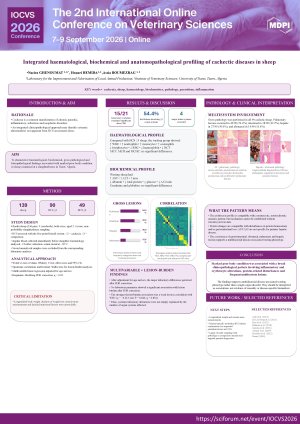
Cachexia is a multifactorial syndrome characterized by progressive weight loss, muscle wasting, metabolic disturbances, and chronic inflammation, and is frequently associated with parasitic, infectious, and neoplastic diseases in sheep. This study aimed to investigate haematological, biochemical, and anatomopathological alterations associated with cachexia using an integrated multisystemic approach. A cross-sectional observational study was conducted on 139 sheep examined at the slaughterhouse of Tiaret province, Algeria. Animals were classified by body condition score into cachectic (n = 90) and non-cachectic control groups (n = 49). All animals were subjected to routine ante-mortem and post-mortem veterinary inspection by official inspectors in accordance with slaughterhouse regulations. Samples were collected during routine slaughterhouse procedures without interfering with veterinary inspection. Haematological and biochemical analyses were performed using automated analysers, while gross and histopathological examinations were conducted on affected organs. Cachectic animals showed significant leucocytosis, neutrophilia, monocytosis, eosinophilia, lymphopenia, and normocytic normochromic anaemia, with decreased erythrocyte count, haemoglobin concentration, and haematocrit (p < 0.05). Biochemical alterations included increased AST, ALT, and urea, together with hypoalbuminaemia, hypoproteinaemia, and a reduced albumin/globulin ratio. Correlation analysis revealed strong associations among erythrogram variables, protein profile indices, and inflammatory leukocyte populations, indicating coordinated metabolic and inflammatory dysregulation. Pathological examination revealed multisystemic lesions mainly affecting the gastrointestinal tract, lungs, liver, and abomasum, characterized by parasitic, granulomatous, chronic inflammatory, suppurative, and neoplastic lesions. These findings indicate that cachexia is a complex systemic syndrome resulting from interacting parasitic, infectious, inflammatory, and neoplastic processes. The integration of haematological, biochemical, and pathological data provides insight into its systemic nature and supports improved surveillance, early detection, herd health management, and animal welfare in small ruminants.
Keywords
Keywords: cachexia
sheep
haematology
biochemistry
pathology
parasitism
inflammation
Poster
MDPI conf.pdf
ISOLATION, IDENTIFICATION, AND ANTIBIOGRAM OF MASTITIS PATHOGENS FROM MILK SAMPLES OF DAIRY BOVINE IN KATHMANDU VALLEY, NEPAL
Evaluation of a Mobile Flow Cytometer as a Rapid Tool for Environmental Hygiene Monitoring in Broiler Farms