Event submissions
Published
This submission belongs to the session S1. One Health Approaches to Emerging Zoonotic Threats of the event The 2nd International Online Conference on Veterinary Sciences
Published date
02 Sep, 2026
Academic Editor
'%3e%3cpath%20d='M12.6657%2010.9104C12.4185%2010.325%2012.0599%209.79327%2011.6097%209.34482C11.1609%208.89508%2010.6293%208.5365%2010.0442%208.28888C10.0389%208.28626%2010.0337%208.28495%2010.0285%208.28233C10.8446%207.69279%2011.3752%206.73249%2011.3752%205.64904C11.3752%203.8542%209.92103%202.39999%208.1262%202.39999C6.33136%202.39999%204.87715%203.8542%204.87715%205.64904C4.87715%206.73249%205.40774%207.69279%206.22393%208.28364C6.21869%208.28626%206.21345%208.28757%206.20821%208.29019C5.62129%208.5378%205.09463%208.89284%204.64265%209.34613C4.1929%209.79493%203.83432%2010.3266%203.58671%2010.9117C3.34345%2011.4845%203.21226%2012.0987%203.20023%2012.7209C3.19988%2012.7349%203.20233%2012.7488%203.20744%2012.7619C3.21255%2012.7749%203.22022%2012.7867%203.22998%2012.7968C3.23975%2012.8068%203.25142%2012.8147%203.26431%2012.8202C3.2772%2012.8256%203.29105%2012.8284%203.30504%2012.8284H4.09109C4.14874%2012.8284%204.19459%2012.7825%204.1959%2012.7262C4.2221%2011.7148%204.62823%2010.7676%205.34617%2010.0497C6.08899%209.30683%207.0755%208.89808%208.1262%208.89808C9.17689%208.89808%2010.1634%209.30683%2010.9062%2010.0497C11.6242%2010.7676%2012.0303%2011.7148%2012.0565%2012.7262C12.0578%2012.7838%2012.1037%2012.8284%2012.1613%2012.8284H12.9474C12.9613%2012.8284%2012.9752%2012.8256%2012.9881%2012.8202C13.001%2012.8147%2013.0126%2012.8068%2013.0224%2012.7968C13.0322%2012.7867%2013.0398%2012.7749%2013.0449%2012.7619C13.0501%2012.7488%2013.0525%2012.7349%2013.0522%2012.7209C13.0391%2012.0947%2012.9094%2011.4855%2012.6657%2010.9104ZM8.1262%207.9024C7.52486%207.9024%206.9589%207.6679%206.53312%207.24211C6.10733%206.81633%205.87283%206.25037%205.87283%205.64904C5.87283%205.0477%206.10733%204.48174%206.53312%204.05596C6.9589%203.63018%207.52486%203.39567%208.1262%203.39567C8.72753%203.39567%209.29349%203.63018%209.71927%204.05596C10.1451%204.48174%2010.3796%205.0477%2010.3796%205.64904C10.3796%206.25037%2010.1451%206.81633%209.71927%207.24211C9.29349%207.6679%208.72753%207.9024%208.1262%207.9024Z'%20fill='%235D1EE1'/%3e%3c/g%3e%3c/svg%3e) Vittorio Sarchese
Vittorio SarcheseCitation
Parichehr Ebrahimi Shahabadi, Mohammad Ali Nazmabadi Nezhad, Application of Nanomedicines in the Control of Gastrointestinal Helminths in Dogs and Cats with a One Health Approach: A Systematic Review, in Proceedings of The 2nd International Online Conference on Veterinary Sciences, 7 September–9 September 2026, MDPI: Basel, Switzerland
Share
Email
Facebook
Twitter
LinkedIn
Application of Nanomedicines in the Control of Gastrointestinal Helminths in Dogs and Cats with a One Health Approach: A Systematic Review
'%3e%3cpath%20d='M12.6647%2010.9104C12.4176%2010.325%2012.0589%209.7933%2011.6088%209.34485C11.16%208.89511%2010.6283%208.53653%2010.0432%208.28891C10.038%208.28629%2010.0327%208.28498%2010.0275%208.28236C10.8437%207.69282%2011.3743%206.73252%2011.3743%205.64907C11.3743%203.85423%209.92005%202.40002%208.12522%202.40002C6.33038%202.40002%204.87618%203.85423%204.87618%205.64907C4.87618%206.73252%205.40677%207.69282%206.22296%208.28367C6.21772%208.28629%206.21248%208.2876%206.20724%208.29022C5.62031%208.53783%205.09365%208.89287%204.64167%209.34616C4.19192%209.79496%203.83334%2010.3266%203.58573%2010.9117C3.34247%2011.4846%203.21128%2012.0987%203.19925%2012.721C3.1989%2012.735%203.20135%2012.7489%203.20646%2012.7619C3.21157%2012.7749%203.21924%2012.7868%203.22901%2012.7968C3.23877%2012.8068%203.25045%2012.8148%203.26334%2012.8202C3.27623%2012.8256%203.29007%2012.8284%203.30406%2012.8284H4.09012C4.14776%2012.8284%204.19362%2012.7825%204.19493%2012.7262C4.22113%2011.7148%204.62726%2010.7676%205.34519%2010.0497C6.08802%209.30686%207.07452%208.89811%208.12522%208.89811C9.17592%208.89811%2010.1624%209.30686%2010.9052%2010.0497C11.6232%2010.7676%2012.0293%2011.7148%2012.0555%2012.7262C12.0568%2012.7839%2012.1027%2012.8284%2012.1603%2012.8284H12.9464C12.9604%2012.8284%2012.9742%2012.8256%2012.9871%2012.8202C13%2012.8148%2013.0117%2012.8068%2013.0214%2012.7968C13.0312%2012.7868%2013.0389%2012.7749%2013.044%2012.7619C13.0491%2012.7489%2013.0515%2012.735%2013.0512%2012.721C13.0381%2012.0947%2012.9084%2011.4856%2012.6647%2010.9104ZM8.12522%207.90243C7.52388%207.90243%206.95792%207.66793%206.53214%207.24215C6.10636%206.81636%205.87185%206.2504%205.87185%205.64907C5.87185%205.04773%206.10636%204.48177%206.53214%204.05599C6.95792%203.63021%207.52388%203.3957%208.12522%203.3957C8.72655%203.3957%209.29252%203.63021%209.7183%204.05599C10.1441%204.48177%2010.3786%205.04773%2010.3786%205.64907C10.3786%206.2504%2010.1441%206.81636%209.7183%207.24215C9.29252%207.66793%208.72655%207.90243%208.12522%207.90243Z'%20fill='%235D1EE1'/%3e%3c/g%3e%3c/svg%3e)
Parichehr Ebrahimi Shahabadi 1
Mohammad Ali Nazmabadi Nezhad 1
1. Veterinary Medicine, Faculty of Veterinary Medicine, Shahid Bahonar University of Kerman, Kerman, Iran
Abstract
Objective and introduction
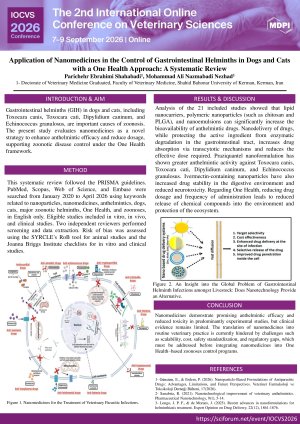
Gastrointestinal helminths (GIH) in dogs and cats, including Toxocara canis, Toxocara cati, Dipylidium caninum, and Echinococcus granulosus, are important causes of zoonosis. The present study evaluates nanomedicines as a novel strategy to enhance anthelmintic efficacy and reduce dosage, supporting zoonotic disease control under the One Health framework.
Methods
This systematic review followed the PRISMA guidelines. PubMed, Scopus, Web of Science, and Embase were searched from January 2020 to April 2026 using keywords related to nanoparticles, nanomedicines, anthelmintics, dogs, cats, major zoonotic helminths, One Health, and zoonoses, in English only. Eligible studies included in vitro, in vivo, and clinical studies. Two independent reviewers performed screening and data extraction. Risk of bias was assessed using the SYRCLE’s RoB tool for animal studies and the Joanna Briggs Institute checklists for in vitro and clinical studies.
Results
Analysis of the 21 included studies showed that lipid nanocarriers, polymeric nanoparticles (such as chitosan and PLGA), and nanoemulsions can significantly increase the bioavailability of anthelmintic drugs. Nanodelivery of drugs, while protecting the active ingredient from enzymatic degradation in the gastrointestinal tract, increases drug absorption via transcytotic mechanisms and reduces the effective dose required. Praziquantel nanoformulation has shown greater anthelmintic activity against Toxocara canis, Toxocara cati, Dipylidium caninum, and Echinococcus granulosus. Ivermectin-containing nanoparticles have also increased drug stability in the digestive environment and reduced neurotoxicity. Regarding One Health, reducing drug dosage and frequency of administration leads to reduced release of chemical compounds into the environment and protection of the ecosystem.
Conclusion
Nanomedicines demonstrate promising anthelmintic efficacy and reduced toxicity in predominantly experimental studies, but clinical evidence remains limited. The translation of nanomedicines into routine veterinary practice is currently hindered by challenges such as scalability, cost, safety standardization, and regulatory gaps, which must be addressed before integrating nanomedicines into One Health–based zoonoses control programs.
Keywords
Drug resistance
Gastrointestinal helminths
Nanomedicine
One Health
Zoonoses
Poster
Poster.pdf
Evaluation of a Mobile Flow Cytometer as a Rapid Tool for Environmental Hygiene Monitoring in Broiler Farms
Antimicrobial resistance in horses in Mexico from a One Health perspective