Event submissions
Published
This submission belongs to the session S1. One Health Approaches to Emerging Zoonotic Threats of the event The 2nd International Online Conference on Veterinary Sciences
Published date
02 Sep, 2026
Academic Editor
'%3e%3cpath%20d='M12.6657%2010.9104C12.4185%2010.325%2012.0599%209.79327%2011.6097%209.34482C11.1609%208.89508%2010.6293%208.5365%2010.0442%208.28888C10.0389%208.28626%2010.0337%208.28495%2010.0285%208.28233C10.8446%207.69279%2011.3752%206.73249%2011.3752%205.64904C11.3752%203.8542%209.92103%202.39999%208.1262%202.39999C6.33136%202.39999%204.87715%203.8542%204.87715%205.64904C4.87715%206.73249%205.40774%207.69279%206.22393%208.28364C6.21869%208.28626%206.21345%208.28757%206.20821%208.29019C5.62129%208.5378%205.09463%208.89284%204.64265%209.34613C4.1929%209.79493%203.83432%2010.3266%203.58671%2010.9117C3.34345%2011.4845%203.21226%2012.0987%203.20023%2012.7209C3.19988%2012.7349%203.20233%2012.7488%203.20744%2012.7619C3.21255%2012.7749%203.22022%2012.7867%203.22998%2012.7968C3.23975%2012.8068%203.25142%2012.8147%203.26431%2012.8202C3.2772%2012.8256%203.29105%2012.8284%203.30504%2012.8284H4.09109C4.14874%2012.8284%204.19459%2012.7825%204.1959%2012.7262C4.2221%2011.7148%204.62823%2010.7676%205.34617%2010.0497C6.08899%209.30683%207.0755%208.89808%208.1262%208.89808C9.17689%208.89808%2010.1634%209.30683%2010.9062%2010.0497C11.6242%2010.7676%2012.0303%2011.7148%2012.0565%2012.7262C12.0578%2012.7838%2012.1037%2012.8284%2012.1613%2012.8284H12.9474C12.9613%2012.8284%2012.9752%2012.8256%2012.9881%2012.8202C13.001%2012.8147%2013.0126%2012.8068%2013.0224%2012.7968C13.0322%2012.7867%2013.0398%2012.7749%2013.0449%2012.7619C13.0501%2012.7488%2013.0525%2012.7349%2013.0522%2012.7209C13.0391%2012.0947%2012.9094%2011.4855%2012.6657%2010.9104ZM8.1262%207.9024C7.52486%207.9024%206.9589%207.6679%206.53312%207.24211C6.10733%206.81633%205.87283%206.25037%205.87283%205.64904C5.87283%205.0477%206.10733%204.48174%206.53312%204.05596C6.9589%203.63018%207.52486%203.39567%208.1262%203.39567C8.72753%203.39567%209.29349%203.63018%209.71927%204.05596C10.1451%204.48174%2010.3796%205.0477%2010.3796%205.64904C10.3796%206.25037%2010.1451%206.81633%209.71927%207.24211C9.29349%207.6679%208.72753%207.9024%208.1262%207.9024Z'%20fill='%235D1EE1'/%3e%3c/g%3e%3c/svg%3e) Chengming Wang
Chengming WangCitation
Rosa Giugliano, Valentina Iovane, Antonio Gentile, Annalisa Chianese, Serena Montagnaro, Carla Zannella, Anna De Filippis, Massimiliano Galdiero, Development of an HR2-Derived Fusion Inhibitor Against Canine Coronavirus; in vitro and in silico approaches, in Proceedings of The 2nd International Online Conference on Veterinary Sciences, 7 September–9 September 2026, MDPI: Basel, Switzerland
Share
Email
Facebook
Twitter
LinkedIn
Development of an HR2-Derived Fusion Inhibitor Against Canine Coronavirus; in vitro and in silico approaches

Rosa Giugliano 1,2
'%3e%3cpath%20d='M12.6647%2010.9104C12.4176%2010.325%2012.0589%209.7933%2011.6088%209.34485C11.16%208.89511%2010.6283%208.53653%2010.0432%208.28891C10.038%208.28629%2010.0327%208.28498%2010.0275%208.28236C10.8437%207.69282%2011.3743%206.73252%2011.3743%205.64907C11.3743%203.85423%209.92005%202.40002%208.12522%202.40002C6.33038%202.40002%204.87618%203.85423%204.87618%205.64907C4.87618%206.73252%205.40677%207.69282%206.22296%208.28367C6.21772%208.28629%206.21248%208.2876%206.20724%208.29022C5.62031%208.53783%205.09365%208.89287%204.64167%209.34616C4.19192%209.79496%203.83334%2010.3266%203.58573%2010.9117C3.34247%2011.4846%203.21128%2012.0987%203.19925%2012.721C3.1989%2012.735%203.20135%2012.7489%203.20646%2012.7619C3.21157%2012.7749%203.21924%2012.7868%203.22901%2012.7968C3.23877%2012.8068%203.25045%2012.8148%203.26334%2012.8202C3.27623%2012.8256%203.29007%2012.8284%203.30406%2012.8284H4.09012C4.14776%2012.8284%204.19362%2012.7825%204.19493%2012.7262C4.22113%2011.7148%204.62726%2010.7676%205.34519%2010.0497C6.08802%209.30686%207.07452%208.89811%208.12522%208.89811C9.17592%208.89811%2010.1624%209.30686%2010.9052%2010.0497C11.6232%2010.7676%2012.0293%2011.7148%2012.0555%2012.7262C12.0568%2012.7839%2012.1027%2012.8284%2012.1603%2012.8284H12.9464C12.9604%2012.8284%2012.9742%2012.8256%2012.9871%2012.8202C13%2012.8148%2013.0117%2012.8068%2013.0214%2012.7968C13.0312%2012.7868%2013.0389%2012.7749%2013.044%2012.7619C13.0491%2012.7489%2013.0515%2012.735%2013.0512%2012.721C13.0381%2012.0947%2012.9084%2011.4856%2012.6647%2010.9104ZM8.12522%207.90243C7.52388%207.90243%206.95792%207.66793%206.53214%207.24215C6.10636%206.81636%205.87185%206.2504%205.87185%205.64907C5.87185%205.04773%206.10636%204.48177%206.53214%204.05599C6.95792%203.63021%207.52388%203.3957%208.12522%203.3957C8.72655%203.3957%209.29252%203.63021%209.7183%204.05599C10.1441%204.48177%2010.3786%205.04773%2010.3786%205.64907C10.3786%206.2504%2010.1441%206.81636%209.7183%207.24215C9.29252%207.66793%208.72655%207.90243%208.12522%207.90243Z'%20fill='%235D1EE1'/%3e%3c/g%3e%3c/svg%3e)
Valentina Iovane 3
Antonio Gentile 3
Annalisa Chianese 4
Serena Montagnaro 1
Carla Zannella 2

Anna De Filippis 2

Massimiliano Galdiero 2
1. Department of Veterinary Medicine and Animal Production, University of Naples Federico II, 80137 Naples, Italy
2. Department of Woman, Child and General and Specialized Surgery, University of Campania Luigi Vanvitelli, 80138 Naples, Italy
3. Department of Agricultural Sciences, University of Naples Federico II, 80055 Portici, Italy
4. Department of Life Sciences, Health and Health Professions, Link Campus University, 00165 Rome, Italy
Abstract
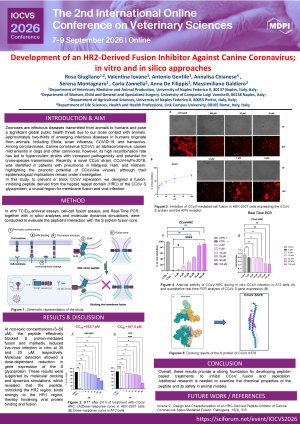
Introduction: Zoonoses are infectious diseases transmitted from animals to humans and pose a significant global public health threat due to our close contact with animals. Approximately two-thirds of emerging infectious diseases in humans originate from animals, including Ebola, avian influenza, COVID-19, and hantavirus. Among coronaviruses, Canine coronavirus (CCoV), an alphacoronavirus, causes mild enteritis in dogs and other carnivores; however, its high recombination rate has led to hypervirulent strains with increased pathogenicity and potential for cross-species transmission. Recently, a novel CCoV strain, CCoV-HuPn-2018, was identified in patients with pneumonia in Malaysia, Haiti, and Vietnam, highlighting the zoonotic potential of CCoV-like viruses, although their epidemiological implications remain under investigation.
Aim: Innovative solutions are needed from a One Health perspective to address growing challenges. In this study, to prevent or block CCoV replication, we designed a fusion-inhibiting peptide derived from the heptad repeat domain (HRC) of the CCoV S glycoprotein, a crucial region for membrane fusion and viral infection.
Material and methods: In vitro TCID50 antiviral assays, cell-cell fusion assays, and Real-Time PCR, together with in silico analyses and molecular dynamics simulations, were conducted to evaluate the peptide's interaction with the S protein fusion core.
Results: At non-toxic concentrations (3–50 µM), the peptide effectively blocked S protein-mediated fusion and markedly reduced live-virus infection in vitro at 35 and 25 µM, respectively. Molecular detection showed a dose-dependent reduction in gene expression of the S glycoprotein. These results were supported by molecular docking and dynamics simulations, which revealed that the peptide, mimicking the HR2 region, binds strongly to the HR1 region, thereby hindering viral protein binding and fusion.
Conclusion: Overall, these results provide a strong foundation for developing peptide-based treatments to inhibit CCoV fusion and replication.
Additional research is needed to examine the chemical properties of the peptide and its safety in animal models.
Keywords
viral fusion
CCoV
antiviral activity
heptad repeat
Spike protein
Poster
POSTER IOCVS.pdf
Artificial Intelligence for Chest Radiography in Tuberculosis Detection Across Humans and Animals: A Systematic Review of One Health Diagnostic Applications
Epidemiological Status of Linguatula serrata Infection among Domestic Ruminants in Northwestern Iran: A Systematic Review and Meta-analysis