Event submissions
Published
This submission belongs to the session S1. One Health Approaches to Emerging Zoonotic Threats of the event The 2nd International Online Conference on Veterinary Sciences
Published date
02 Sep, 2026
Academic Editor
'%3e%3cpath%20d='M12.6657%2010.9104C12.4185%2010.325%2012.0599%209.79327%2011.6097%209.34482C11.1609%208.89508%2010.6293%208.5365%2010.0442%208.28888C10.0389%208.28626%2010.0337%208.28495%2010.0285%208.28233C10.8446%207.69279%2011.3752%206.73249%2011.3752%205.64904C11.3752%203.8542%209.92103%202.39999%208.1262%202.39999C6.33136%202.39999%204.87715%203.8542%204.87715%205.64904C4.87715%206.73249%205.40774%207.69279%206.22393%208.28364C6.21869%208.28626%206.21345%208.28757%206.20821%208.29019C5.62129%208.5378%205.09463%208.89284%204.64265%209.34613C4.1929%209.79493%203.83432%2010.3266%203.58671%2010.9117C3.34345%2011.4845%203.21226%2012.0987%203.20023%2012.7209C3.19988%2012.7349%203.20233%2012.7488%203.20744%2012.7619C3.21255%2012.7749%203.22022%2012.7867%203.22998%2012.7968C3.23975%2012.8068%203.25142%2012.8147%203.26431%2012.8202C3.2772%2012.8256%203.29105%2012.8284%203.30504%2012.8284H4.09109C4.14874%2012.8284%204.19459%2012.7825%204.1959%2012.7262C4.2221%2011.7148%204.62823%2010.7676%205.34617%2010.0497C6.08899%209.30683%207.0755%208.89808%208.1262%208.89808C9.17689%208.89808%2010.1634%209.30683%2010.9062%2010.0497C11.6242%2010.7676%2012.0303%2011.7148%2012.0565%2012.7262C12.0578%2012.7838%2012.1037%2012.8284%2012.1613%2012.8284H12.9474C12.9613%2012.8284%2012.9752%2012.8256%2012.9881%2012.8202C13.001%2012.8147%2013.0126%2012.8068%2013.0224%2012.7968C13.0322%2012.7867%2013.0398%2012.7749%2013.0449%2012.7619C13.0501%2012.7488%2013.0525%2012.7349%2013.0522%2012.7209C13.0391%2012.0947%2012.9094%2011.4855%2012.6657%2010.9104ZM8.1262%207.9024C7.52486%207.9024%206.9589%207.6679%206.53312%207.24211C6.10733%206.81633%205.87283%206.25037%205.87283%205.64904C5.87283%205.0477%206.10733%204.48174%206.53312%204.05596C6.9589%203.63018%207.52486%203.39567%208.1262%203.39567C8.72753%203.39567%209.29349%203.63018%209.71927%204.05596C10.1451%204.48174%2010.3796%205.0477%2010.3796%205.64904C10.3796%206.25037%2010.1451%206.81633%209.71927%207.24211C9.29349%207.6679%208.72753%207.9024%208.1262%207.9024Z'%20fill='%235D1EE1'/%3e%3c/g%3e%3c/svg%3e) Vittorio Sarchese
Vittorio SarcheseCitation
Soroush Partovi Moghaddam, Mohammad Mehdi Ranjbar Kamrani, Dorsa Moghimi Esfandabadi, Ali Heydari, Application of Nanobiosensors in the Diagnosis of Leishmaniasis in Humans with a One Health Approach: A Systematic Review, in Proceedings of The 2nd International Online Conference on Veterinary Sciences, 7 September–9 September 2026, MDPI: Basel, Switzerland
Share
Email
Facebook
Twitter
LinkedIn
Application of Nanobiosensors in the Diagnosis of Leishmaniasis in Humans with a One Health Approach: A Systematic Review
'%3e%3cpath%20d='M12.6647%2010.9104C12.4176%2010.325%2012.0589%209.7933%2011.6088%209.34485C11.16%208.89511%2010.6283%208.53653%2010.0432%208.28891C10.038%208.28629%2010.0327%208.28498%2010.0275%208.28236C10.8437%207.69282%2011.3743%206.73252%2011.3743%205.64907C11.3743%203.85423%209.92005%202.40002%208.12522%202.40002C6.33038%202.40002%204.87618%203.85423%204.87618%205.64907C4.87618%206.73252%205.40677%207.69282%206.22296%208.28367C6.21772%208.28629%206.21248%208.2876%206.20724%208.29022C5.62031%208.53783%205.09365%208.89287%204.64167%209.34616C4.19192%209.79496%203.83334%2010.3266%203.58573%2010.9117C3.34247%2011.4846%203.21128%2012.0987%203.19925%2012.721C3.1989%2012.735%203.20135%2012.7489%203.20646%2012.7619C3.21157%2012.7749%203.21924%2012.7868%203.22901%2012.7968C3.23877%2012.8068%203.25045%2012.8148%203.26334%2012.8202C3.27623%2012.8256%203.29007%2012.8284%203.30406%2012.8284H4.09012C4.14776%2012.8284%204.19362%2012.7825%204.19493%2012.7262C4.22113%2011.7148%204.62726%2010.7676%205.34519%2010.0497C6.08802%209.30686%207.07452%208.89811%208.12522%208.89811C9.17592%208.89811%2010.1624%209.30686%2010.9052%2010.0497C11.6232%2010.7676%2012.0293%2011.7148%2012.0555%2012.7262C12.0568%2012.7839%2012.1027%2012.8284%2012.1603%2012.8284H12.9464C12.9604%2012.8284%2012.9742%2012.8256%2012.9871%2012.8202C13%2012.8148%2013.0117%2012.8068%2013.0214%2012.7968C13.0312%2012.7868%2013.0389%2012.7749%2013.044%2012.7619C13.0491%2012.7489%2013.0515%2012.735%2013.0512%2012.721C13.0381%2012.0947%2012.9084%2011.4856%2012.6647%2010.9104ZM8.12522%207.90243C7.52388%207.90243%206.95792%207.66793%206.53214%207.24215C6.10636%206.81636%205.87185%206.2504%205.87185%205.64907C5.87185%205.04773%206.10636%204.48177%206.53214%204.05599C6.95792%203.63021%207.52388%203.3957%208.12522%203.3957C8.72655%203.3957%209.29252%203.63021%209.7183%204.05599C10.1441%204.48177%2010.3786%205.04773%2010.3786%205.64907C10.3786%206.2504%2010.1441%206.81636%209.7183%207.24215C9.29252%207.66793%208.72655%207.90243%208.12522%207.90243Z'%20fill='%235D1EE1'/%3e%3c/g%3e%3c/svg%3e)
Soroush Partovi Moghaddam 1
Mohammad Mehdi Ranjbar Kamrani 2
Dorsa Moghimi Esfandabadi 1
Ali Heydari 3
1. Department of Pathobiology, Faculty of Veterinary Specialized Science, Science and Research Branch, Islamic Azad University, Tehran, Iran
2. Faculty of Veterinary Medicine, Islamic Azad University, Shabestar Branch, Shabestar, East Azerbaijan Province, Iran
3. Department of Clinical Science, Veterinary Faculty, Karaj Branch, Islamic Azad University, Karaj, Iran
Abstract
Introduction
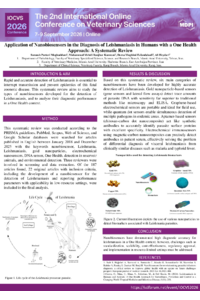
Rapid and accurate detection of Leishmaniasis is essential to interrupt transmission and prevent epidemics of this fatal zoonotic disease. This systematic review aims to study the types of nanobiosensors developed for the detection of Leishmaniasis, and to analyze their diagnostic performance in a One Health context.
Methods
This systematic review was conducted according to the PRISMA guidelines. PubMed, Scopus, Web of Science, and Google Scholar databases were searched for articles published in English between January 2018 and December 2025 with the keywords nanobiosensor, Leishmania, Leishmaniasis, gold nanoparticles, electrochemical nanosensors, DNA sensor, One Health, detection in reservoir animals, and environmental detection. Three reviewers were involved in screening and data extraction. Of the 187 articles found, 22 original articles with inclusion criteria, including the development of a nanobiosensor for the detection of Leishmaniasis and reporting performance parameters with applicability in low-resource settings, were included in the final analysis.
Results
Based on this systematic review, six main categories of nanobiosensors have been developed for highly accurate detection of Leishmaniasis. Gold nanoparticle-based sensors (gene sensors and lateral flow assays) detect trace amounts of parasite DNA with sensitivity far superior to traditional methods like microscopy and ELISA. Graphene-based electrochemical sensors are portable and ideal for field use, while quantum dot sensors enable simultaneous detection of multiple pathogens in endemic areas. Aptamer-based sensors (chitosan-carbon dot nanocomposite) act like synthetic antibodies to accurately identify parasite surface proteins with excellent specificity. Electrochemical immunosensors using magnetic-carbon nanocomposites can precisely detect antibodies in patient serum, effectively solving the problem of differential diagnosis of visceral leishmaniasis from clinically similar diseases such as malaria and typhoid fever.
Conclusion
Nanobiosensors have demonstrated high diagnostic accuracy for leishmaniasis in a One Health context; however, challenges such as standardization, scalability, cost-effectiveness, regulatory approval, and implementation in resource-limited settings must be addressed.
Keywords
Leishmaniasis
Metal nanoparticles
Nanobiosensor
One Health
Zoonoses detection
Poster
Poster.pdf
Epidemiological Status of Linguatula serrata Infection among Domestic Ruminants in Northwestern Iran: A Systematic Review and Meta-analysis
Molecular Characterization of Canine Distemper Virus (CDV) in Suspected Dogs Referred to Civil Veterinary Hospital, Peshawar, Khyber Pakhtunkhwa, Pakistan