Event submissions
Published
This submission belongs to the session S2. Surveillance and Epidemiological Modelling at the Human–Animal–Environment Interface of the event The 2nd International Online Conference on Veterinary Sciences
Published date
02 Sep, 2026
Academic Editor
'%3e%3cpath%20d='M12.6657%2010.9104C12.4185%2010.325%2012.0599%209.79327%2011.6097%209.34482C11.1609%208.89508%2010.6293%208.5365%2010.0442%208.28888C10.0389%208.28626%2010.0337%208.28495%2010.0285%208.28233C10.8446%207.69279%2011.3752%206.73249%2011.3752%205.64904C11.3752%203.8542%209.92103%202.39999%208.1262%202.39999C6.33136%202.39999%204.87715%203.8542%204.87715%205.64904C4.87715%206.73249%205.40774%207.69279%206.22393%208.28364C6.21869%208.28626%206.21345%208.28757%206.20821%208.29019C5.62129%208.5378%205.09463%208.89284%204.64265%209.34613C4.1929%209.79493%203.83432%2010.3266%203.58671%2010.9117C3.34345%2011.4845%203.21226%2012.0987%203.20023%2012.7209C3.19988%2012.7349%203.20233%2012.7488%203.20744%2012.7619C3.21255%2012.7749%203.22022%2012.7867%203.22998%2012.7968C3.23975%2012.8068%203.25142%2012.8147%203.26431%2012.8202C3.2772%2012.8256%203.29105%2012.8284%203.30504%2012.8284H4.09109C4.14874%2012.8284%204.19459%2012.7825%204.1959%2012.7262C4.2221%2011.7148%204.62823%2010.7676%205.34617%2010.0497C6.08899%209.30683%207.0755%208.89808%208.1262%208.89808C9.17689%208.89808%2010.1634%209.30683%2010.9062%2010.0497C11.6242%2010.7676%2012.0303%2011.7148%2012.0565%2012.7262C12.0578%2012.7838%2012.1037%2012.8284%2012.1613%2012.8284H12.9474C12.9613%2012.8284%2012.9752%2012.8256%2012.9881%2012.8202C13.001%2012.8147%2013.0126%2012.8068%2013.0224%2012.7968C13.0322%2012.7867%2013.0398%2012.7749%2013.0449%2012.7619C13.0501%2012.7488%2013.0525%2012.7349%2013.0522%2012.7209C13.0391%2012.0947%2012.9094%2011.4855%2012.6657%2010.9104ZM8.1262%207.9024C7.52486%207.9024%206.9589%207.6679%206.53312%207.24211C6.10733%206.81633%205.87283%206.25037%205.87283%205.64904C5.87283%205.0477%206.10733%204.48174%206.53312%204.05596C6.9589%203.63018%207.52486%203.39567%208.1262%203.39567C8.72753%203.39567%209.29349%203.63018%209.71927%204.05596C10.1451%204.48174%2010.3796%205.0477%2010.3796%205.64904C10.3796%206.25037%2010.1451%206.81633%209.71927%207.24211C9.29349%207.6679%208.72753%207.9024%208.1262%207.9024Z'%20fill='%235D1EE1'/%3e%3c/g%3e%3c/svg%3e) Francesco Mira
Francesco MiraCitation
Mohammad Derogar Jahromi, Parsa Shaker Dooshanloo, Dogs as Sentinels for Emerging Human Infectious Diseases: A Systematic Review of One Health Surveillance Opportunities, in Proceedings of The 2nd International Online Conference on Veterinary Sciences, 7 September–9 September 2026, MDPI: Basel, Switzerland
Share
Email
Facebook
Twitter
LinkedIn
Dogs as Sentinels for Emerging Human Infectious Diseases: A Systematic Review of One Health Surveillance Opportunities
'%3e%3cpath%20d='M12.6647%2010.9104C12.4176%2010.325%2012.0589%209.7933%2011.6088%209.34485C11.16%208.89511%2010.6283%208.53653%2010.0432%208.28891C10.038%208.28629%2010.0327%208.28498%2010.0275%208.28236C10.8437%207.69282%2011.3743%206.73252%2011.3743%205.64907C11.3743%203.85423%209.92005%202.40002%208.12522%202.40002C6.33038%202.40002%204.87618%203.85423%204.87618%205.64907C4.87618%206.73252%205.40677%207.69282%206.22296%208.28367C6.21772%208.28629%206.21248%208.2876%206.20724%208.29022C5.62031%208.53783%205.09365%208.89287%204.64167%209.34616C4.19192%209.79496%203.83334%2010.3266%203.58573%2010.9117C3.34247%2011.4846%203.21128%2012.0987%203.19925%2012.721C3.1989%2012.735%203.20135%2012.7489%203.20646%2012.7619C3.21157%2012.7749%203.21924%2012.7868%203.22901%2012.7968C3.23877%2012.8068%203.25045%2012.8148%203.26334%2012.8202C3.27623%2012.8256%203.29007%2012.8284%203.30406%2012.8284H4.09012C4.14776%2012.8284%204.19362%2012.7825%204.19493%2012.7262C4.22113%2011.7148%204.62726%2010.7676%205.34519%2010.0497C6.08802%209.30686%207.07452%208.89811%208.12522%208.89811C9.17592%208.89811%2010.1624%209.30686%2010.9052%2010.0497C11.6232%2010.7676%2012.0293%2011.7148%2012.0555%2012.7262C12.0568%2012.7839%2012.1027%2012.8284%2012.1603%2012.8284H12.9464C12.9604%2012.8284%2012.9742%2012.8256%2012.9871%2012.8202C13%2012.8148%2013.0117%2012.8068%2013.0214%2012.7968C13.0312%2012.7868%2013.0389%2012.7749%2013.044%2012.7619C13.0491%2012.7489%2013.0515%2012.735%2013.0512%2012.721C13.0381%2012.0947%2012.9084%2011.4856%2012.6647%2010.9104ZM8.12522%207.90243C7.52388%207.90243%206.95792%207.66793%206.53214%207.24215C6.10636%206.81636%205.87185%206.2504%205.87185%205.64907C5.87185%205.04773%206.10636%204.48177%206.53214%204.05599C6.95792%203.63021%207.52388%203.3957%208.12522%203.3957C8.72655%203.3957%209.29252%203.63021%209.7183%204.05599C10.1441%204.48177%2010.3786%205.04773%2010.3786%205.64907C10.3786%206.2504%2010.1441%206.81636%209.7183%207.24215C9.29252%207.66793%208.72655%207.90243%208.12522%207.90243Z'%20fill='%235D1EE1'/%3e%3c/g%3e%3c/svg%3e)
Mohammad Derogar Jahromi 1
Parsa Shaker Dooshanloo 1
1. Faculty of Veterinary Medicine, Islamic Azad University, Baft Branch, Baft, Iran
Abstract
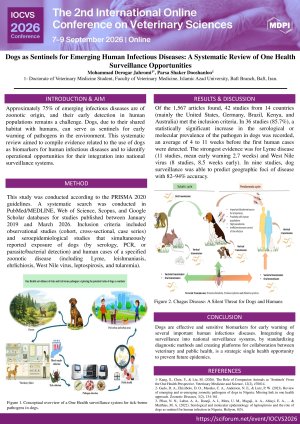
Background/Objective: Approximately 75% of emerging infectious diseases are of zoonotic origin, and their early detection in human populations remains a challenge. Dogs, due to their shared habitat with humans, can serve as sentinels for early warning of the presence of pathogens in the environment. This systematic review aimed to compile evidence related to the use of dogs as biomarkers for human infectious diseases and to identify operational opportunities for their integration into national surveillance systems.
Methods: This study was conducted according to the PRISMA 2020 guidelines. A systematic search was conducted in PubMed/MEDLINE, Web of Science, Scopus, and Google Scholar databases for studies published between January 2019 and March 2026. Inclusion criteria included observational studies (cohort, cross-sectional, case series) and seroepidemiological studies that simultaneously reported exposure of dogs (by serology, PCR, or parasite/bacterial detection) and human cases of a specified zoonotic disease (including Lyme, leishmaniasis, ehrlichiosis, West Nile virus, leptospirosis, and tularemia).
Results: Of the 1,567 articles found, 42 studies from 14 countries (mainly the United States, Germany, Brazil, Kenya, and Australia) met the inclusion criteria. In 36 studies (85.7%), a statistically significant increase in the serological or molecular prevalence of the pathogen in dogs was recorded, an average of 4 to 11 weeks before the first human cases were detected. The strongest evidence was for Lyme disease (11 studies, mean early warning 2.7 weeks) and West Nile virus (8 studies, 8.5 weeks early). In nine studies, dog surveillance was able to predict geographic foci of disease with 82–94% accuracy.
Conclusion: Dogs are effective and sensitive biomarkers for early warning of several important human infectious diseases. Integrating dog surveillance into national surveillance systems, by standardizing diagnostic methods and creating platforms for collaboration between veterinary and public health, is a strategic single health opportunity to prevent future epidemics.
Keywords
Biomarker
Dog
Emerging Infectious Diseases
One Health
Zoonoses
Poster
Poster.pdf
Molecular Characterization of Canine Distemper Virus (CDV) in Suspected Dogs Referred to Civil Veterinary Hospital, Peshawar, Khyber Pakhtunkhwa, Pakistan
Spatial-Temporal Risk Mapping and Epidemiological Modeling of Bovine Fascioliasis in Uganda: A One Health Surveillance Framework at the Livestock, Snail, and Water Interface (IOCVS 2026)