Event submissions
Published
This submission belongs to the session S1. One Health Approaches to Emerging Zoonotic Threats of the event The 2nd International Online Conference on Veterinary Sciences
Published date
02 Sep, 2026
Academic Editor
'%3e%3cpath%20d='M12.6657%2010.9104C12.4185%2010.325%2012.0599%209.79327%2011.6097%209.34482C11.1609%208.89508%2010.6293%208.5365%2010.0442%208.28888C10.0389%208.28626%2010.0337%208.28495%2010.0285%208.28233C10.8446%207.69279%2011.3752%206.73249%2011.3752%205.64904C11.3752%203.8542%209.92103%202.39999%208.1262%202.39999C6.33136%202.39999%204.87715%203.8542%204.87715%205.64904C4.87715%206.73249%205.40774%207.69279%206.22393%208.28364C6.21869%208.28626%206.21345%208.28757%206.20821%208.29019C5.62129%208.5378%205.09463%208.89284%204.64265%209.34613C4.1929%209.79493%203.83432%2010.3266%203.58671%2010.9117C3.34345%2011.4845%203.21226%2012.0987%203.20023%2012.7209C3.19988%2012.7349%203.20233%2012.7488%203.20744%2012.7619C3.21255%2012.7749%203.22022%2012.7867%203.22998%2012.7968C3.23975%2012.8068%203.25142%2012.8147%203.26431%2012.8202C3.2772%2012.8256%203.29105%2012.8284%203.30504%2012.8284H4.09109C4.14874%2012.8284%204.19459%2012.7825%204.1959%2012.7262C4.2221%2011.7148%204.62823%2010.7676%205.34617%2010.0497C6.08899%209.30683%207.0755%208.89808%208.1262%208.89808C9.17689%208.89808%2010.1634%209.30683%2010.9062%2010.0497C11.6242%2010.7676%2012.0303%2011.7148%2012.0565%2012.7262C12.0578%2012.7838%2012.1037%2012.8284%2012.1613%2012.8284H12.9474C12.9613%2012.8284%2012.9752%2012.8256%2012.9881%2012.8202C13.001%2012.8147%2013.0126%2012.8068%2013.0224%2012.7968C13.0322%2012.7867%2013.0398%2012.7749%2013.0449%2012.7619C13.0501%2012.7488%2013.0525%2012.7349%2013.0522%2012.7209C13.0391%2012.0947%2012.9094%2011.4855%2012.6657%2010.9104ZM8.1262%207.9024C7.52486%207.9024%206.9589%207.6679%206.53312%207.24211C6.10733%206.81633%205.87283%206.25037%205.87283%205.64904C5.87283%205.0477%206.10733%204.48174%206.53312%204.05596C6.9589%203.63018%207.52486%203.39567%208.1262%203.39567C8.72753%203.39567%209.29349%203.63018%209.71927%204.05596C10.1451%204.48174%2010.3796%205.0477%2010.3796%205.64904C10.3796%206.25037%2010.1451%206.81633%209.71927%207.24211C9.29349%207.6679%208.72753%207.9024%208.1262%207.9024Z'%20fill='%235D1EE1'/%3e%3c/g%3e%3c/svg%3e) Vittorio Sarchese
Vittorio SarcheseCitation
Seyed Pouria Mirrezai, Romina Tohidi, Arshia Neshat Taherzadeh, The Gap Between Human Rabies Deaths and Animal Rabies Surveillance Data: A Systematic Review of One Health Opportunities, in Proceedings of The 2nd International Online Conference on Veterinary Sciences, 7 September–9 September 2026, MDPI: Basel, Switzerland
Share
Email
Facebook
Twitter
LinkedIn
The Gap Between Human Rabies Deaths and Animal Rabies Surveillance Data: A Systematic Review of One Health Opportunities
'%3e%3cpath%20d='M12.6647%2010.9104C12.4176%2010.325%2012.0589%209.7933%2011.6088%209.34485C11.16%208.89511%2010.6283%208.53653%2010.0432%208.28891C10.038%208.28629%2010.0327%208.28498%2010.0275%208.28236C10.8437%207.69282%2011.3743%206.73252%2011.3743%205.64907C11.3743%203.85423%209.92005%202.40002%208.12522%202.40002C6.33038%202.40002%204.87618%203.85423%204.87618%205.64907C4.87618%206.73252%205.40677%207.69282%206.22296%208.28367C6.21772%208.28629%206.21248%208.2876%206.20724%208.29022C5.62031%208.53783%205.09365%208.89287%204.64167%209.34616C4.19192%209.79496%203.83334%2010.3266%203.58573%2010.9117C3.34247%2011.4846%203.21128%2012.0987%203.19925%2012.721C3.1989%2012.735%203.20135%2012.7489%203.20646%2012.7619C3.21157%2012.7749%203.21924%2012.7868%203.22901%2012.7968C3.23877%2012.8068%203.25045%2012.8148%203.26334%2012.8202C3.27623%2012.8256%203.29007%2012.8284%203.30406%2012.8284H4.09012C4.14776%2012.8284%204.19362%2012.7825%204.19493%2012.7262C4.22113%2011.7148%204.62726%2010.7676%205.34519%2010.0497C6.08802%209.30686%207.07452%208.89811%208.12522%208.89811C9.17592%208.89811%2010.1624%209.30686%2010.9052%2010.0497C11.6232%2010.7676%2012.0293%2011.7148%2012.0555%2012.7262C12.0568%2012.7839%2012.1027%2012.8284%2012.1603%2012.8284H12.9464C12.9604%2012.8284%2012.9742%2012.8256%2012.9871%2012.8202C13%2012.8148%2013.0117%2012.8068%2013.0214%2012.7968C13.0312%2012.7868%2013.0389%2012.7749%2013.044%2012.7619C13.0491%2012.7489%2013.0515%2012.735%2013.0512%2012.721C13.0381%2012.0947%2012.9084%2011.4856%2012.6647%2010.9104ZM8.12522%207.90243C7.52388%207.90243%206.95792%207.66793%206.53214%207.24215C6.10636%206.81636%205.87185%206.2504%205.87185%205.64907C5.87185%205.04773%206.10636%204.48177%206.53214%204.05599C6.95792%203.63021%207.52388%203.3957%208.12522%203.3957C8.72655%203.3957%209.29252%203.63021%209.7183%204.05599C10.1441%204.48177%2010.3786%205.04773%2010.3786%205.64907C10.3786%206.2504%2010.1441%206.81636%209.7183%207.24215C9.29252%207.66793%208.72655%207.90243%208.12522%207.90243Z'%20fill='%235D1EE1'/%3e%3c/g%3e%3c/svg%3e)
Seyed Pouria Mirrezai 1
Romina Tohidi 1
Arshia Neshat Taherzadeh 2
1. Department of Pathobiology, Faculty of Veterinary Specialized Science, Garmsar Branch, Islamic Azad University, Semnan, Iran
2. Department of Pathobiology, Faculty of Veterinary Specialized Science, Science, and Research Branch, Islamic Azad University, Tehran, Iran
Abstract
Objective and introduction
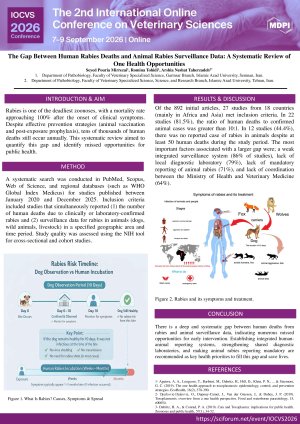
Rabies is one of the deadliest zoonoses with a mortality rate approaching 100% after the onset of clinical symptoms. Despite effective prevention strategies (animal vaccination and post-exposure prophylaxis), tens of thousands of human deaths still occur annually. This systematic review aimed to quantify this gap and identify missed opportunities for public health.
Methods
A systematic search was conducted in PubMed, Scopus, Web of Science, and regional databases (such as WHO Global Index Medicus) for studies published between January 2020 and December 2025. Inclusion criteria included studies that simultaneously reported (1) the number of human deaths due to clinically or laboratory-confirmed rabies and (2) surveillance data for rabies in animals (dogs, wild animals, livestock) in a specified geographic area and time period. Study quality was assessed using the NIH tool for cross-sectional and cohort studies.
Results
Of the 892 initial articles, 27 studies from 18 countries (mainly in Africa and Asia) met inclusion criteria. In 22 studies (81.5%), the ratio of human deaths to confirmed animal cases was greater than 10:1. In 12 studies (44.4%), there was no reported case of rabies in animals despite at least 50 human deaths during the study period. The most important factors associated with a larger gap were; a weak integrated surveillance system (86% of studies), lack of local diagnostic laboratory (79%), lack of mandatory reporting of animal rabies (71%), and lack of coordination between the Ministry of Health and Veterinary Medicine (64%).
Conclusion
There is a deep and systematic gap between human deaths from rabies and animal surveillance data, indicating numerous missed opportunities for early intervention. Establishing integrated human-animal reporting systems, strengthening shared diagnostic laboratories, and making animal rabies reporting mandatory are recommended as key health priorities to fill this gap and save lives.
Keywords
Animal Surveillance
Health Unit
Human Mortality
Rabies
Zoonoses
Poster
Poster.pdf
Animal Reservoir Hosts of Zoonotic Visceral Leishmaniasis in Iran: A Systematic Review and Meta-Analysis
The peregrine falcon (Falco peregrinus) as a sentinel species for environmental contamination at the human–animal–environment interface