Event submissions
Published
This submission belongs to the session S2. Surveillance and Epidemiological Modelling at the Human–Animal–Environment Interface of the event The 2nd International Online Conference on Veterinary Sciences
Published date
02 Sep, 2026
Academic Editor
'%3e%3cpath%20d='M12.6657%2010.9104C12.4185%2010.325%2012.0599%209.79327%2011.6097%209.34482C11.1609%208.89508%2010.6293%208.5365%2010.0442%208.28888C10.0389%208.28626%2010.0337%208.28495%2010.0285%208.28233C10.8446%207.69279%2011.3752%206.73249%2011.3752%205.64904C11.3752%203.8542%209.92103%202.39999%208.1262%202.39999C6.33136%202.39999%204.87715%203.8542%204.87715%205.64904C4.87715%206.73249%205.40774%207.69279%206.22393%208.28364C6.21869%208.28626%206.21345%208.28757%206.20821%208.29019C5.62129%208.5378%205.09463%208.89284%204.64265%209.34613C4.1929%209.79493%203.83432%2010.3266%203.58671%2010.9117C3.34345%2011.4845%203.21226%2012.0987%203.20023%2012.7209C3.19988%2012.7349%203.20233%2012.7488%203.20744%2012.7619C3.21255%2012.7749%203.22022%2012.7867%203.22998%2012.7968C3.23975%2012.8068%203.25142%2012.8147%203.26431%2012.8202C3.2772%2012.8256%203.29105%2012.8284%203.30504%2012.8284H4.09109C4.14874%2012.8284%204.19459%2012.7825%204.1959%2012.7262C4.2221%2011.7148%204.62823%2010.7676%205.34617%2010.0497C6.08899%209.30683%207.0755%208.89808%208.1262%208.89808C9.17689%208.89808%2010.1634%209.30683%2010.9062%2010.0497C11.6242%2010.7676%2012.0303%2011.7148%2012.0565%2012.7262C12.0578%2012.7838%2012.1037%2012.8284%2012.1613%2012.8284H12.9474C12.9613%2012.8284%2012.9752%2012.8256%2012.9881%2012.8202C13.001%2012.8147%2013.0126%2012.8068%2013.0224%2012.7968C13.0322%2012.7867%2013.0398%2012.7749%2013.0449%2012.7619C13.0501%2012.7488%2013.0525%2012.7349%2013.0522%2012.7209C13.0391%2012.0947%2012.9094%2011.4855%2012.6657%2010.9104ZM8.1262%207.9024C7.52486%207.9024%206.9589%207.6679%206.53312%207.24211C6.10733%206.81633%205.87283%206.25037%205.87283%205.64904C5.87283%205.0477%206.10733%204.48174%206.53312%204.05596C6.9589%203.63018%207.52486%203.39567%208.1262%203.39567C8.72753%203.39567%209.29349%203.63018%209.71927%204.05596C10.1451%204.48174%2010.3796%205.0477%2010.3796%205.64904C10.3796%206.25037%2010.1451%206.81633%209.71927%207.24211C9.29349%207.6679%208.72753%207.9024%208.1262%207.9024Z'%20fill='%235D1EE1'/%3e%3c/g%3e%3c/svg%3e) Francesco Mira
Francesco MiraCitation
Parisa Ghazanfaripanah, Reza Fayaz, Epidemiological Status of Theileriosis and Babesiosis among Domestic Ruminants in West Azerbaijan Province, Iran: A Systematic Review and Meta-analysis, in Proceedings of The 2nd International Online Conference on Veterinary Sciences, 7 September–9 September 2026, MDPI: Basel, Switzerland
Share
Email
Facebook
Twitter
LinkedIn
Epidemiological Status of Theileriosis and Babesiosis among Domestic Ruminants in West Azerbaijan Province, Iran: A Systematic Review and Meta-analysis
'%3e%3cpath%20d='M12.6647%2010.9104C12.4176%2010.325%2012.0589%209.7933%2011.6088%209.34485C11.16%208.89511%2010.6283%208.53653%2010.0432%208.28891C10.038%208.28629%2010.0327%208.28498%2010.0275%208.28236C10.8437%207.69282%2011.3743%206.73252%2011.3743%205.64907C11.3743%203.85423%209.92005%202.40002%208.12522%202.40002C6.33038%202.40002%204.87618%203.85423%204.87618%205.64907C4.87618%206.73252%205.40677%207.69282%206.22296%208.28367C6.21772%208.28629%206.21248%208.2876%206.20724%208.29022C5.62031%208.53783%205.09365%208.89287%204.64167%209.34616C4.19192%209.79496%203.83334%2010.3266%203.58573%2010.9117C3.34247%2011.4846%203.21128%2012.0987%203.19925%2012.721C3.1989%2012.735%203.20135%2012.7489%203.20646%2012.7619C3.21157%2012.7749%203.21924%2012.7868%203.22901%2012.7968C3.23877%2012.8068%203.25045%2012.8148%203.26334%2012.8202C3.27623%2012.8256%203.29007%2012.8284%203.30406%2012.8284H4.09012C4.14776%2012.8284%204.19362%2012.7825%204.19493%2012.7262C4.22113%2011.7148%204.62726%2010.7676%205.34519%2010.0497C6.08802%209.30686%207.07452%208.89811%208.12522%208.89811C9.17592%208.89811%2010.1624%209.30686%2010.9052%2010.0497C11.6232%2010.7676%2012.0293%2011.7148%2012.0555%2012.7262C12.0568%2012.7839%2012.1027%2012.8284%2012.1603%2012.8284H12.9464C12.9604%2012.8284%2012.9742%2012.8256%2012.9871%2012.8202C13%2012.8148%2013.0117%2012.8068%2013.0214%2012.7968C13.0312%2012.7868%2013.0389%2012.7749%2013.044%2012.7619C13.0491%2012.7489%2013.0515%2012.735%2013.0512%2012.721C13.0381%2012.0947%2012.9084%2011.4856%2012.6647%2010.9104ZM8.12522%207.90243C7.52388%207.90243%206.95792%207.66793%206.53214%207.24215C6.10636%206.81636%205.87185%206.2504%205.87185%205.64907C5.87185%205.04773%206.10636%204.48177%206.53214%204.05599C6.95792%203.63021%207.52388%203.3957%208.12522%203.3957C8.72655%203.3957%209.29252%203.63021%209.7183%204.05599C10.1441%204.48177%2010.3786%205.04773%2010.3786%205.64907C10.3786%206.2504%2010.1441%206.81636%209.7183%207.24215C9.29252%207.66793%208.72655%207.90243%208.12522%207.90243Z'%20fill='%235D1EE1'/%3e%3c/g%3e%3c/svg%3e)
Parisa Ghazanfaripanah 1
Reza Fayaz 1
1. Faculty of Veterinary Medicine, Islamic Azad University, Urmia Branch, Urmia, Iran
Abstract
Background: Theileriosis and babesiosis are major tick-borne hemoprotozoan diseases of domestic ruminants associated with economic losses, including anemia, reduced productivity, reproductive disorders, and mortality. West Azerbaijan Province, northwestern Iran, is considered an endemic region for these infections because of favorable climatic conditions, extensive livestock farming, and transboundary animal movement. This systematic review and meta-analysis aimed to evaluate the epidemiological status and prevalence of theileriosis and babesiosis among domestic ruminants in this province.
Methods: A systematic search of English and Persian databases, including PubMed, Scopus, Web of Science, ScienceDirect, Google Scholar, SID, Magiran, IranMedex, and ElmNet, was conducted for studies published between 2000 and 2025. Studies reporting the prevalence of Theileria spp. and Babesia spp. infections in cattle, sheep, goats, and buffaloes in West Azerbaijan Province were included. Data on sample size, host species, diagnostic methods, parasite species, and prevalence rates were extracted. Meta-analysis was performed using a random-effects model with 95% confidence intervals. Heterogeneity was assessed using the I² statistic, and publication bias was evaluated through subgroup analyses and funnel plot assessment.
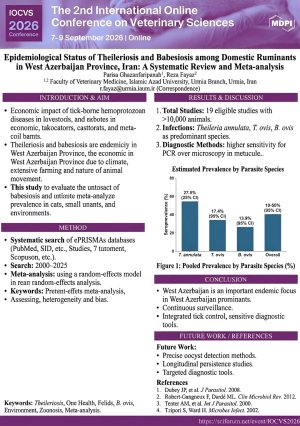
Results: A total of 19 eligible studies involving more than 10,000 domestic ruminants were included. Infection rates ranged from 10% to 50% depending on parasite species, host animal, and diagnostic method, with higher prevalence in sheep than cattle and goats. Theileria annulata, T. lestoquardi, T. ovis, and Babesia ovis were the predominant species identified. The prevalence of T. annulata, T. ovis, and B. ovis was estimated at 27.5%, 17.4%, and 13.9%, respectively. PCR-based methods demonstrated greater sensitivity than conventional microscopy.
Conclusion: West Azerbaijan Province represents an important endemic focus for theileriosis and babesiosis among domestic ruminants in Iran. Continuous epidemiological surveillance, integrated tick-control programs, and implementation of sensitive diagnostic approaches should be strengthened to reduce the economic and veterinary impacts of these infections on livestock production.
Keywords
Theileria spp.
Babesia spp.
Theileriosis
Babesiosis
Domestic ruminant disease
Tick-borne
Iran
Poster
Parisa Ghazanfaripanah _ poster.pdf
The peregrine falcon (Falco peregrinus) as a sentinel species for environmental contamination at the human–animal–environment interface
One Health-Based Modelling of H5N1 Clade 2.3.4.4b Spillover Risk in Urban and Peri-Urban Interfaces