Event submissions
Published
This submission belongs to the session S3. Antimicrobial Resistance and Food Safety: A One Health Perspective of the event The 2nd International Online Conference on Veterinary Sciences
Published date
02 Sep, 2026
Academic Editor
'%3e%3cpath%20d='M12.6657%2010.9104C12.4185%2010.325%2012.0599%209.79327%2011.6097%209.34482C11.1609%208.89508%2010.6293%208.5365%2010.0442%208.28888C10.0389%208.28626%2010.0337%208.28495%2010.0285%208.28233C10.8446%207.69279%2011.3752%206.73249%2011.3752%205.64904C11.3752%203.8542%209.92103%202.39999%208.1262%202.39999C6.33136%202.39999%204.87715%203.8542%204.87715%205.64904C4.87715%206.73249%205.40774%207.69279%206.22393%208.28364C6.21869%208.28626%206.21345%208.28757%206.20821%208.29019C5.62129%208.5378%205.09463%208.89284%204.64265%209.34613C4.1929%209.79493%203.83432%2010.3266%203.58671%2010.9117C3.34345%2011.4845%203.21226%2012.0987%203.20023%2012.7209C3.19988%2012.7349%203.20233%2012.7488%203.20744%2012.7619C3.21255%2012.7749%203.22022%2012.7867%203.22998%2012.7968C3.23975%2012.8068%203.25142%2012.8147%203.26431%2012.8202C3.2772%2012.8256%203.29105%2012.8284%203.30504%2012.8284H4.09109C4.14874%2012.8284%204.19459%2012.7825%204.1959%2012.7262C4.2221%2011.7148%204.62823%2010.7676%205.34617%2010.0497C6.08899%209.30683%207.0755%208.89808%208.1262%208.89808C9.17689%208.89808%2010.1634%209.30683%2010.9062%2010.0497C11.6242%2010.7676%2012.0303%2011.7148%2012.0565%2012.7262C12.0578%2012.7838%2012.1037%2012.8284%2012.1613%2012.8284H12.9474C12.9613%2012.8284%2012.9752%2012.8256%2012.9881%2012.8202C13.001%2012.8147%2013.0126%2012.8068%2013.0224%2012.7968C13.0322%2012.7867%2013.0398%2012.7749%2013.0449%2012.7619C13.0501%2012.7488%2013.0525%2012.7349%2013.0522%2012.7209C13.0391%2012.0947%2012.9094%2011.4855%2012.6657%2010.9104ZM8.1262%207.9024C7.52486%207.9024%206.9589%207.6679%206.53312%207.24211C6.10733%206.81633%205.87283%206.25037%205.87283%205.64904C5.87283%205.0477%206.10733%204.48174%206.53312%204.05596C6.9589%203.63018%207.52486%203.39567%208.1262%203.39567C8.72753%203.39567%209.29349%203.63018%209.71927%204.05596C10.1451%204.48174%2010.3796%205.0477%2010.3796%205.64904C10.3796%206.25037%2010.1451%206.81633%209.71927%207.24211C9.29349%207.6679%208.72753%207.9024%208.1262%207.9024Z'%20fill='%235D1EE1'/%3e%3c/g%3e%3c/svg%3e) BeiBei Li
BeiBei LiCitation
Mahdis Mahdavi, Mohammad Amin Aghaahmadi, Molecular Detection, Antimicrobial Resistance Profiling, and Genetic Diversity of Campylobacter jejuni and Campylobacter coli Isolated from Urban Backyard Poultry, Companion Animals, and Environmental Samples: A One Health Approach in Peri-Urban Regions, in Proceedings of The 2nd International Online Conference on Veterinary Sciences, 7 September–9 September 2026, MDPI: Basel, Switzerland
Share
Email
Facebook
Twitter
LinkedIn
Molecular Detection, Antimicrobial Resistance Profiling, and Genetic Diversity of Campylobacter jejuni and Campylobacter coli Isolated from Urban Backyard Poultry, Companion Animals, and Environmental Samples: A One Health Approach in Peri-Urban Regions
'%3e%3cpath%20d='M12.6647%2010.9104C12.4176%2010.325%2012.0589%209.7933%2011.6088%209.34485C11.16%208.89511%2010.6283%208.53653%2010.0432%208.28891C10.038%208.28629%2010.0327%208.28498%2010.0275%208.28236C10.8437%207.69282%2011.3743%206.73252%2011.3743%205.64907C11.3743%203.85423%209.92005%202.40002%208.12522%202.40002C6.33038%202.40002%204.87618%203.85423%204.87618%205.64907C4.87618%206.73252%205.40677%207.69282%206.22296%208.28367C6.21772%208.28629%206.21248%208.2876%206.20724%208.29022C5.62031%208.53783%205.09365%208.89287%204.64167%209.34616C4.19192%209.79496%203.83334%2010.3266%203.58573%2010.9117C3.34247%2011.4846%203.21128%2012.0987%203.19925%2012.721C3.1989%2012.735%203.20135%2012.7489%203.20646%2012.7619C3.21157%2012.7749%203.21924%2012.7868%203.22901%2012.7968C3.23877%2012.8068%203.25045%2012.8148%203.26334%2012.8202C3.27623%2012.8256%203.29007%2012.8284%203.30406%2012.8284H4.09012C4.14776%2012.8284%204.19362%2012.7825%204.19493%2012.7262C4.22113%2011.7148%204.62726%2010.7676%205.34519%2010.0497C6.08802%209.30686%207.07452%208.89811%208.12522%208.89811C9.17592%208.89811%2010.1624%209.30686%2010.9052%2010.0497C11.6232%2010.7676%2012.0293%2011.7148%2012.0555%2012.7262C12.0568%2012.7839%2012.1027%2012.8284%2012.1603%2012.8284H12.9464C12.9604%2012.8284%2012.9742%2012.8256%2012.9871%2012.8202C13%2012.8148%2013.0117%2012.8068%2013.0214%2012.7968C13.0312%2012.7868%2013.0389%2012.7749%2013.044%2012.7619C13.0491%2012.7489%2013.0515%2012.735%2013.0512%2012.721C13.0381%2012.0947%2012.9084%2011.4856%2012.6647%2010.9104ZM8.12522%207.90243C7.52388%207.90243%206.95792%207.66793%206.53214%207.24215C6.10636%206.81636%205.87185%206.2504%205.87185%205.64907C5.87185%205.04773%206.10636%204.48177%206.53214%204.05599C6.95792%203.63021%207.52388%203.3957%208.12522%203.3957C8.72655%203.3957%209.29252%203.63021%209.7183%204.05599C10.1441%204.48177%2010.3786%205.04773%2010.3786%205.64907C10.3786%206.2504%2010.1441%206.81636%209.7183%207.24215C9.29252%207.66793%208.72655%207.90243%208.12522%207.90243Z'%20fill='%235D1EE1'/%3e%3c/g%3e%3c/svg%3e)
Mahdis Mahdavi 1
Mohammad Amin Aghaahmadi 1
1. Veterinary Medicine, Bab.C., Islamic Azad University, Babol, Iran
Abstract
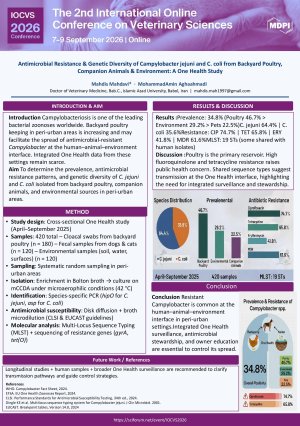
Background:Campylobacteriosis caused by Campylobacter jejuni and Campylobacter coli is among the leading bacterial zoonotic gastroenteritis diseases worldwide. The increasing practice of backyard poultry keeping in urban and peri-urban areas may facilitate the circulation of antimicrobial-resistant Campylobacter strains at the human–animal–environment interface. However, integrated One Health investigations in these settings remain limited.
Objectives:This study aimed to determine the prevalence, antimicrobial resistance patterns, and genetic diversity of C. jejuni and C. coli isolated from backyard poultry, companion animals, and environmental sources in peri-urban areas.
Methods:A cross-sectional study was conducted from April to September 2025. A total of 420 samples, including cloacal swabs from backyard poultry (n = 180), fecal samples from dogs and cats (n = 120), and environmental samples (n = 120), were collected using systematic random sampling. Following enrichment and culture on mCCDA under microaerophilic conditions, isolates were confirmed by species-specific PCR targeting the hipO and asp genes. Antimicrobial susceptibility testing was performed using disk diffusion and broth microdilution methods according to CLSI and EUCAST guidelines. Genetic diversity was evaluated by Multi-Locus Sequence Typing (MLST) and sequencing of resistance-associated genes.
Results:Overall, 34.8% (146/420) of samples were positive for Campylobacter spp., including 64.4% C. jejuni and 35.6% C. coli. The highest prevalence was detected in backyard poultry (46.7%), followed by environmental samples (29.2%) and companion animals (22.5%) (p < 0.01). High resistance rates were observed against ciprofloxacin (74.7%), tetracycline (65.8%), and erythromycin (41.8%), while 61.6% of isolates showed multidrug resistance. MLST identified 19 sequence types, several closely related to human clinical isolates.
Conclusions:The widespread occurrence of antimicrobial-resistant Campylobacter in peri-urban settings highlights the importance of integrated One Health surveillance, antimicrobial stewardship, and public education regarding backyard poultry management.
Keywords
Campylobacter jejuni
Campylobacter coli
Antimicrobial Resistance
Multidrug Resistance
One Health
Backyard Poultry
MLST
Zoonotic Transmission
Peri-urban Areas
Poster
Sciforum-189035.pdf
One Health-Based Modelling of H5N1 Clade 2.3.4.4b Spillover Risk in Urban and Peri-Urban Interfaces
Healthy Livestock as Silent Reservoirs of Enterococci with Vancomycin Resistance Determinants in Sabah, Malaysian Borneo