Event submissions
Published
This submission belongs to the session S3. Antimicrobial Resistance and Food Safety: A One Health Perspective of the event The 2nd International Online Conference on Veterinary Sciences
Published date
02 Sep, 2026
Academic Editor
'%3e%3cpath%20d='M12.6657%2010.9104C12.4185%2010.325%2012.0599%209.79327%2011.6097%209.34482C11.1609%208.89508%2010.6293%208.5365%2010.0442%208.28888C10.0389%208.28626%2010.0337%208.28495%2010.0285%208.28233C10.8446%207.69279%2011.3752%206.73249%2011.3752%205.64904C11.3752%203.8542%209.92103%202.39999%208.1262%202.39999C6.33136%202.39999%204.87715%203.8542%204.87715%205.64904C4.87715%206.73249%205.40774%207.69279%206.22393%208.28364C6.21869%208.28626%206.21345%208.28757%206.20821%208.29019C5.62129%208.5378%205.09463%208.89284%204.64265%209.34613C4.1929%209.79493%203.83432%2010.3266%203.58671%2010.9117C3.34345%2011.4845%203.21226%2012.0987%203.20023%2012.7209C3.19988%2012.7349%203.20233%2012.7488%203.20744%2012.7619C3.21255%2012.7749%203.22022%2012.7867%203.22998%2012.7968C3.23975%2012.8068%203.25142%2012.8147%203.26431%2012.8202C3.2772%2012.8256%203.29105%2012.8284%203.30504%2012.8284H4.09109C4.14874%2012.8284%204.19459%2012.7825%204.1959%2012.7262C4.2221%2011.7148%204.62823%2010.7676%205.34617%2010.0497C6.08899%209.30683%207.0755%208.89808%208.1262%208.89808C9.17689%208.89808%2010.1634%209.30683%2010.9062%2010.0497C11.6242%2010.7676%2012.0303%2011.7148%2012.0565%2012.7262C12.0578%2012.7838%2012.1037%2012.8284%2012.1613%2012.8284H12.9474C12.9613%2012.8284%2012.9752%2012.8256%2012.9881%2012.8202C13.001%2012.8147%2013.0126%2012.8068%2013.0224%2012.7968C13.0322%2012.7867%2013.0398%2012.7749%2013.0449%2012.7619C13.0501%2012.7488%2013.0525%2012.7349%2013.0522%2012.7209C13.0391%2012.0947%2012.9094%2011.4855%2012.6657%2010.9104ZM8.1262%207.9024C7.52486%207.9024%206.9589%207.6679%206.53312%207.24211C6.10733%206.81633%205.87283%206.25037%205.87283%205.64904C5.87283%205.0477%206.10733%204.48174%206.53312%204.05596C6.9589%203.63018%207.52486%203.39567%208.1262%203.39567C8.72753%203.39567%209.29349%203.63018%209.71927%204.05596C10.1451%204.48174%2010.3796%205.0477%2010.3796%205.64904C10.3796%206.25037%2010.1451%206.81633%209.71927%207.24211C9.29349%207.6679%208.72753%207.9024%208.1262%207.9024Z'%20fill='%235D1EE1'/%3e%3c/g%3e%3c/svg%3e) Ruichao Li
Ruichao LiCitation
Gundega Gulbe, Agnese Brūvere, Vaira Saulīte, Antagonistic activity of Lactobacillus helveticus postbiotics against mastitis causing and dairy spoilage bacteria and their produced biofilms, in Proceedings of The 2nd International Online Conference on Veterinary Sciences, 7 September–9 September 2026, MDPI: Basel, Switzerland
Share
Email
Facebook
Twitter
LinkedIn
Antagonistic activity of Lactobacillus helveticus postbiotics against mastitis causing and dairy spoilage bacteria and their produced biofilms
'%3e%3cpath%20d='M12.6647%2010.9104C12.4176%2010.325%2012.0589%209.7933%2011.6088%209.34485C11.16%208.89511%2010.6283%208.53653%2010.0432%208.28891C10.038%208.28629%2010.0327%208.28498%2010.0275%208.28236C10.8437%207.69282%2011.3743%206.73252%2011.3743%205.64907C11.3743%203.85423%209.92005%202.40002%208.12522%202.40002C6.33038%202.40002%204.87618%203.85423%204.87618%205.64907C4.87618%206.73252%205.40677%207.69282%206.22296%208.28367C6.21772%208.28629%206.21248%208.2876%206.20724%208.29022C5.62031%208.53783%205.09365%208.89287%204.64167%209.34616C4.19192%209.79496%203.83334%2010.3266%203.58573%2010.9117C3.34247%2011.4846%203.21128%2012.0987%203.19925%2012.721C3.1989%2012.735%203.20135%2012.7489%203.20646%2012.7619C3.21157%2012.7749%203.21924%2012.7868%203.22901%2012.7968C3.23877%2012.8068%203.25045%2012.8148%203.26334%2012.8202C3.27623%2012.8256%203.29007%2012.8284%203.30406%2012.8284H4.09012C4.14776%2012.8284%204.19362%2012.7825%204.19493%2012.7262C4.22113%2011.7148%204.62726%2010.7676%205.34519%2010.0497C6.08802%209.30686%207.07452%208.89811%208.12522%208.89811C9.17592%208.89811%2010.1624%209.30686%2010.9052%2010.0497C11.6232%2010.7676%2012.0293%2011.7148%2012.0555%2012.7262C12.0568%2012.7839%2012.1027%2012.8284%2012.1603%2012.8284H12.9464C12.9604%2012.8284%2012.9742%2012.8256%2012.9871%2012.8202C13%2012.8148%2013.0117%2012.8068%2013.0214%2012.7968C13.0312%2012.7868%2013.0389%2012.7749%2013.044%2012.7619C13.0491%2012.7489%2013.0515%2012.735%2013.0512%2012.721C13.0381%2012.0947%2012.9084%2011.4856%2012.6647%2010.9104ZM8.12522%207.90243C7.52388%207.90243%206.95792%207.66793%206.53214%207.24215C6.10636%206.81636%205.87185%206.2504%205.87185%205.64907C5.87185%205.04773%206.10636%204.48177%206.53214%204.05599C6.95792%203.63021%207.52388%203.3957%208.12522%203.3957C8.72655%203.3957%209.29252%203.63021%209.7183%204.05599C10.1441%204.48177%2010.3786%205.04773%2010.3786%205.64907C10.3786%206.2504%2010.1441%206.81636%209.7183%207.24215C9.29252%207.66793%208.72655%207.90243%208.12522%207.90243Z'%20fill='%235D1EE1'/%3e%3c/g%3e%3c/svg%3e)
Gundega Gulbe 1
Agnese Brūvere 1
Vaira Saulīte 1
1. Riga Stradins University, Institute of Microbiology and Virology, Ratsupites 5, LV-1067, Riga, Latvia
Abstract
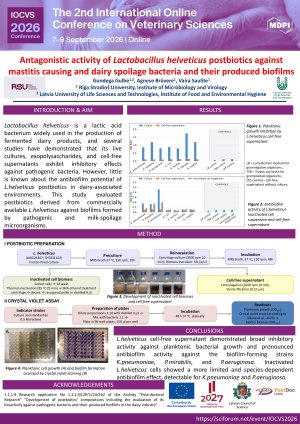
INTRODUCTION. Lactobacillus helveticus is a lactic acid bacterium widely used in the production of fermented dairy products, and several studies have demonstrated that its live cultures, exopolysaccharides, and cell-free supernatants exhibit inhibitory effects against pathogenic bacteria. However, little is known about the antibiofilm potential of L. helveticus postbiotics in dairy-associated environments. This study evaluated postbiotics derived from commercially available L. helveticus against biofilms formed by pathogenic and milk-spoilage microorganisms.
METHODS. Freeze-dried L. helveticus (LMG26307; THT031102) was precultured in MRS broth at 37°C. After 18 h, cultures were centrifuged, and biomass was reinoculated (5% w/v). Following incubation, cells were collected, washed, thermally inactivated, and ethanol-treated, yielding postbiotics consisting of inactivated cell biomass. Cell-free supernatant was obtained by centrifugation and sterile filtration (0.22 μm). Indicator strains (Klebsiella pneumoniae, Proteus mirabilis, Pseudomonas aeruginosa, Escherichia coli, Staphylococcus aureus, Enterococcus faecalis, and Bacillus subtilis) were cultured and standardized to 0.5 McFarland. Preparations were diluted (1:10), mixed with bacterial suspensions (1:1 v/v), and incubated for 48 h at 37 °C in 96-well plates. Planktonic growth (OD620) and biofilm biomass were measured.
RESULTS. Both preparations affected bacterial growth and biofilm formation. The supernatant inhibited planktonic growth in all tested species and reduced biofilm formation in K. pneumoniae, P. mirabilis, and P. aeruginosa. Postbiotics increased planktonic OD values due to cell-derived turbidity but reduced biofilm formation in K. pneumoniae and P. aeruginosa, although less effectively than supernatant. S. aureus, B. subtilis, E. coli, and E. faecalis strains did not form biofilms under tested conditions.
CONCLUSION. L. helveticus supernatant exhibited strong antimicrobial and antibiofilm activity, while postbiotics showed a more limited but still notable effect.
ACKNOWLEDGEMENTS. 1.1.1.9 Research application No 1.1.1.9/LZP/1/24/162 of the Activity "Post-doctoral Research" "Development of postbiotics’ compositions including the evaluation of its bioactivity against pathogenic bacteria and their produced biofilms in the dairy industry"
Keywords
Postbiotics
Paraprobiotics
Cell-free supernatant
Antibiofilm activity
Mastitis
Lactic acid bacteria
Dairy environment
Poster
Poster_Gulbe.pdf
Healthy Livestock as Silent Reservoirs of Enterococci with Vancomycin Resistance Determinants in Sabah, Malaysian Borneo
Genomic Characterization of Multidrug-Resistance mecC-MRSA in Portuguese Rabbit Production