Event submissions
Published
This submission belongs to the session S3. Antimicrobial Resistance and Food Safety: A One Health Perspective of the event The 2nd International Online Conference on Veterinary Sciences
Published date
02 Sep, 2026
Academic Editor
'%3e%3cpath%20d='M12.6657%2010.9104C12.4185%2010.325%2012.0599%209.79327%2011.6097%209.34482C11.1609%208.89508%2010.6293%208.5365%2010.0442%208.28888C10.0389%208.28626%2010.0337%208.28495%2010.0285%208.28233C10.8446%207.69279%2011.3752%206.73249%2011.3752%205.64904C11.3752%203.8542%209.92103%202.39999%208.1262%202.39999C6.33136%202.39999%204.87715%203.8542%204.87715%205.64904C4.87715%206.73249%205.40774%207.69279%206.22393%208.28364C6.21869%208.28626%206.21345%208.28757%206.20821%208.29019C5.62129%208.5378%205.09463%208.89284%204.64265%209.34613C4.1929%209.79493%203.83432%2010.3266%203.58671%2010.9117C3.34345%2011.4845%203.21226%2012.0987%203.20023%2012.7209C3.19988%2012.7349%203.20233%2012.7488%203.20744%2012.7619C3.21255%2012.7749%203.22022%2012.7867%203.22998%2012.7968C3.23975%2012.8068%203.25142%2012.8147%203.26431%2012.8202C3.2772%2012.8256%203.29105%2012.8284%203.30504%2012.8284H4.09109C4.14874%2012.8284%204.19459%2012.7825%204.1959%2012.7262C4.2221%2011.7148%204.62823%2010.7676%205.34617%2010.0497C6.08899%209.30683%207.0755%208.89808%208.1262%208.89808C9.17689%208.89808%2010.1634%209.30683%2010.9062%2010.0497C11.6242%2010.7676%2012.0303%2011.7148%2012.0565%2012.7262C12.0578%2012.7838%2012.1037%2012.8284%2012.1613%2012.8284H12.9474C12.9613%2012.8284%2012.9752%2012.8256%2012.9881%2012.8202C13.001%2012.8147%2013.0126%2012.8068%2013.0224%2012.7968C13.0322%2012.7867%2013.0398%2012.7749%2013.0449%2012.7619C13.0501%2012.7488%2013.0525%2012.7349%2013.0522%2012.7209C13.0391%2012.0947%2012.9094%2011.4855%2012.6657%2010.9104ZM8.1262%207.9024C7.52486%207.9024%206.9589%207.6679%206.53312%207.24211C6.10733%206.81633%205.87283%206.25037%205.87283%205.64904C5.87283%205.0477%206.10733%204.48174%206.53312%204.05596C6.9589%203.63018%207.52486%203.39567%208.1262%203.39567C8.72753%203.39567%209.29349%203.63018%209.71927%204.05596C10.1451%204.48174%2010.3796%205.0477%2010.3796%205.64904C10.3796%206.25037%2010.1451%206.81633%209.71927%207.24211C9.29349%207.6679%208.72753%207.9024%208.1262%207.9024Z'%20fill='%235D1EE1'/%3e%3c/g%3e%3c/svg%3e) Ruichao Li
Ruichao LiCitation
Caio Vidal, Thiago Vinicius Costa Nascimento, Glenda Lidice Cortez Marinho Silva, Detection of Antibiotic Residues in Raw Bovine Milk and Environmental Risks Associated with Improper Disposal: A One Health Approach, in Proceedings of The 2nd International Online Conference on Veterinary Sciences, 7 September–9 September 2026, MDPI: Basel, Switzerland
Share
Email
Facebook
Twitter
LinkedIn
Detection of Antibiotic Residues in Raw Bovine Milk and Environmental Risks Associated with Improper Disposal: A One Health Approach
Detection of Antibiotic Residues in Raw Bovine Milk and Environmental Risks Associated with Improper Disposal: A One Health Approach

Caio Vidal 1
'%3e%3cpath%20d='M12.6647%2010.9104C12.4176%2010.325%2012.0589%209.7933%2011.6088%209.34485C11.16%208.89511%2010.6283%208.53653%2010.0432%208.28891C10.038%208.28629%2010.0327%208.28498%2010.0275%208.28236C10.8437%207.69282%2011.3743%206.73252%2011.3743%205.64907C11.3743%203.85423%209.92005%202.40002%208.12522%202.40002C6.33038%202.40002%204.87618%203.85423%204.87618%205.64907C4.87618%206.73252%205.40677%207.69282%206.22296%208.28367C6.21772%208.28629%206.21248%208.2876%206.20724%208.29022C5.62031%208.53783%205.09365%208.89287%204.64167%209.34616C4.19192%209.79496%203.83334%2010.3266%203.58573%2010.9117C3.34247%2011.4846%203.21128%2012.0987%203.19925%2012.721C3.1989%2012.735%203.20135%2012.7489%203.20646%2012.7619C3.21157%2012.7749%203.21924%2012.7868%203.22901%2012.7968C3.23877%2012.8068%203.25045%2012.8148%203.26334%2012.8202C3.27623%2012.8256%203.29007%2012.8284%203.30406%2012.8284H4.09012C4.14776%2012.8284%204.19362%2012.7825%204.19493%2012.7262C4.22113%2011.7148%204.62726%2010.7676%205.34519%2010.0497C6.08802%209.30686%207.07452%208.89811%208.12522%208.89811C9.17592%208.89811%2010.1624%209.30686%2010.9052%2010.0497C11.6232%2010.7676%2012.0293%2011.7148%2012.0555%2012.7262C12.0568%2012.7839%2012.1027%2012.8284%2012.1603%2012.8284H12.9464C12.9604%2012.8284%2012.9742%2012.8256%2012.9871%2012.8202C13%2012.8148%2013.0117%2012.8068%2013.0214%2012.7968C13.0312%2012.7868%2013.0389%2012.7749%2013.044%2012.7619C13.0491%2012.7489%2013.0515%2012.735%2013.0512%2012.721C13.0381%2012.0947%2012.9084%2011.4856%2012.6647%2010.9104ZM8.12522%207.90243C7.52388%207.90243%206.95792%207.66793%206.53214%207.24215C6.10636%206.81636%205.87185%206.2504%205.87185%205.64907C5.87185%205.04773%206.10636%204.48177%206.53214%204.05599C6.95792%203.63021%207.52388%203.3957%208.12522%203.3957C8.72655%203.3957%209.29252%203.63021%209.7183%204.05599C10.1441%204.48177%2010.3786%205.04773%2010.3786%205.64907C10.3786%206.2504%2010.1441%206.81636%209.7183%207.24215C9.29252%207.66793%208.72655%207.90243%208.12522%207.90243Z'%20fill='%235D1EE1'/%3e%3c/g%3e%3c/svg%3e)
Thiago Vinicius Costa Nascimento 1
Glenda Lidice Cortez Marinho Silva 1
1. Department of Veterinary Medicine , Federal University of Sergipe (UFS), Nossa Senhora da Glória, Sergipe, Brazil
Abstract
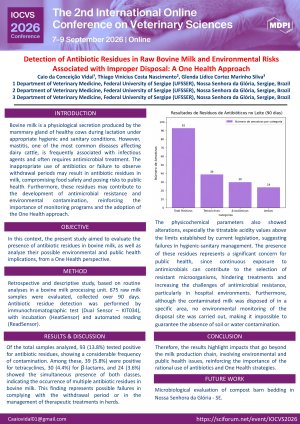
Bovine milk is a physiological secretion produced by the mammary gland of healthy cows during lactation under adequate hygienic-sanitary conditions. However, mastitis, commonly associated with infectious agents, frequently requires the use of antibiotics in dairy cattle farming, which may result in antibiotic residues in milk and pose risks to public health and the environment. This study aimed to evaluate antibiotic residues in bovine milk over a three-month period and discuss their environmental implications from a One Health perspective. A retrospective and descriptive study was conducted based on routine analyses performed in a bovine milk processing unit. During 90 days, 675 milk samples from different rural properties were analyzed using a rapid immunochromatographic test for the detection of antibiotic residues. Among the analyzed samples, 93 (13.8%) tested positive, with 39 (5.8%) positive for tetracyclines, 30 (4.4%) for β-lactams, and 24 (3.6%) showing simultaneous presence of both classes, demonstrating the occurrence of multiple antibiotic residues in bovine milk. Physicochemical parameters also showed significant alterations, especially titratable acidity values above the limits established by current legislation, suggesting failures in hygienic-sanitary management, refrigeration, or milk quality control. The presence of these residues represents a significant public health concern, since continuous exposure to antimicrobials may contribute to the selection of resistant microorganisms, making therapeutic treatments more difficult and increasing antimicrobial resistance challenges, particularly in hospital environments. Furthermore, although contaminated milk was disposed of in a specific area, no environmental monitoring of the disposal site was carried out, making it impossible to ensure the absence of soil or water contamination. Therefore, the findings highlight impacts that extend beyond the dairy production chain, involving environmental and collective health issues, reinforcing the importance of rational antibiotic use and One Health strategies.
Keywords
Raw milk
human health
bacterial resistance
hospital.
Poster
Detection of Antibiotic Residues in Raw Bovine Milk and Environmental Risks Associated with Improper Disposal A One Health Approach.pdf
Antagonistic activity of Lactobacillus helveticus postbiotics against mastitis causing and dairy spoilage bacteria and their produced biofilms
Genomic Characterization of Multidrug-Resistance mecC-MRSA in Portuguese Rabbit Production