Event submissions
Published
This submission belongs to the session S2. Surveillance and Epidemiological Modelling at the Human–Animal–Environment Interface of the event The 2nd International Online Conference on Veterinary Sciences
Published date
02 Sep, 2026
Academic Editor
'%3e%3cpath%20d='M12.6657%2010.9104C12.4185%2010.325%2012.0599%209.79327%2011.6097%209.34482C11.1609%208.89508%2010.6293%208.5365%2010.0442%208.28888C10.0389%208.28626%2010.0337%208.28495%2010.0285%208.28233C10.8446%207.69279%2011.3752%206.73249%2011.3752%205.64904C11.3752%203.8542%209.92103%202.39999%208.1262%202.39999C6.33136%202.39999%204.87715%203.8542%204.87715%205.64904C4.87715%206.73249%205.40774%207.69279%206.22393%208.28364C6.21869%208.28626%206.21345%208.28757%206.20821%208.29019C5.62129%208.5378%205.09463%208.89284%204.64265%209.34613C4.1929%209.79493%203.83432%2010.3266%203.58671%2010.9117C3.34345%2011.4845%203.21226%2012.0987%203.20023%2012.7209C3.19988%2012.7349%203.20233%2012.7488%203.20744%2012.7619C3.21255%2012.7749%203.22022%2012.7867%203.22998%2012.7968C3.23975%2012.8068%203.25142%2012.8147%203.26431%2012.8202C3.2772%2012.8256%203.29105%2012.8284%203.30504%2012.8284H4.09109C4.14874%2012.8284%204.19459%2012.7825%204.1959%2012.7262C4.2221%2011.7148%204.62823%2010.7676%205.34617%2010.0497C6.08899%209.30683%207.0755%208.89808%208.1262%208.89808C9.17689%208.89808%2010.1634%209.30683%2010.9062%2010.0497C11.6242%2010.7676%2012.0303%2011.7148%2012.0565%2012.7262C12.0578%2012.7838%2012.1037%2012.8284%2012.1613%2012.8284H12.9474C12.9613%2012.8284%2012.9752%2012.8256%2012.9881%2012.8202C13.001%2012.8147%2013.0126%2012.8068%2013.0224%2012.7968C13.0322%2012.7867%2013.0398%2012.7749%2013.0449%2012.7619C13.0501%2012.7488%2013.0525%2012.7349%2013.0522%2012.7209C13.0391%2012.0947%2012.9094%2011.4855%2012.6657%2010.9104ZM8.1262%207.9024C7.52486%207.9024%206.9589%207.6679%206.53312%207.24211C6.10733%206.81633%205.87283%206.25037%205.87283%205.64904C5.87283%205.0477%206.10733%204.48174%206.53312%204.05596C6.9589%203.63018%207.52486%203.39567%208.1262%203.39567C8.72753%203.39567%209.29349%203.63018%209.71927%204.05596C10.1451%204.48174%2010.3796%205.0477%2010.3796%205.64904C10.3796%206.25037%2010.1451%206.81633%209.71927%207.24211C9.29349%207.6679%208.72753%207.9024%208.1262%207.9024Z'%20fill='%235D1EE1'/%3e%3c/g%3e%3c/svg%3e) Patrick Butaye
Patrick ButayeCitation
Vladimir Gajdov, Tamas Petrovic, Gospava Lazic, Isidora Prosic, Mihaela Kavran, Andrea Radalj, Ana Vasic, Comparative Metagenomic Analysis of the Viromes of Culex pipiens, Aedes albopictus, and Anopheles maculipennis Mosquitoes in Serbia, in Proceedings of The 2nd International Online Conference on Veterinary Sciences, 7 September–9 September 2026, MDPI: Basel, Switzerland
Share
Email
Facebook
Twitter
LinkedIn
Comparative Metagenomic Analysis of the Viromes of Culex pipiens, Aedes albopictus, and Anopheles maculipennis Mosquitoes in Serbia
'%3e%3cpath%20d='M12.6647%2010.9104C12.4176%2010.325%2012.0589%209.7933%2011.6088%209.34485C11.16%208.89511%2010.6283%208.53653%2010.0432%208.28891C10.038%208.28629%2010.0327%208.28498%2010.0275%208.28236C10.8437%207.69282%2011.3743%206.73252%2011.3743%205.64907C11.3743%203.85423%209.92005%202.40002%208.12522%202.40002C6.33038%202.40002%204.87618%203.85423%204.87618%205.64907C4.87618%206.73252%205.40677%207.69282%206.22296%208.28367C6.21772%208.28629%206.21248%208.2876%206.20724%208.29022C5.62031%208.53783%205.09365%208.89287%204.64167%209.34616C4.19192%209.79496%203.83334%2010.3266%203.58573%2010.9117C3.34247%2011.4846%203.21128%2012.0987%203.19925%2012.721C3.1989%2012.735%203.20135%2012.7489%203.20646%2012.7619C3.21157%2012.7749%203.21924%2012.7868%203.22901%2012.7968C3.23877%2012.8068%203.25045%2012.8148%203.26334%2012.8202C3.27623%2012.8256%203.29007%2012.8284%203.30406%2012.8284H4.09012C4.14776%2012.8284%204.19362%2012.7825%204.19493%2012.7262C4.22113%2011.7148%204.62726%2010.7676%205.34519%2010.0497C6.08802%209.30686%207.07452%208.89811%208.12522%208.89811C9.17592%208.89811%2010.1624%209.30686%2010.9052%2010.0497C11.6232%2010.7676%2012.0293%2011.7148%2012.0555%2012.7262C12.0568%2012.7839%2012.1027%2012.8284%2012.1603%2012.8284H12.9464C12.9604%2012.8284%2012.9742%2012.8256%2012.9871%2012.8202C13%2012.8148%2013.0117%2012.8068%2013.0214%2012.7968C13.0312%2012.7868%2013.0389%2012.7749%2013.044%2012.7619C13.0491%2012.7489%2013.0515%2012.735%2013.0512%2012.721C13.0381%2012.0947%2012.9084%2011.4856%2012.6647%2010.9104ZM8.12522%207.90243C7.52388%207.90243%206.95792%207.66793%206.53214%207.24215C6.10636%206.81636%205.87185%206.2504%205.87185%205.64907C5.87185%205.04773%206.10636%204.48177%206.53214%204.05599C6.95792%203.63021%207.52388%203.3957%208.12522%203.3957C8.72655%203.3957%209.29252%203.63021%209.7183%204.05599C10.1441%204.48177%2010.3786%205.04773%2010.3786%205.64907C10.3786%206.2504%2010.1441%206.81636%209.7183%207.24215C9.29252%207.66793%208.72655%207.90243%208.12522%207.90243Z'%20fill='%235D1EE1'/%3e%3c/g%3e%3c/svg%3e)
Vladimir Gajdov 1

Tamas Petrovic 1
Gospava Lazic 1
Isidora Prosic 2

Mihaela Kavran 3
Andrea Radalj 2

Ana Vasic 1
1. Scientific Veterinary Institute "Novi Sad", Novi Sad, 21000, Serbia
2. Faculty of Veterinary Medicine, University of Belgrade, Belgrade, 11000, Serbia
3. Faculty of Agriculture, University of Novi Sad, Novi Sad, 21000, Serbia
Abstract
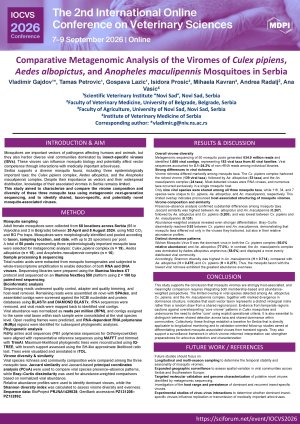
Mosquitoes harbor complex viral communities dominated by insect-specific viruses, yet comparative virome data from Southeastern Europe remain limited. This study aimed to characterize and compare the viromes of three epidemiologically important mosquito taxa in Serbia: the Culex pipiens complex, Aedes albopictus, and the Anopheles maculipennis complex. Adult mosquitoes were collected from multiple locations across Serbia during 2024 and grouped into 50 pools according to species, sampling site, and date. Total nucleic acids were extracted and subjected to Illumina NextSeq metagenomic sequencing (2×150 bp). Bioinformatic analysis included quality filtering, host read removal, de novo assembly, taxonomic annotation using BLAST and DIAMOND, viral abundance estimation, and phylogenetic analysis of RdRp regions.
A total of 1,688 viral contigs belonging to 40 viral families and 183 viral taxa were identified. The Culex pipiens complex exhibited the highest virome richness (140 viral taxa), followed by Ae. albopictus (54 taxa) and An. maculipennis (24 taxa). Only nine viral species were shared among all three mosquito taxa, indicating strong host-associated virome structuring. Abundance-weighted analyses demonstrated pronounced species-specific dominance patterns, with Wuhan Mosquito Virus 6 representing the most abundant virus in both Culex and Aedes mosquitoes, whereas Anopheles mosquitoes displayed a more even viral community structure and the highest Shannon diversity. Several putative novel viruses were also identified. These findings provide the first comparative overview of mosquito viromes in Serbia and establish a baseline for future arbovirus surveillance and longitudinal virome monitoring.
Keywords
mosquito
virome
metagenomics
next-generation sequencing
insect-specific viruses
arbovirus surveillance
Culex pipiens
Aedes albopictus
Anopheles maculipennis
Poster
IOCVS2026_Gajdov_Mosquito_Virome_Poster.pdf
AI-based evaluation of testicular damage in stray dogs from environmentally polluted areas of the Campania Region, Italy
Drug repurposing of farnesyltransferase inhibitors as novel anthelmintics for the treatment of larval cestodiases