Event submissions
Published
This submission belongs to the session S1. One Health Approaches to Emerging Zoonotic Threats of the event The 2nd International Online Conference on Veterinary Sciences
Published date
02 Sep, 2026
Academic Editor
'%3e%3cpath%20d='M12.6657%2010.9104C12.4185%2010.325%2012.0599%209.79327%2011.6097%209.34482C11.1609%208.89508%2010.6293%208.5365%2010.0442%208.28888C10.0389%208.28626%2010.0337%208.28495%2010.0285%208.28233C10.8446%207.69279%2011.3752%206.73249%2011.3752%205.64904C11.3752%203.8542%209.92103%202.39999%208.1262%202.39999C6.33136%202.39999%204.87715%203.8542%204.87715%205.64904C4.87715%206.73249%205.40774%207.69279%206.22393%208.28364C6.21869%208.28626%206.21345%208.28757%206.20821%208.29019C5.62129%208.5378%205.09463%208.89284%204.64265%209.34613C4.1929%209.79493%203.83432%2010.3266%203.58671%2010.9117C3.34345%2011.4845%203.21226%2012.0987%203.20023%2012.7209C3.19988%2012.7349%203.20233%2012.7488%203.20744%2012.7619C3.21255%2012.7749%203.22022%2012.7867%203.22998%2012.7968C3.23975%2012.8068%203.25142%2012.8147%203.26431%2012.8202C3.2772%2012.8256%203.29105%2012.8284%203.30504%2012.8284H4.09109C4.14874%2012.8284%204.19459%2012.7825%204.1959%2012.7262C4.2221%2011.7148%204.62823%2010.7676%205.34617%2010.0497C6.08899%209.30683%207.0755%208.89808%208.1262%208.89808C9.17689%208.89808%2010.1634%209.30683%2010.9062%2010.0497C11.6242%2010.7676%2012.0303%2011.7148%2012.0565%2012.7262C12.0578%2012.7838%2012.1037%2012.8284%2012.1613%2012.8284H12.9474C12.9613%2012.8284%2012.9752%2012.8256%2012.9881%2012.8202C13.001%2012.8147%2013.0126%2012.8068%2013.0224%2012.7968C13.0322%2012.7867%2013.0398%2012.7749%2013.0449%2012.7619C13.0501%2012.7488%2013.0525%2012.7349%2013.0522%2012.7209C13.0391%2012.0947%2012.9094%2011.4855%2012.6657%2010.9104ZM8.1262%207.9024C7.52486%207.9024%206.9589%207.6679%206.53312%207.24211C6.10733%206.81633%205.87283%206.25037%205.87283%205.64904C5.87283%205.0477%206.10733%204.48174%206.53312%204.05596C6.9589%203.63018%207.52486%203.39567%208.1262%203.39567C8.72753%203.39567%209.29349%203.63018%209.71927%204.05596C10.1451%204.48174%2010.3796%205.0477%2010.3796%205.64904C10.3796%206.25037%2010.1451%206.81633%209.71927%207.24211C9.29349%207.6679%208.72753%207.9024%208.1262%207.9024Z'%20fill='%235D1EE1'/%3e%3c/g%3e%3c/svg%3e) Vittorio Sarchese
Vittorio SarcheseCitation
João Vítor Almeida Petrucci, Marina Monteiro Guedes, Marcelo Pasa Panesso, Renato Kulakowski Corá, Henrique Bunselmeyer Ferreira, Drug repurposing of farnesyltransferase inhibitors as novel anthelmintics for the treatment of larval cestodiases, in Proceedings of The 2nd International Online Conference on Veterinary Sciences, 7 September–9 September 2026, MDPI: Basel, Switzerland
Share
Email
Facebook
Twitter
LinkedIn
Drug repurposing of farnesyltransferase inhibitors as novel anthelmintics for the treatment of larval cestodiases
'%3e%3cpath%20d='M12.6647%2010.9104C12.4176%2010.325%2012.0589%209.7933%2011.6088%209.34485C11.16%208.89511%2010.6283%208.53653%2010.0432%208.28891C10.038%208.28629%2010.0327%208.28498%2010.0275%208.28236C10.8437%207.69282%2011.3743%206.73252%2011.3743%205.64907C11.3743%203.85423%209.92005%202.40002%208.12522%202.40002C6.33038%202.40002%204.87618%203.85423%204.87618%205.64907C4.87618%206.73252%205.40677%207.69282%206.22296%208.28367C6.21772%208.28629%206.21248%208.2876%206.20724%208.29022C5.62031%208.53783%205.09365%208.89287%204.64167%209.34616C4.19192%209.79496%203.83334%2010.3266%203.58573%2010.9117C3.34247%2011.4846%203.21128%2012.0987%203.19925%2012.721C3.1989%2012.735%203.20135%2012.7489%203.20646%2012.7619C3.21157%2012.7749%203.21924%2012.7868%203.22901%2012.7968C3.23877%2012.8068%203.25045%2012.8148%203.26334%2012.8202C3.27623%2012.8256%203.29007%2012.8284%203.30406%2012.8284H4.09012C4.14776%2012.8284%204.19362%2012.7825%204.19493%2012.7262C4.22113%2011.7148%204.62726%2010.7676%205.34519%2010.0497C6.08802%209.30686%207.07452%208.89811%208.12522%208.89811C9.17592%208.89811%2010.1624%209.30686%2010.9052%2010.0497C11.6232%2010.7676%2012.0293%2011.7148%2012.0555%2012.7262C12.0568%2012.7839%2012.1027%2012.8284%2012.1603%2012.8284H12.9464C12.9604%2012.8284%2012.9742%2012.8256%2012.9871%2012.8202C13%2012.8148%2013.0117%2012.8068%2013.0214%2012.7968C13.0312%2012.7868%2013.0389%2012.7749%2013.044%2012.7619C13.0491%2012.7489%2013.0515%2012.735%2013.0512%2012.721C13.0381%2012.0947%2012.9084%2011.4856%2012.6647%2010.9104ZM8.12522%207.90243C7.52388%207.90243%206.95792%207.66793%206.53214%207.24215C6.10636%206.81636%205.87185%206.2504%205.87185%205.64907C5.87185%205.04773%206.10636%204.48177%206.53214%204.05599C6.95792%203.63021%207.52388%203.3957%208.12522%203.3957C8.72655%203.3957%209.29252%203.63021%209.7183%204.05599C10.1441%204.48177%2010.3786%205.04773%2010.3786%205.64907C10.3786%206.2504%2010.1441%206.81636%209.7183%207.24215C9.29252%207.66793%208.72655%207.90243%208.12522%207.90243Z'%20fill='%235D1EE1'/%3e%3c/g%3e%3c/svg%3e)
João Vítor Almeida Petrucci 1
Marina Monteiro Guedes 1
Marcelo Pasa Panesso 1
Renato Kulakowski Corá 1
Henrique Bunselmeyer Ferreira 1
1. Campus do Vale, Department of Molecular Biology and Biotechnology, Federal University of Rio Grande do Sul (UFRGS), Institute of Biosciences, Porto Alegre - RS, Av. Bento Gonçalves, 9500 - Post code 91501970, Brazil
Abstract
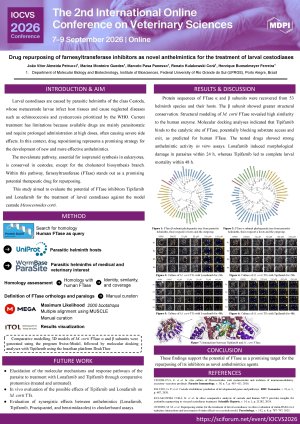
Introduction: Larval cestodiases are caused by parasitic helminths of the class Cestoda, whose metacestode larvae infect host tissues and cause neglected diseases such as echinococcosis and cysticercosis. Current treatments are limited because available drugs are mainly parasitostatic and require prolonged administration at high doses, often causing severe side effects. In this context, drug repurposing represents a promising strategy for the development of more effective anthelmintics. The mevalonate pathway, essential for isoprenoid synthesis in eukaryotes, is conserved in cestodes, except for the cholesterol biosynthesis branch. Within this pathway, farnesyltransferase (FTase) emerges as a potential therapeutic drug. Objectives: This study evaluated the potential of the FTase inhibitors Tipifarnib and Lonafarnib for the treatment of larval cestodiases against the model cestode Mesocestoides corti. Methods: amino acid sequences of FTase α and β subunits from parasitic helminths and their hosts were identified and used for phylogenetic analyses. Ab initio 3D models of M. corti FTase subunits were generated, followed by molecular docking analyses with Tipifarnib. In addition, in vitro assays with M. corti larvae were performed to evaluate anthelmintic activity. Results: FTase α and β subunit sequences from 53 helminth species and their hosts were recovered. The β subunit showed greater structural conservation. Structural modeling of M. corti FTase revealed high similarity to the human enzyme. Molecular docking analyses indicated that Tipifarnib binds to catalytic site of FTase, potentially blocking substrate access. In vitro assays demonstrated strong anthelmintic activity. Lonafarnib induced morphological damage in parasites within 24 h, whereas Tipifarnib caused complete parasite mortality within 48 h. Conclusions: These findings support FTase as a promising target for the repurposing of its inhibitors as novel anthelmintic agents. Future studies exposing parasites to Tipifarnib and Lonafarnib will be conducted to generate samples for proteomic analyses and to further investigate their mechanisms of action.
Keywords
Parasitic helminths
Mesocestoides corti
Larval cestodiases
Drug repurposing
Farnesyltransferase.
Poster
João Vítor Almeida Petrucci - Poster IOCVS 2026.pdf
Comparative Metagenomic Analysis of the Viromes of Culex pipiens, Aedes albopictus, and Anopheles maculipennis Mosquitoes in Serbia
Tipping the Balance: A One Health Analysis of Climate-Driven Mosquito Expansion and Emerging Vulnerabilities (Case Study: Iceland)